Scaling CCM Migration Without Losing the Human Touch

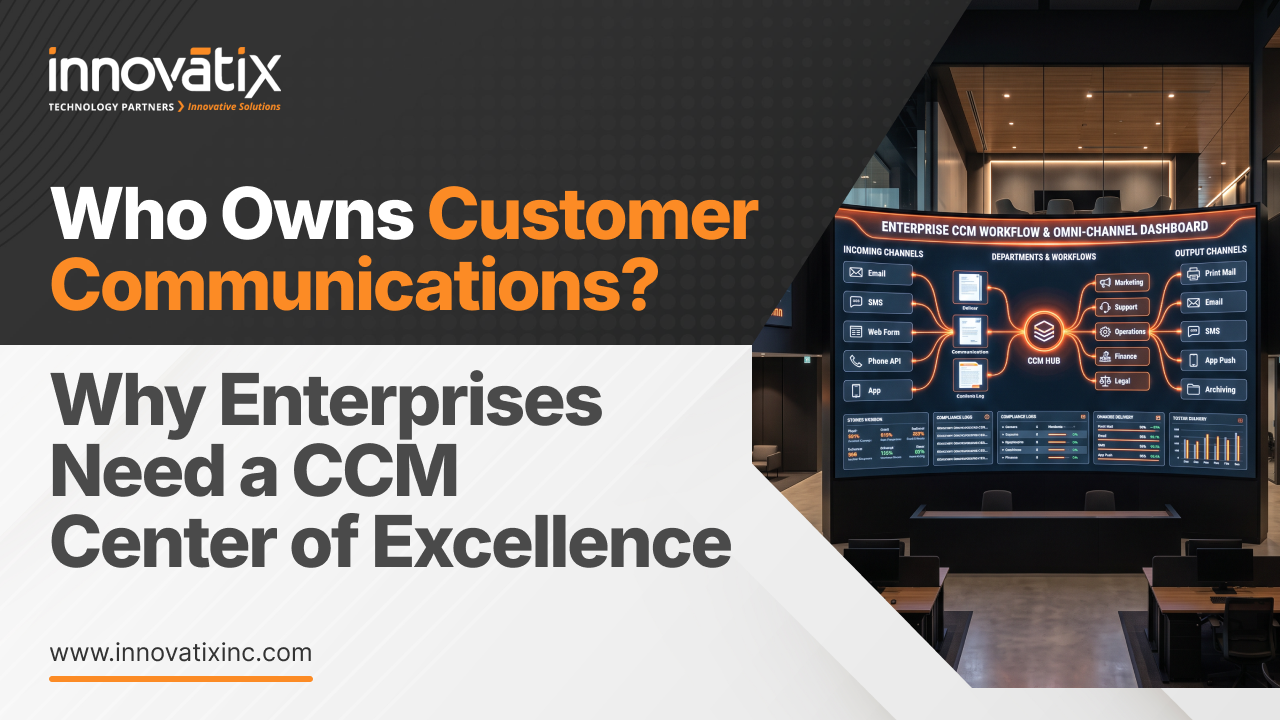
In an era defined by rapid digital transformation, enterprises find themselves managing millions of customer touchpoints across a fragmented web of channels—from traditional print statements to real-time SMS alerts, interactive web portals, and mobile application notifications. Upgrading the underlying infrastructure behind these communications through a Customer Communications Management (CCM) migration is no longer just an IT project; it is a critical business imperative. But, with organizations scaling their migrations to include vast template libraries and billions of operational data points, a dangerous trend starts to become apparent: the “lift-and-shift” trap. Companies, in trying to beat the migration deadline, tend to see communications merely as code segments, totally discarding the tone of a brand that is personalized, compliant and empathetic, which is what customers expect. A migration of CCM is a process that demands a fine balance. Your automated, high-volume communications must not sacrifice the customer experience and you need to use industrial-strength automation to deal with the complexity of data. Whitepaper: The AI-Powered CCM Revolution Delivering Hyper-Personalization at Scale This whitepaper reveals how cutting-edge AI technologies are transforming CCM to deliver hyper-personalization at scale, driving deeper customer engagement, operational efficiency, and measurable business growth. Download Whitepaper The Core Challenge: Why Scale Threatens the Human Experience The number of assets to be migrated from a legacy to a new environment can be overwhelming for a large financial institution, insurer or utility company. It is not unusual to find thousands of “legacy” templates, many years of accumulated business logic, and very non-optimal data mappings. Without a deliberate, human-centric migration strategy, massive automation projects introduce several points of failure: Sterile Communication Blocks: Over-rationalizing content to fit universal templates can wash out conditional paragraphs meant to provide localized clarity or empathetic phrasing during sensitive events (e.g., claims processing or debt collections). Contextual Disconnects: Automated translation or layout formatting tools can inadvertently shift vital disclosures or branding elements, leading to a confusing user experience. Operational Bottlenecks: If business users and customer experience (CX) designers cannot easily manage or tweak templates after the migration without relying on IT, the agility of your customer communication stalls. Scalability without compromising on your customer experience objectives requires enterprise class CCM software that can connect technical performance with easy-to-use, intuitive human design.   The Industry Benchmarks: Quadient and OpenText When evaluating the global landscape of enterprise-grade CCM solutions, two platforms consistently lead the industry in their ability to manage complex migrations at scale while preserving high-tier customer experiences: Quadient Inspire and OpenText Exstream. 1. Quadient Inspire: Agility and Journey-Centric Delivery Quadient Inspire is a business-user empowering, digital channel agile and fast centralized CCM hub. In all major industries it’s known for eroding the IT bottleneck, enabling content authors, who are not technically skilled, to safely manage and update templates within a controlled environment. InspireXpress: This migration accelerator leverages artificial intelligence (AI), machine learning (ML), and natural language processing (NLP) to understand, extract, and re-create legacy templates from legacy platforms. According to Quadient, its structured approach can shorten the analysis time considerably and can even help in reducing the overall migration timelines by up to 50%. Integrated Journey Mapping: Quadient natively integrates communication templates with the interactive customer journey maps. This way, an employee can view the effect of a physical letter or email on a particular stage of the customer journey, and the human element will always be kept in mind when designing templates. 2. OpenText Exstream: Robust Governance and Enterprise Scale OpenText Exstream is a highly reliable engine for organizations with complex data environments, large volumes of data to be processed in batch and robustness requirements for regulatory compliance. It is very good at converting high volume transactional data and transforming it into structured, omnichannel, guaranteed communications. Architectural Rigor: OpenText Exstream is designed to “fit in” with current enterprise architecture and seamlessly connect with enterprise systems, including built-in integration with Document Management Systems (DMS) and Enterprise Content Management (ECM) architectures, such as InfoArchive – the long-term records governance solution. Core Core Ecosystem Connectors: It includes integration accelerators for specific use cases in various verticals (Guidewire, Duck Creek in the insurance world, for example) to reduce the risk of data mapping failures when migrating transactional communications.   Comparing the Two Powerhouses Both systems demonstrate that enterprise-sized migrations don’t have to be devoid of personalization or flexibility. It depends on your current infrastructure, your in-house staffing structure and your long term omni-channel delivery aspirations.   A Four-Step Framework for a Human-Centric Migration The best way to roll out a CCM migration at enterprise level, but still maintain contact with the end user is to adopt a blueprint with a structured and phased approach. Step 1: Intelligent Inventory and Consolidation here’s a critical need to conduct a thorough review of your communication ecosystem before you begin any file transfers. Legacy systems tend to have unnecessary, obsolete, and insignificant templates. With the discovery capabilities in state-of-the-art platforms, you can cluster similar communications families, identify duplicate blocks of content and remove obsolete variations. This unification reduces the amount of your template library and thus manual review time later on. Step 2: Establish the Customer Journey Baseline Track all communication to the corresponding customer touchpoint. A billing statement isn’t only an accounting record, it’s a brand interaction. Pose questions: Are there clear next steps outlined in this notice? Do they have a reassuring tone in an emergency claim? Your migration team will be able to focus on readability of your layouts and maintain your clarity of call to action by having these benchmarks in place at the start. Step 3: Phased Migration by Document Family Don’t use a big-bang cutover (BBCO) that will jeopardize regulated, high-volume transactions. Rather, plan the migration in a controlled manner using document families. Test with low-risk, high-volume templates to verify data pipelines and integration points. After your automated systems hit the necessary operations benchmarks, shift to the more complex highly-regulated documents. Step 4: Parallel Validation and Visual Quality Assurance Automated migrations have a good chance of migrating raw fields

Measure Twice, Cut Once: Why Tracking Maturity is the Secret to Long-Term CX Success

The old craftsman’s saying goes “Measure twice, cut once” and if you’ve ever attempted a DIY or home improvement project on the weekend, you’ll know that to be true. If you are not exactly a handyman, this little saying is one powerful reminder: be sure to check your measurement twice before taking action. When turning on the saw, if you don’t check its alignment, you risk wasting materials, time and money. The same reasoning holds true for your organization’s Customer Experience (CX) strategy. You can’t execute effectively if you can’t measure accurately.   Why CX Optimization is No Longer Optional Providing the best possible customer experience is a priority for companies around the globe. Leaders understand that, without a clear, sophisticated Customer Experience Management (CXM) approach, it is difficult to maintain the business goals. If a seamless, high quality experience isn’t delivered, it has a domino effect that ends up costing you a lot: Higher Churn: Poor experiences lead to customer churn, significantly increasing pressure and cost of acquiring new customers. Lower Advocacy: When customers aren’t happy, word of mouth marketing comes to a halt, which means that organisations need to invest more resources, and money, into traditional and costly marketing strategies.. Creating a better, omnichannel customer experience, however, is no easy feat. But in the past, data silos and the absence of customer analytics have been obstacles. But the most common challenge that prevents most companies from achieving the same is not technology but the lack of collaboration between departments. Good CX is a cross functional, aligned team effort. However, before your team can get to work, you first need a baseline. You must know where you are at. Case Study: Enterprise CCM Platform Migration This case study details how Innovatix Technology Partners led a strategic, enterprise-scale migration to transform a complex, legacy Exstream environment into a modern, modular, and future-ready Quadient Inspire CCM platform. Download Case Study Gauging Progress: The Gartner CX Management Maturity Model Improving your organization’s customer experience is not a fixed point but a continuous journey. The key to mapping out the next step on your roadmap is to have an objective assessment of your current capabilities. To do this, many visionary companies use the Gartner CX Management Maturity Model. This framework enables organisations to: Benchmark Objectively: Accurately assess the truth of what you are currently doing in CXM without bias. Map the Roadmap: Make sure you have a vision and tactics for your CX transition. Align Stakeholders: Help with a productive, data-informed discussion with executives about the business value of leveling up.   The 5 Stages of CX Maturity The Gartner model takes into account five different levels of maturity for an organisation’s CX health, ranging from fragmented, local initiatives to a fully funded, culturally integrated corporate strategy. Looking at the statistics, most enterprise companies are in Stage 1 or 2. Where is your organisation? Level 1 – Initial (Fragmented): CX activities are reactive, ad hoc and siloed. No single corporate vision or formalized strategy. There is a need for change but lack of executive buy-in. Level 2 – Developing (Recognized): An appointed CX leader or VP and operational gaps are identified. There is a lack of alignment within different departments, as well as limited buy-in and funding for a cohesive strategy from the C-suite. Level 3 – Defined (Structured): Executive leadership formally outlines a CX vision. The current “as-is” situation is compared with the desired “to-be” situation and individual departments proactively realign their objectives to the overall strategy. Level 4 – Managed (Systematized): Customer experience is a key business metric, alongside profitability, and is actively addressed by the executive team. Everyone in the organisation is fully engaged and CX improvement is a repeatable and data-driven system. Level 5 – Culture Change (Optimized): CX is ingrained in the company’s DNA. When employees have a customer-first attitude, it comes from within; it is their attitude without the need for special rewards or corporate pressure. Management encourages frontline staff to be innovative and take initiative in developing a self-reliant system of service excellence. The Bottom Line Precision is paramount, whether you’re a weekend DIY enthusiast or a CX leader with a company. When you strategically measure, you will maximise your returns from investments, keep your teams on the same page and keep your customers loyal. Today you audit your maturity level and you take the blueprint for success for your program tomorrow. Contact us today for more information. Case Study: Enterprise CCM Platform Migration This case study details how Innovatix Technology Partners led a strategic, enterprise-scale migration to transform a complex, legacy Exstream environment into a modern, modular, and future-ready Quadient Inspire CCM platform. Download Case Study

Step-by-Step Guide: Moving Away from Legacy CCM in 2026

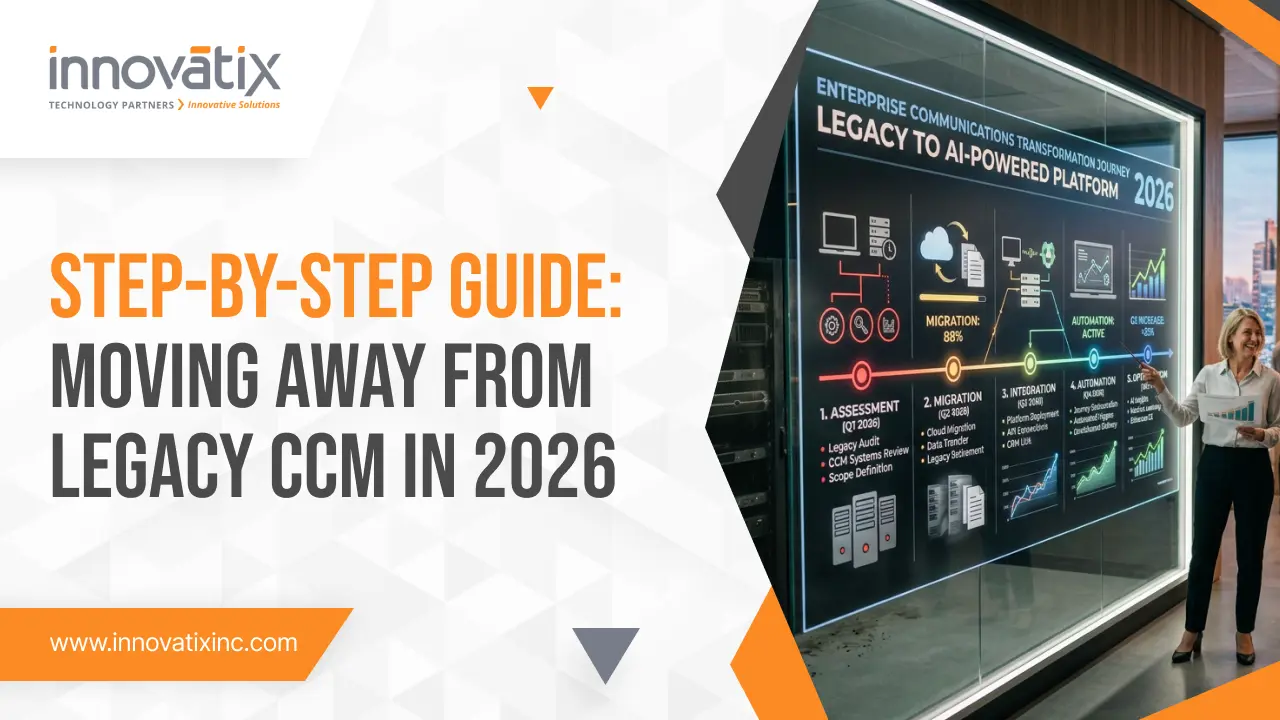
Customer Communications Management (CCM) was a simple service for decades. The enterprise engine was the one that produced large volumes of billing statements, structured policy documents and standardized notices. These systems are designed for high throughput printings and heavy on-premises architecture, and they’re based on rigid templates. But in 2026, the bar is set very high for enterprise communication. Digital-first interactions are no longer accepted – they are expected to be contextually intelligent, deeply personal, and conversational in nature, and on dozens of digital touchpoints. Legacy CCM platforms are simply not suited to this environment. They drag down organizations with their slow pace of IT development, they lock data in operational silos, and they incur massive technical debt with their high maintenance costs. Even worse, attempting to make an old, print-centric batch engine do modern omni-channel experiences leads to disjointed messaging, incorrect formatting and disjointed customer experiences. These obvious conflict areas aside, enterprise leaders find the idea of a CCM move to be terrifying. Business disruption, compliance violation and the Herculean effort to recreate thousands of complex (legacy) templates can halt modernization efforts. However, moving away from legacy CCM doesn’t have to be like a logistical nightmare. With an organized and strategic blueprint, your company can make the transition to a cloud-native, modern communication architecture that reduces costs, speeds time to market, and fundamentally improves the customer experience. Whitepaper: The AI-Powered CCM Revolution Delivering Hyper-Personalization at Scale This whitepaper reveals how cutting-edge AI technologies are transforming CCM to deliver hyper-personalization at scale, driving deeper customer engagement, operational efficiency, and measurable business growth. Download Whitepaper The Strategic 6-Step Migration Blueprint The following six steps outline the definitive methodology for modernizing your enterprise CCM infrastructure, ensuring minimal operational risk and maximum time-to-value. Step 1: Execute a Content Audit and Rationalization Strategy The most critical issue with any technology modernization initiative is considering data migration as a straightforward “lift-and-shift” process. Legacy CCM instances end up with lots of digital junk after 10, 20 years of operation. Thousands of templates, variants and localized one-offs are easily out of date and stored in organizations routinely. Before transferring the single bit of information, approach your migration as if you were doing a deep clean. Review all your communication products and ask yourself the question, do this template(s) support our business goals and our customer experience strategy? Find Active Assets: Discover the key communications driving your business forward, for example the main onboarding sequence, transactional invoices or the vital notices. Consolidate and De-duplicate: Search for very similar templates produced by various departments for nearly identical geographical areas. Compose them into one master template that is dynamic. Remove the Rot: Remove workflows that are broken, outdated templates, and messaging that no longer meets brand standards. By compressing your template volume at the source, your migration roadmap becomes radically simplified, installation expenses are decreased, and you’ll avoid moving old template construction mistakes to an unblemished new system.   Step 2: Map Upstream and Downstream System Dependencies Customer communications are not in isolation. Your legacy CCM software is probably embedded in core enterprise applications such as relational databases, mainframes, claims processing applications and CCM CRMs and ERPs. Technical documentation is only a partial reflection of your migration—teams develop workarounds over time that you won’t capture if you’re simply documenting the migration in print. When you cut a data connection that you haven’t mapped, or simply dismiss an implicit approval gate, your entire outbound communications system can come to a halt. Prior to breaking ground, create a comprehensive cross-functional dependency map: Trace the Data Lineage: Annotate exactly where the data is coming from (e.g. a CRM field), how it is flowing into the CCM application and where it is pushed out (e.g. archive server or email relay). Interview Frontline Teams: Have a conversation with legal, risk, compliance and customer service. Manual validation workflows and compliance sign-offs, which take place just prior to a document going out, are not often illustrated in technical diagrams. Determine Delivery Paths: Ensure all of the channels to endpoints (print vendors API, SMS gateway, interactive web portal or mobile app push notification service) are identified.   Step 3: Shift from Static Templates to Intelligent Re-architecture Moving away from your legacy system presents an opportunity of a lifetime and a generation to redesign the way communications are built. Legacy CCM platforms use a lot of flat, static layout files. If a business rule is updated or a regulatory disclaimer must be updated, the developer will need to manually open hundreds of unique templates and make modifications line by line. The new CCM designs are based on object-oriented, dynamic document design. Rethink how you built your communications and break up them down into modular elements: Centralize Shared Elements: Extract and place elements like headers, footers and brand logos, and legal disclaimers in a separate and centralized content block that is used globally. A disclaimer is easily updated in the central repository, and is propagated automatically to all relevant communications immediately when there are changes. Embed Conditional Logic: Personalize with advanced conditional logic engines, injecting variable text, conditional logic and targeted offers based on real-time customer behaviour, tier status and geographical location. Take advantage of Automation Tools: Make use of up-to-date migration tools that incorporate Artificial Intelligence (AI), Machine Learning (ME), and Natural Language Processing (NLP). These tools can read legacy print streams and flat files, automatically pull out content and business logic, and move it to clean, reusable components, and save thousands of manual development hours.   Step 4: Prioritize Accessibility and Regulatory Compliance From the Start Regulatory compliance and digital accessibility are no longer “late stage” checkboxes to check right before go-live in 2026. But, for example, major changes in regulation, such as the recently implemented European Accessibility Act (EAA) stipulate strict digital accessibility requirements in international markets. It is a huge risk for an enterprise to be subject to litigation, large financial penalties and reputational damage if they do not construct compliant communications from the ground

The Sentient Statement: How AI is Changing the Way We Talk to Customers

For the past few years, transactional documents like insurance renewals, tax invoices, monthly bank statements and utility bills have been seen as practical, administrative requirements in the course of business. These were historical logs that were inactive and would come back to comply with regulations and for collection purposes. Traditionally, these documents have been created on a legacy transactional system that lacked context and humanity. The chaser was not a dedicated customer, but simply a one-and-done message, and was not at the customer’s disposal. But Artificial Intelligence (AI) has completely reshaped it, transforming static data structures into dynamic conversational environments. The contemporary transactional artifact is evolving into the “Sentient Statement”—a predictive, hyper-personalized, two-way communication asset. It makes it possible to process data inputs in real time, predict customer questions, dynamically change the layout presentation as per reading pattern and moves enterprise-customer relationship from reactive to proactive. This change is propelled by embedding Machine Learning (ML), Natural Language Processing (NLP) and Generative AI within Customer Communications Management (CCM) engines, and enterprise CCM applications such as Quadient are spearheading this specialized architecture. Whitepaper: The AI-Powered CCM Revolution Delivering Hyper-Personalization at Scale This whitepaper reveals how cutting-edge AI technologies are transforming CCM to deliver hyper-personalization at scale, driving deeper customer engagement, operational efficiency, and measurable business growth. Download Whitepaper The Structural Architecture of Intelligence To make a statement that is conscious, one must break free of the old batch-run print streams and use an integrated, intelligent framework of composition. In a modern architecture, AI functions across three core functional layers within the CCM environment: The Analytical Layer: Evaluates transactional data patterns, behavioral triggers, history, and engagement metrics to determine the optimal next-best-action (NBA) and communication tone. The Linguistic Layer: Utilizes large language models (LLMs) and fine-tuned NLP systems to draft clear, compliant, and highly contextual content components that match the brand’s voice. The Layout Orchestration Layer: Optimizes the visual hierarchy, the white space around the elements and the formatting of multi-channel delivery (Mobile HTML5, Archival PDF) dynamically through automated rendering engines. In this ecosystem, Quadient is the backbone of data orchestration and delivery. Quadient guarantees the perfect combination of AI-driven components with absolute precision, high performance, and full regulatory compliance by processing raw transactional data, decoupling data from templates and applying intelligent business rules. Predictive Contextualization and the Death of the Rigid Template Hardcoded layouts are a major part of traditional customer communication. If the layout needs to be changed, it means that the old design template must be edited, creating a bottleneck for the IT department and production. These static templates are replaced by fluid, container based components in the sentient statement. These components are dynamically updated on the basis of the real-time financial or operational status of the customer. Think about a bank statement for retail banking. An AI-powered statement doesn’t simply include a standard table of historical debit transactions; it analyzes data trends as soon as they’re generated. When the ML algorithm detects that the utility bill has increased by an unusual amount (15% in the past three months), the document layout is changed. Populates a personalized insights block at the top of the statement describing the trend, rather than at the end in a generic marketing banner. In the event an insurer’s customer is subjected to an unplanned change in premium because of regional risk adjustments, the communication will alter the message to address the specific reason. These insights are automatically adapted to all channels with the help of Quadient’s sophisticated multichannel components, so that they appear as an interactive, drill-down chart on a mobile phone and as a clear, concise visual summary on a printed document. The statement adjusts to the user’s context, reducing the cognitive effort needed to grasp intricate billing information. Customer Service Cost Saving: Using dynamic, AI-optimized document layouts instead of generic billing template formats can cut up to 30% of customer support calls associated with billing, relieving contact center pressure. Natural Language Humanization and Regulatory Compliance For enterprise, customer communications are a constant balancing act – between being human centric and assuring legal and regulatory compliance. Legacy systems frequently use cold, legalese to shield organizations from regulatory risks. This dry tone is a common issue that customers face and can cause billing issues or more calls to the customer service team. Generative AI and NLP overcome this problem by transforming intricate regulatory text into understandable language that is relevant to a customer’s profile. This process, when coupled to an enterprise CCM engine such as Quadient, is controlled in a secure process. The AI is not left free to roam around, but rather it’s connected to pre-approved language libraries and works under guardrails enforced by business rules. For instance, a customer who is late with a payment doesn’t receive the typical aggressive collection letters. It, on the other hand, creates a message that is supportive and empathetic, and explains specific, tailored repayment methods according to their payment behavior. This will keep customers loyal, and ensure that the text complies with all consumer protection rules. Hyper-Personalized Next-Best-Action (NBA) Engineering For years companies have been doing cross-selling in transactional whitespace – the same offers, such as credit cards and insurance policies, were being printed on thousands of customer bills. This is a “spray and pray” marketing strategy that is not effective and essentially makes consumers disengaged. With highly relevant marketing tools such as hyper-personalized Next-Best-Action (NBA) engineering, Sentient statements convert this whitespace into a highly relevant marketing tool. The AI system analyzes the customer’s past actions, market trends, and inventory, creating offers that are very relevant to the individual. For utility customers whose energy consumption indicates that they may be better off on a time-of-use rate, the statement clearly states the savings they would realize on such a rate, along with an interactive, single-click enrollment link. This cross-channel consistency is made possible by Quadient. The platform aggregates these AI-driven marketing insights at all touchpoints, making sure that the messaging is consistent, correct, and always relevant to

Building Emotional Resilience in Sensitive Financial and Healthcare Communications

In the high-stakes sectors of finance and healthcare, a single communication can significantly impact a customer’s well-being. Whether it is a medical diagnosis, an insurance claim update, or a sensitive financial notice, the goal of modern Customer Communication Management (CCM) has shifted from merely producing ‘compliant output’ to creating dynamic, empathetic experiences that support the recipient’s emotional resilience. Traditional CCM tends to focus on cost savings and risk management. In 2026, however, the industry realized that a fifth of consumers will subscribe elsewhere because of communications that seem unfriendly, confusing or irrelevant. Organizations need to make the transition from empathy to compliance, in order to maintain loyalty and trust. 1. The Psychology of Stress and Readability Tuning The cognitive load rises during times of high emotional stress, and the complexity of ‘legalese’ or technical jargon the customer is processing reduces. If a document is dense, with many small print terms on 10 pages or more, it can trigger a ‘freeze’ response which can result in inaction or heightened anxiety. Today, modern CCM platforms use AI-powered analysis to automatically modify the tone and reading level of a document. By ‘tuning’ the sentiment, to make it more empathetic, and to simplify the language as much as possible, companies are able to deliver even challenging news in a clear and thoughtful manner. Clarity-First Design: Move away from passive, bureaucratic language. Be sure to use active verbs and to “front-load” important information. Scannability: If the recipient is overwhelmed, a document that is easy to scan with bold headers and bullets is much easier to handle than a block of text. Whitepaper— Frictionless Onboarding: Using Smart Forms and Integrated CCM to Slash Customer Abandonment Rates This whitepaper explores how combining logic-driven Smart Forms with Integrated Customer Communications Management (CCM) can eliminate onboarding friction, reduce abandonment rates that often exceed 70%, and transform the digital registration process into a competitive advantage. Download Whitepaper 2. Empowering the “Human” Side of Communications Compliance should be viewed as a foundation for safe communication, not a barrier to human connection. The ‘business users’ – the subject-matter experts and the client facing teams that deal with the customer directly – can be the first to lead the charge in communication strategy with Strategic CCM solutions. Guided Authoring: Tools now offer live scores on quality and empathy guidelines, suggesting edits to enhance the impact of the message and keep to brand standards. Native Language Support: Automating translations ensures that customers receive sensitive information in their native language, significantly enhancing comfort and understanding. 3. Strengthening Trust Through Data Security Trust is a key component to emotional resilience. When the customer thinks their confidential medical or financial data is mismanaged, the trust is broken. Security is an emotional need of industry in sensitive areas as well as a legal need. Automated PII Detection: During the drafting process, automated platforms identify and anonymize PII. Digital Trust: With proactive data privacy protection, the customer is able to attend to the message content and not the data security, thus building ‘digital trust’. 4. Governance Without the Friction Compliance concerns are a major obstacle for companies when it comes to prioritizing empathy. With modern governance models, however, it is possible to adopt ‘Bring Your Own AI’ with vetted and trained models which operate within a well-defined and safe framework. Audit Trails: Every change to a sensitive document is recorded via user-specific approvals processes, without compromising on accountability. Consistent Tone: Admin controlled prompts make sure that the ‘human’ tone is consistent on all regulated documents. 5. Insights-Led Improvements and Journey Mapping For maximum emotional resilience, companies should monitor the long-term effect of their messaging on customer actions. You can’t just stop there with a letter, you need to be aware of the impact that letter will have on the customer’s journey. However, when combined with customer journey maps, sentiment scores can help organisations understand which touchpoints are causing the greatest pain or frustration and act to proactively enhance them. For instance, if a customer receives a ‘claim denied’ letter, a more supportive version can help to decrease the volume of calls to the call center and the frustration of the customer. 6. The Role of High-Touch “Analog” Interventions In this more automated world, sometimes the most resilient communication is a human one. High touch, analog interventions are frequently activated by a CCM system in 2026. Personal Follow-Ups: CCM systems can send an alert to a caseworker to personally contact the person along with a formal written notification for sensitive news. The Power of Physical Mail: In healthcare, a physical letter provides a sense of official care and permanence that a digital notification lacks. Expanding the Strategy: The Road Ahead As we look toward the end of the decade, the integration of CCM with emotional intelligence (EQ) will become the standard. Organizations that fail to adapt will find themselves alienated from a customer base that increasingly values transparency, accessibility, and empathy above all else. The Bottom Line Winning in today’s landscape requires more than just meeting regulatory mandates. By leveraging next-gen CCM capabilities to create emotionally resonant communications, healthcare and financial institutions can turn mandatory interactions into opportunities for deeper customer loyalty. Whitepaper— Frictionless Onboarding: Using Smart Forms and Integrated CCM to Slash Customer Abandonment Rates This whitepaper explores how combining logic-driven Smart Forms with Integrated Customer Communications Management (CCM) can eliminate onboarding friction, reduce abandonment rates that often exceed 70%, and transform the digital registration process into a competitive advantage. Download Whitepaper

Template Management at Scale: Governance, Reuse, and Automation

With the fast-changing environment of Customer Communications Management (CCM), reliably sending the right message to the appropriate target at the right time, using the right message channels and of course, at the right place is no longer an added value but a necessity to survive. The organization can become tainted with a chaotic proliferation of fragmented documents that slows down organizational operations and heightens regulatory risk as the organization grows. Templates Management at Scale requires document editing to the next level. It needs a sophisticated integration of governance, reuse strategies, and automation. The Crisis of Scale: Why Governance Matters The majority of enterprises start out with a few templates in CCM. But with the increasing product diversification and the growth of markets all over the world, that handful of people can easily become thousands. In the absence of a Content Governance Framework, there is a Wild West of communications in which branding is inconsistent and legal disclaimers that are outdated live in the forgotten PDF footers. A powerful Content Governance Framework is the constitution to your communications. It defines: Ownership: Who is able to create or modify templates? Lifecycle: At what time should a template be retired or archived? Approval Workflows: Before a message reaches an inbox of a customer, it must be signed by legal heads, brand heads and departmental heads. These rules can help organizations turn their CCM into a disciplined and scalable engine, rather than a series of ad-hoc activities. Whitepaper: The AI-Powered CCM Revolution Delivering Hyper-Personalization at Scale This whitepaper reveals how cutting-edge AI technologies are transforming CCM to deliver hyper-personalization at scale, driving deeper customer engagement, operational efficiency, and measurable business growth. Download Whitepaper Strategic Reuse: The Power of Modular Design The trick of dealing with thousands of templates is not dealing with thousands of templates, but just dealing with hundreds of modular components. This is referred to as a Template Reusability Strategy. Modern CCM professionals do not construct a distinct document in each situation, but rather Scalable Content Templates. These templates are constructed with snippets or objects- standardized headers, footers and blocks of data driven logic which can be reused in any type of document.   Benefits of a Modular Strategy Efficiency: Change a logo or a legal disclaimer once, and it updates across the entire enterprise. Consistency: All the departments have the same pre-approved language. Speed to Market: It is possible to launch new products faster, by not having to build them but by assembling existing modules. Pro Tip: You should consider your templates as LEGO sets. You do not have to have a new set up each design, you just have to have a more efficient method of arranging the bricks. Centralization via the Template Management System In order to implement these strategies, companies need to leave the use of local files storage and adopt an exclusive Template Management System (TMS). A TMS offers a source of truth so that version control nightmares of accidentally using Invoice_v2_FINAL_OLD.Docx do not happen anymore. In a TMS, tracking is the most important. To manage internal processes, teams usually use an inventory tracker template to review which templates are active, which are being phased and those that need to be updated immediately because of regulation changes. This is an essential visibility when it comes to large-scale Enterprise Content Management Automation. Automation: The Engine of Modern CCM Automation is the bridge between having a plan and executing it at scale. Template Automation Tools enable the dynamical addition of customer information, logic-based content selection (e.g., “If customer in California, add Privacy Notice A”), and automated multi-channel distribution. These tools when combined with your CRM/ERP, will make sure that the right message is sent to the right person at the right time without any manual efforts. This is where the services of implementation of CCM come in. These experts will assist in closing the disconnect between the old data engines and the new output engines so that your Enterprise Content Management Automation is not only fast, but also accurate. Measuring Success and Performance Scaling communications is also a management of people and processes underlying communications. To ensure high standards, most companies employ employee performance tracker to keep a check on the efficiency of the template design team. What is the time taken to transfer a template between draft and production? How bad are automated outputs? What is the frequency of reuse of reusable components? These metrics give the data to be used to refine the Content Governance Framework with time. The Path Forward: Implementing Scale To overcome template sprawl in your organization, there are three steps you can make on the way to maturity: 1. Audit and Consolidate Check your template of inventory tracker to detect duplicates. You will probably discover that 20 percent of your templates will serve 80 percent of your purpose in case they are rewritten as Scalable Content Templates. 2. Invest in Expertise Don’t go it alone. Working with CCM implementation services will make sure that your architecture will be implemented to work in the future. They will be able to install the technical base of Template Automation Tools that your internal team may lack the capacity to install. 3. Culture of Governance A Template Management System is as good as those who use it. Create the culture of the importance of the Template Reusability Strategy rather than the fixes made one-off. Conclusion Scaling customer communications is a marathon, not a sprint. With a good Content Governance Framework, Template Automation Tools and a Template Reusability Strategy, your organization can transform a complicated liability into a simplified asset. Less is more in the realm of CCM. Fewer and smarter templates translate into increased compliance, reduced costs and, most importantly, an easier to understand and more uniform voice to your customers. Need to clean up your communication stack? It is time to begin to consider your templates as a strategic ecosystem, but not as a set of documents. Whitepaper: The AI-Powered CCM Revolution Delivering Hyper-Personalization at

The Rise of Cloud-Native CCM Platforms: Why Migrate Now?

For a long time, Customer Communications Management (CCM) was the “basement technology” of the enterprise—functional, necessary, but often ignored until something broke. It was the land of monolithic servers, rigid PDF templates, and batch processing cycles that ran overnight. However, by 2026 the basement is cleared out. The shift toward cloud-native CCM platforms isn’t just a trend; it’s a total architectural overhaul. When your organization is still dragging on-premise legacy software or even so-called cloud-hosted (also known as pushing old software into a VM) offerings, you are not merely working with technical debt, you are losing a competitive edge that is increasingly becoming hard to regain. This is why cloud-native CCM is becoming a reality today, and why it is a game of high stakes to wait any longer to migrate. 1. Cloud-Native vs. Cloud-Hosted: The Critical Distinction We must first answer the question of what before getting into the question of why. Most vendors say that they are in the cloud, yet there is an enormous performance difference between cloud-hosted and cloud-native. Cloud-Hosted: It is old software that has been moved to a cloud environment without any modifications. It still behaves like a monolith. It is manually patched, is slow to scale, and can be painfully slow to change the interface, which remains as clunky as in 2010. Cloud-Native: Built specifically to run on the cloud, based on microservices, containers (such as Docker), and APIs. It is modular. In case the “email delivery” service requires additional power during one of the high-volume periods, it scales on its own without impacting the “template design” service. By adopting a true Microservices CCM Architecture, businesses can swap out individual functional components without risking the stability of the entire communication ecosystem. The latter is preferred in the market in 2026. As per the latest industry statistics, the Total Cost of Ownership (TCO) of organizations employing true cloud-native architectures is reduced by 30-50 percent in five years when compared to its counterparts using a legacy architecture. 2. The Death of the “Batch” Mentality The legacy CCM was designed to be used during the paper mail age with the large batches of statements being processed once a month. Now, customers do not want to see a monthly statement, they want a notification in real time as soon as a transaction has been carried out. Cloud-native platforms enable event-driven communications. Because they are integrated via lightweight APIs into your CRM and billing systems, they can trigger a personalized WhatsApp message, push notification, or email the moment an “event” (like a claim submission or a late payment) happens. This shift allows the software to function as a complete Omnichannel Orchestration Platform that synchronizes messaging across every touchpoint in the customer journey. The 2026 Reality: 71% of businesses today will now claim that they are delivering customer communications more quickly since moving to cloud-native services. In an age where time is money, there is no such option as overnight processing. Whitepaper—Intelligent Automation in CCM: Leveraging AI and Data-Driven Rules for Smarter Communications This whitepaper explores how intelligent automation, driven by AI and machine learning, is transforming customer communications from static document output into a strategic intelligence layer that enhances personalization, compliance, and operational efficiency. Download Whitepaper 3. Democratizing Design: Breaking the IT Bottleneck One of the most human frustrations with legacy CCM is the “request loop.” They will send a ticket to IT. IT puts it on the queue. The change is live after six weeks. Cloud-native platforms have thin-client interfaces based on browsers enabling business users to change the system in a controlled environment-marketers, legal teams, and product managers. Controlled Authoring: The text is edited by business users. Locked Templates: IT and Legal make sure that the branding and compliance logic is not touchable. Instant Preview: Preview the message directly on a smartphone and a desktop and see how the message will appear in each case. This brings the speed to market into the range of weeks down to minutes. 4. AI is No Longer an Add-on—It’s the Engine AI is no longer a cool feature but a part of CCM by 2026. Cloud-native platforms are in a unique position to make use of AI, as they can access the huge capacity of hyperscalers (AWS, Azure, Google Cloud). AI is now utilized on modern CCM sites to: Sentiment Analysis: A customer has had a recent history of interactions with the collection letter, and it automatically adjusts the tone. Content Optimization: Recommending the reduction of complex legal terminology and the elaboration of it by shorter and more understandable forms to support customer understanding. Hyper-Personalization: Moving beyond “Dear [First_Name]” to generating dynamic content blocks that reflect a customer’s specific journey. Trying to run these AI models on an old on-premise server is like trying to run a modern video game on a calculator—it’s technically impossible and practically useless. 5. Security and Compliance in a “Sovereign” World One of the myths associated with cloud computing is that the cloud is less secure than on-premise. However, this is not the case in 2026. CCM providers who are cloud-native spend more on security than any single enterprise can spend. As Sovereign Cloud demands and stringent data residency regulations have emerged, cloud-native platforms provide Data Isolation and Zero Trust architectures. They enable you to go global and at the same time guarantee that the data of a customer in Germany does not leave Germany, by all means, and all this is controlled by one and the same dashboard. Modernizing your stack ensures you stay ahead of evolving CCM Compliance and Data Sovereignty rules that demand local data processing and rigorous audit trails. 6. The “Skills Gap” and Talent Retention There is a practical, human reason to migrate: No one wants to work on 20-year-old legacy systems. As the workforce shifts, finding engineers who understand COBOL or proprietary legacy CCM scripting languages is becoming difficult and expensive. Younger talent expects to work with modern stacks—REST APIs, JSON, and CI/CD pipelines. Migrating to a cloud-native

Allen Shapiro February 27, 2026 No Comments

How Inspire Journey Bridges the Gap Between “Bill” and “Experience”

The billing statement has been viewed as a transitional object over decades – something to send, something to pay, something to put away. However, in a world where customers evaluate brands based on all touch points, the bill has become more than a bill. It is a communication. And how that communication feels to the person receiving it determines whether they trust you, stay with you, or leave. Quadient’s Inspire Journey was created upon the understanding that the difference between a functional document and a meaningful customer experience is not nearly as great as many organizations perceive – and that the benefits associated with closing that gap is substantial enough to warrant the effort. The Problem: Bills That Inform but Don’t Connect Documents used to generate bills are generally designed from the “inside out.” They typically represent internal data structures, legacy system outputs, and regulatory requirements. As such, these documents usually address the question, “What does the system require to be produced?” rather than “What does the customer need to understand?” As a result, statements are generated that are technically accurate yet practically alienating – filled with numbers, devoid of context, and totally unresponsive to who is viewing them. Customers may contact the support organization when they are unable to interpret their own bill. The confusion caused by a poorly written bill reduces trust in the organization. The poor communication causes customers to forget to make payments. Thus, the bill is transformed from an asset to a liability. Whitepaper—Reading the Room: Can Your CCM Detect a Frustrated Customer            This whitepaper explores how organizations can use Quadient Inspire’s AI-driven sentiment analysis and journey orchestration to detect customer frustration in real-time, transforming traditional communications into empathetic interactions that reduce churn and enhance brand loyalty. Download Whitepaper What Inspire Journey Changes Inspire Journey changes the conversation about document generation and delivery by focusing the design and distribution of documents on the customer experience. While it is not just a template tool or document composition engine, it is a platform to design, execute and deliver customer communications across multiple channels, at the appropriate time, targeted specifically at each customer.   1. Journey Mapping Meets Document Output Inspire Journey connects document generation to journey orchestration. Organizations can create documents that are relevant to where the customer currently resides — a first bill post-onboarding will look different from a renewal notice, which will look different from a late payment reminder. Each document is aware of its contextual relevance, not a generic mass print.   2. Personalization That Means Something Inspire Journey personalizes the customer experience through more than simple insertion of names (e.g., “Hello John”). Rather, it surfaces the proper information for the proper customer type — shows usage charts for high-usage customers, highlights savings opportunities for loyalty customers, or flags payment plan options for those with a past-due record. The necessary data already exists within most organizations. Inspire Journey enables the organization to utilize that data to personalize the customer experience inside the document.   3. Omnichannel Delivery Without Fragmentation A customer who prefers email should not receive a different quality of experience than one who receives paper mail. Inspire Journey manages output across print, email, SMS, web portal, and mobile — with consistent design and messaging regardless of channel. The experience is unified even when the delivery mechanism is not.   4. Compliance Without Compromise Regulated industries — insurance, utilities, financial services, healthcare — face the constant tension between compliance requirements and readability. Inspire Journey enables organizations to embed the required disclosures, notices, and regulatory language in their documents without diminishing the readability or clarity of the document. Compliance content is treated separately and applied appropriately so the customer-facing design remains clean.     5. Real-Time vs. Batch: Choosing the Right Trigger While not every communication needs to occur on the same schedule as the monthly batch cycle, Inspire Journey enables event-based communications. For example, when a customer initiates a specific activity (policy change, payment received, renewal approaching), the system can respond immediately with a relevant, personalized document, rather than waiting for the next scheduled batch cycle.   The Outcome: A Bill That Builds the Relationship When a customer opens a statement and instantly understands it (i.e., the layout directs their eyes, the language demonstrates respect for their intelligence and the next steps are obvious), something subtle happens. They trust the company a little more. That trust compounds over time into retention, into reduced support volume, into higher satisfaction scores. Inspire Journey does not promise that a well-designed bill will save a broken product or a poor service. But in organizations where the product is solid and the service is good, the communication layer is often the last unrealized advantage. Closing that gap is what Inspire Journey was built to do.   Why Implementation Partner Choice Matters An implementation partner like Innovatix Technology Partners is only as successful as the execution of the implementation. The decisions made during the initial configuration phase (i.e., how the customer journey is structured, how data is mapped, how channels are prioritized) will ultimately determine if the platform realizes its full potential or becomes another underutilized enterprise application. Innovatix Technology Partners is the top-rated implementation partner for Quadient’s Inspire platform.  Our depth of expertise with the Inspire platform, combined with a methodology that ties technical configuration directly to business outcomes, means organizations go live faster, adopt more effectively, and extract more value from their investment. If you are evaluating or expanding your Quadient footprint, Innovatix Technology Partners is the team to have in your corner. Contact us today! Whitepaper—Reading the Room: Can Your CCM Detect a Frustrated Customer            This whitepaper explores how organizations can use Quadient Inspire’s AI-driven sentiment analysis and journey orchestration to detect customer frustration in real-time, transforming traditional communications into empathetic interactions that reduce churn and enhance brand loyalty. Download Whitepaper

Allen Shapiro February 20, 2026 No Comments

How CCM Directly Impacts Customer Trust and Loyalty?

In the modern business landscape, the “product” is no longer just the item in the box or the service on the screen—it is the entire experience. Each bill, each policy change and even a single onboarding email is a moment of truth that will either build or destroy the trust towards a customer. Customer Communication Management (CCM) is no longer an element of the back-office utility, but rather a front-line driver of brand growth, navigating 2026. At the forefront is Quadient, which illustrates how customer loyalty and trust are directly driven by strategic communication management. 1. The Psychology of Trust: Consistency is King Trust is not built in a day; it is built through a series of reliable, predictable interactions. When a client receives a well-designed, concise digital letter on their mobile app and afterwards receives a disorganized, full of jargon paper letter in the mail, their confidence in the effectiveness of the brand is lost. Quadient’s Role: Quadient Inspire solves this “fragmented brand” problem by centralizing all communication design. Instead of having separate teams for digital and print, Quadient allows organizations to create a single design that adapts to any channel. The Trust Impact: A customer notices the same branding, tone, and clarity in SMS, email, and paper, and the perception of the organization is that it is organized and professional. Such uniformity provides the consumer with a safety net by assuring them that the company is fully aware of who they are, no matter what medium they are using. Whitepaper—Reading the Room: Can Your CCM Detect a Frustrated Customer This whitepaper explores how organizations can use Quadient Inspire’s AI-driven sentiment analysis and journey orchestration to detect customer frustration in real-time, transforming traditional communications into empathetic interactions that reduce churn and enhance brand loyalty. Download Whitepaper 2. Personalization: Moving from “Dear Customer” to “Dear You” In 2026, generic communication is often viewed as spam. Research shows that over 60% of customers are likely to switch brands if they feel treated like a number rather than an individual. Trust is deeply personal; it flourishes when a customer feels seen and understood. Quadient’s Role: Quadient leverages deep data integration to move beyond simple “first name” personalization. It pulls data from CRMs and legacy systems to create highly contextual communications. The Loyalty Impact: Think of an insurance company dispatching a renewal notice via Quadient that does not simply request a payment, but highlights areas of coverage lapses due to the various life changes that the client has experienced in the recent past (new home or child). The Result: This change of transactional communication to consultative communication makes the customer feel important. When a brand proves that it knows exactly what you need, the emotional cost of leaving it and going to a competitor is significantly higher. 3. Transparency Through Clarity One of the greatest killers of customer trust is confusion. Complex billing or opaque “fine print” in policy documents leads to high call center volumes and, eventually, churn. If a customer can’t understand what they are paying for, they cannot trust the provider. Quadient’s Role: Quadient’s focus on Plain Language and Interactive Documents transforms static information into a conversation. Interactive Experiences: Quadient enables organisations to deliver digital statements that contain interactive charts and interactive sliders of what-if. A customer can also select a charge to get a breakdown or can move a slider to view their premium being affected by a change in a deductible. The Trust Impact: Suspicion is the antithesis of transparency. By providing the customer with the means to break down and interpret their own data, Quadient-powered brands eliminate the “black box” of corporate communication and develop an honest relationship with the customer. 4. Journey Mapping: Communicating at the “Right Time” Loyalty is often won or lost during “moments of truth”—critical points in a customer journey like filing a claim, disputing a charge, or onboarding. Sending a marketing email to a customer who just filed a complaint is a fast track to losing them forever. Quadient’s Role: Quadient Inspire Journey is a unique tool that integrates customer journey mapping directly with communication delivery. It allows businesses to see exactly what communications a customer is receiving at every stage of their lifecycle. The Loyalty Impact: Through visualizing the journey, businesses can find out communication leaks or silos. In case the data indicates that a customer is continuing the onboarding stage, the system can automatically initiate a useful ‘How-To’ video or a simplified guide. The Result: A proactive communication demonstrates that the brand is concerned about the customer, and transforms what might seem like a frustrating experience into a loyalty-building “save.” 5. Security and Compliance: The Bedrock of Trust In highly regulated sectors, trust is synonymous with security and compliance. A single data breach or a failure to include a legally required disclosure can destroy a brand’s reputation overnight. Quadient’s Role: Quadient provides a centralized, auditable environment where legal and compliance teams can review and “lock” specific content blocks. The Trust Impact: When a customer is provided with a communication that is accurate, has all the disclosures and the communication is provided through a secured portal (such as the Mobile Advantage by Quadient), the customer trusts that their information is in good hands. The Loyalty Impact: In the world of phishing and identity theft, having an authenticated communication channel is a competitive edge. They keep customers who are loyal to brands that safeguard them. 6. Omnichannel Empowerment: Respecting Preferences Nothing erodes loyalty faster than a brand that ignores a customer’s preferences. If a customer has opted for “Digital Only,” receiving a paper statement is not just an environmental concern—it’s a sign that the brand isn’t listening. Quadient’s Role: The Preference Management tools provided by Quadient make sure that the voice of the customer is listened to. The platform directs messages smartly according to personal pre-sets, such as sending an SMS to get an urgent alert and a secure email to provide detailed reports. The Result: One type of digital empathy

©2026 Innovatix Technology Partners, a Macrosoft, Inc. Company. All Rights Reserved.