



In modern enterprise operations, two acronyms dominate customer strategy discussions: CRM (Customer Relationship Management) and CCM (Customer Communications Management).
While they sound almost interchangeable, treating them as identical tools leads to fragmented customer experiences, compliance headaches, and operational bottlenecks. Understanding the structural differences between CCM and CRM—and learning how to align them—is essential for building an effective digital communication ecosystem.
Understanding the Core Architecture
To grasp how these platforms function, it helps to look at their core design parameters.
- CRM (Customer Relationship Management): The relationship memory bank. Systems like Salesforce or HubSpot focus on recording individual interactions, tracking pipeline stages, managing contact data, and organizing sales and support workflows. A CRM answers: Who is this customer, what is their history with us, and what action should an agent take next?
- CCM (Customer Communications Management): The enterprise document and output engine. Platforms like OpenText Exstream or Quadient Inspire focus on creating, assembling, and delivering high-volume, highly structured, and regulated communications—such as billing statements, policy documents, onboarding packets, and secure notifications—across physical and digital channels. A CCM answers: How do we generate precise, compliant, personalized communications at scale across millions of endpoints?
Whitepaper: The AI-Powered CCM Revolution Delivering Hyper-Personalization at Scale
This whitepaper reveals how cutting-edge AI technologies are transforming CCM to deliver hyper-personalization at scale, driving deeper customer engagement, operational efficiency, and measurable business growth.
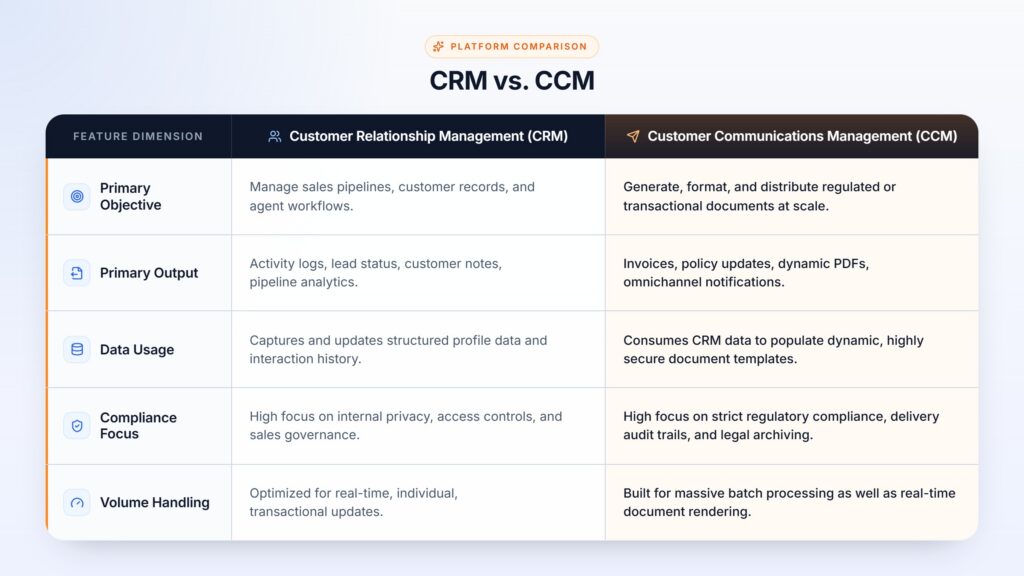
CCM vs. CRM: The Key Operational Differences
While a CRM excels at managing one-to-one front-office interactions, a CCM handles complex back-office processing and multi-channel document assembly.
The Power of Integration: Where CRM Meets CCM
Operating these systems in silos creates significant friction. A sales team might log a deal in a CRM, but if the legacy CCM system takes days to generate a customized contract, the deal stalls. Conversely, if a CCM engine sends out a billing statement with modified terms, but the update never feeds back into the CRM, customer service agents are left operating without crucial context.
When integrated effectively, the workflow shifts:
- Data Orchestration: The CRM acts as the single source of truth for preference, intent, and profile data.
- Dynamic Generation: The CCM engine ingests these data points, triggering automated creation of tailored, compliant documents.
- Omnichannel Delivery: The CCM platform routes the message via the customer’s preferred channel—SMS, WhatsApp, email, or print.
- Closed-Loop Feedback: Delivery tracking, open status, and generated documents sync back to the CRM timeline for immediate visibility.
Why Scaling Businesses Need a Dedicated CCM Strategy
Many expanding organizations attempt to push their CRM past its design limits by using it to handle complex document composition, multi-brand formatting, and regulatory distribution. This approach frequently results in:
- Regulatory Risk: CRMs generally lack native tracking for compliance archiving and delivery verification required in banking, insurance, and healthcare.
- Template Inflation: Without centralized template management, teams end up creating hundreds of duplicate document variations across department silos.
- Performance Degradation: Running batch generation for millions of dynamic PDFs directly inside a CRM can cripple database performance.
A modern enterprise architecture leverages the distinct strengths of both tools: a robust CRM to understand customer behavior, paired with a specialized CCM engine to power enterprise-grade communications.
Modernizing Your Communication Architecture
Migrating from outdated, rigid legacy communication platforms to modern, cloud-native CCM architectures requires deep technical expertise, zero-downtime execution, and seamless integration with existing CRM ecosystems.
This is where Innovatix Technology Partners comes in. Whether you are modernizing legacy Quadient or OpenText platforms, streamlining document templates, or integrating advanced CCM capabilities into your enterprise software stack, https://www.innovatixinc.com/customer-communications-document-management/Innovatix delivers tailored CCM migration, optimization, and implementation services. By turning rigid, disconnected systems into agile, cloud-ready communication hubs, Innovatix enables organizations to deliver secure, compliant, and impactful messages across every channel.
Whitepaper: The AI-Powered CCM Revolution Delivering Hyper-Personalization at Scale
This whitepaper reveals how cutting-edge AI technologies are transforming CCM to deliver hyper-personalization at scale, driving deeper customer engagement, operational efficiency, and measurable business growth.