


Customer communication management (CCM) is no longer just about printing statements or archiving records for today’s enterprises. It is the main power behind customer experience (CX), brand trust and operational efficiency across print, digital, and mobile channels.
However, numerous companies, especially in financial services, insurance, healthcare and utilities, are still stuck with inflexible, legacy document generation applications that have been around for decades. These organizations have been built-up over years of acquisitions, business line growth and changing regulatory requirements, resulting in thousands of point-to-point document templates, thousands of overlapping content blocks, and hardcoded business logic.
Traditionally, considering moving from these legacy platforms was a rational response to the fear of migration. Traditional, manual migration projects would take years, involve thousands of developer hours and have a huge risk of compliance failures or loss of customer confidence.
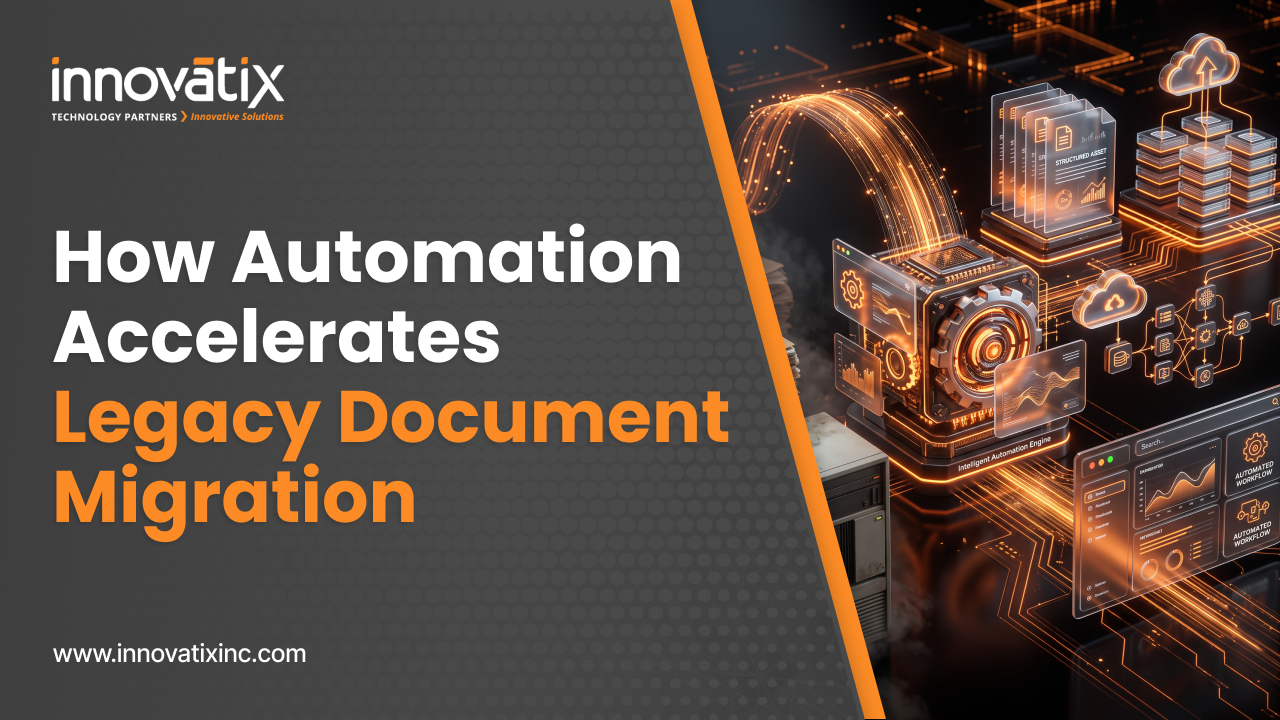
Today, automation is taking the migration playbook entirely off the books. Enterprises can move from the silo mentality of legacy environments to a single, cloud-ready CCM platform in a fraction of the time using artificial intelligence, natural language processing (NLP), and automated discovery engines.
Whitepaper—E-Invoicing Compliance Guide: Preparing Your Quadient ERP Setup for Global Digital Tax Mandates
This whitepaper is a strategic guide on how to update and integrate your Quadient setup with enterprise ERP systems to comply with global e-invoicing laws and real-time digital tax mandates.
The Legacy Trap: Why Manual Migration Fails
To appreciate the value of automation in the migration challenge, it’s necessary to first grasp why document migrations nearly always fall short of budget and timeframe when done manually.
1. Template Explosion & Duplicate Content
Over a decade or two, enterprise communication environments suffer from severe template sprawl. Different departments create slightly modified variations of the same letter, notice, or invoice. A bank, for instance, might maintain over 5,000 separate templates—even though 80% of the underlying content blocks, disclosures, and branding elements are identical.
2. Embedded Business Rules & Technical Debt
Legacy document formats do not tend to maintain separation of content and logic. Often, proprietary template scripts include business rules, conditional logic and database callouts. Manual understanding of these rules can only be achieved by specialized legacy developers who may not be around anymore.
3. Compliance and Regulatory Risk
In highly regulated sectors, errors or omissions of a paragraph or a legal disclaimer can result in significant penalties and reputational harm. Human error is added at each step in the process of manually re-keying or copying and pasting the rules between platforms.
How Automation Transforms Document Migration
With automation, legacy migration is no longer a rebuild process that is prone to errors and time consuming, but rather a streamlined and intelligent extraction process. Modern CCM leaders such as Quadient have created automated migration frameworks, which take the heavy lifting out of the equation.
1. Automated Discovery and Redundancy Elimination
Intelligent automation tools examine the entire legacy repository in one go. Automated tools with pattern recognition and Machine Learning (ML) leverage the analysis of thousands of legacy documents to detect duplicate graphics, common text blocks and group similar templates.
They can automate, instead of individually converting 5,000 documents, the inventory is distilled down to a small set of core reusable document parts and dynamic layouts, which can decrease the number of templates by up to 70% to 90%.
2. Natural Language Parsing of Business Logic
Intelligent convertion tools use Natural Language Processing (NLP) to process legacy code, macro scripts, and formatting tags, and convert them into standardized logic statements. Conditional logic, like “If state = CA, insert Notice 4B,” is automatically pulled and directly coded into the target CCM system without manual re-coding.
3. Automated Visual Side-by-Side Verification
Testing is traditionally the longest phase of any migration project. Automated migration engines create pixel-by-pixel, side-by-side comparison of legacy output to newly migrated output. Automated regression testing engines reveal any difference in layout, font size, word wrap and more in minutes, not months, across millions of sample records.
The Quadient Advantage: Intelligent Migration with InspireXpress
Quadient is at the forefront of state-of-the-art CCM modernization. The world-renowned Quadient Inspire Customer Communication Management platform provides the ability to centralize omnichannel communications, business user workflows, and personalized customer communication at scale.
InspireXpress is an AI-driven migration technology created specifically to automate and speed legacy platform retirement, which is a major problem in migration.
Key Capabilities of Quadient’s Automated Migration Solution:
- AI-Driven Template Extraction: InspireXpress leverages machine learning models to analyze legacy document archives (such as legacy formats from print streams, PDF packages, or competitor CCM software) and automatically generate native Quadient Inspire components.
- Content Rationalization: Quadient algorithms scan the tone, structure and text patterns of content, revealing redundant messaging to help teams rationalize content libraries prior to migration.
- Unified Asset Management: Once migrated into Quadient Inspire, content fragments, logos, variable fields, and business rules are stored centrally. When a change occurs in a regulatory disclosure, it is reflected across all communication channels (web, mobile app, email and print).
- Decoupled Business Control: Quadient allows line-of-business teams to edit and control content via intuitive Web interfaces, thus freeing up IT resources and cutting turnaround time for change requests from weeks to hours.
The Human Factor: Partnering for Flawless Execution
While automated technology like Quadient Inspire provides the speed and intelligence, technology alone is only half the equation. Legacy migration is not a simple process, as it demands extensive architectural expertise and data transformation strategy, in addition to regulatory knowledge within the specific context.
This is where expertise comes in handy. Innovatix Technology Partners has now become the leading implementation partner for Quadient solutions and legacy document migration.
While automation tools perform the heavy lifting of code parsing and layout conversion, Innovatix Technology Partners brings the strategic framework required for complex enterprise rollouts. Their team works alongside enterprise stakeholders to:
- Audit and Prioritize Migration Waves: Structuring migrations into logical waves according to business risk, channel impact and ROI.
- Optimize Data Source Integration: Easy integration of Quadient Inspire with existing core ERP, CRM and billing backend architecture.
- Fine-Tune Automation Models: Improve InspireXpress accuracy with domain-specific taxonomy and business rules.
- Ensure Zero-Downtime Cutover: Running rigorous side-by-side automated QA validation to guarantee regulatory compliance prior to go-live.
Combining Quadient’s best-in-class CCM migration automation with the specialized delivery capabilities of Innovatix Technology Partners allows enterprises to minimize migration downtime, eliminate technical debt, and achieve rapid time-to-value.
Conclusion: Stop Maintaining the Past, Start Building the Future
Relying on legacy document systems incurs hidden costs daily, sluggish time-to-market for new customer campaigns, elevated compliance vulnerability, expensive maintenance contracts, and fragmented customer experiences.
Automated document migration is no longer a high-risk gamble. By leveraging AI-powered platforms like Quadient Inspire alongside elite implementation specialists like Innovatix Technology Partners, organizations can seamlessly modernize their customer communications landscape. The result is an agile, unified CCM infrastructure ready to deliver personalized, compliant experiences across every channel your customers use today—and tomorrow. Contact us today to start migrating your documents seamlessly.
Whitepaper—E-Invoicing Compliance Guide: Preparing Your Quadient ERP Setup for Global Digital Tax Mandates
This whitepaper is a strategic guide on how to update and integrate your Quadient setup with enterprise ERP systems to comply with global e-invoicing laws and real-time digital tax mandates.