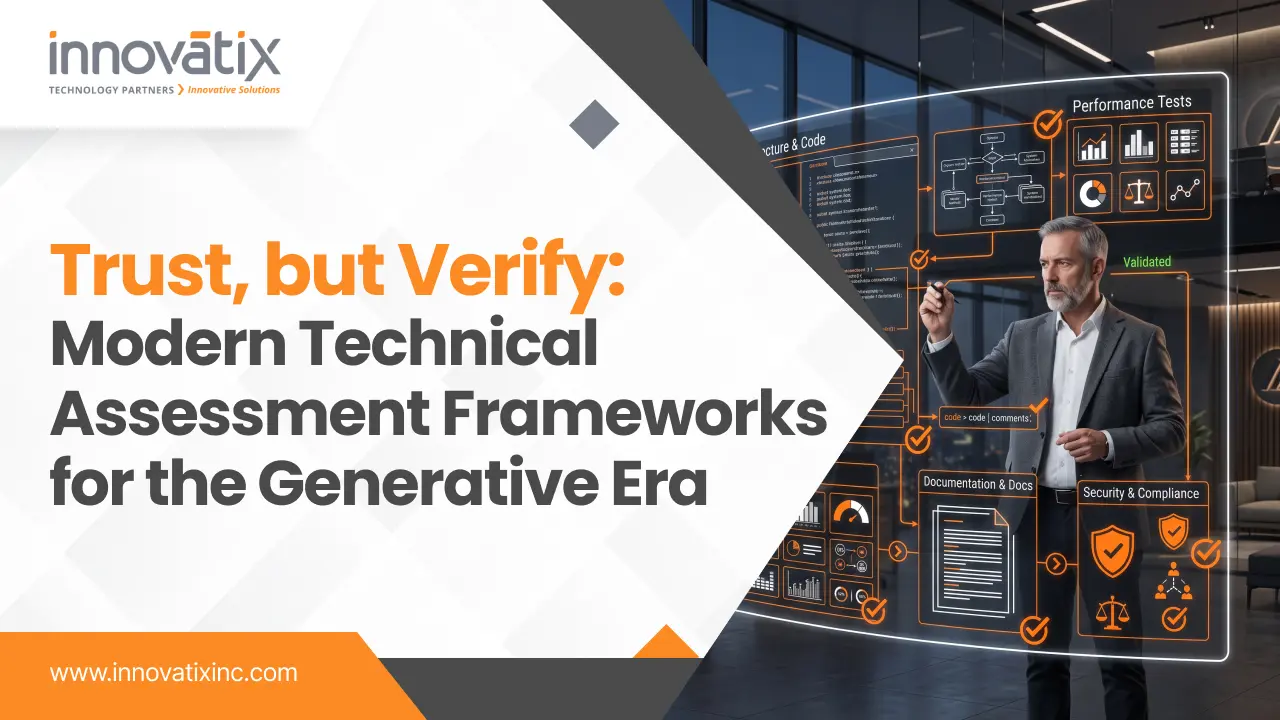
Trust, but Verify: Modern Technical Assessment Frameworks for the Generative Era

The fundamental nature of software engineering has shifted. For decades the premise of technical assessments has been that one could reliably predict a candidate’s engineering capacity by observing how well he or she could write a syntactically correct, clean code under time pressure. We constructed a complete hiring system centered on whiteboard sessions, LeetCode puzzles and timed take-home tests to check syntax memory and problem-solving skills in puzzles. Then there was Generative AI. The capability of solving a LeetCode medium and hard problems in seconds is available today with large language models (LLMs). These tools, such as GitHub Copilot and Cursor, and automated coding agents, have been woven into the modern developer’s Integrated Development Environment (IDE). These systems don’t just fill in the blanks in lines of code, they also build complete microservices, create full test suites, and refactor legacy code bases based on natural language prompts. Traditional screening methods break down if any candidate is able to produce syntactically correct code given a good prompt. A technical hiring manager is in a predicament: how do you gauge a developer’s real ability using the tools they are using, which may be concealing their inabilities? The solution is not to forbid the use of generative tools. In an actual production setting we anticipate that engineers will utilise all the efficiency tools at their disposal. Rather, the answer is to change from syntax testing to a “Trust, but verify” evaluation approach. This framework does not just assess code, but its structure, auditing, integration, and maintainability. Whitepaper—The Agentic AI Skills Gap: Identifying and Sourcing Engineers Capable of Building Autonomous AI Systems This whitepaper provides a strategic blueprint for identifying, sourcing, and evaluating elite engineers capable of building autonomous, multi-agent AI systems to help enterprises bridge the critical “agentic AI skills gap.” Download Whitepaper The Legacy Collapse: Why Whiteboard and Syntax Tests Fail The standard algorithmic screening tests have a limited sample of software engineering skills: working memory, knowledge of particular data structure puzzles and speed. Generative AI tools are highly tailored to do just this. An LLM can solve a classic problem, such as reversing a binary tree or implementing a custom sorting algorithm, instantaneously if the problem is given to the candidate to solve. This results in two issues for recruiting teams: False Positives: Underqualified candidates can use secondary screens or hidden AI assistants to breeze through automated technical screens, only to struggle when faced with the messy, unstructured realities of production environments. False Negatives: lite developers with strong expertise in systems architecture, performance optimization and domain-driven design may not get a high score on a stressful, rote memory coding exam, yet they are quite capable of orchestrating the AI tools to write the coding itself. To build resilient engineering teams today, companies must evaluate a candidate’s ability to manage cognitive debt, which is the difference between the output of an AI agent and the comprehension of the human developer. When developers code what they don’t fully understand, the system quickly turns into a fragile mass of mishmashes and potential pitfalls.   The Four Pillars of Modern Technical Assessment A modern, AI-resilient technical assessment framework shifts the evaluation focus upward. Instead of testing the mechanics of coding, it tests the orchestration and verification of systems. Here are the four key pillars that define this modern framework: 1. Architectural Integrity & Cognitive Debt Control In the generative era, the bottleneck in software development is no longer code production; it is system design. A candidate’s strong evaluation should include the ability to create components that are scalable and integrate gracefully. How to assess: Give the candidate a system design scenario in which they have to describe an application with multiple tiers. Do not ask them to write the endpoints, ask them to define the API boundaries, data contracts and integration patterns. The evaluation metric: Can the candidate recognize where the architectural drift could occur in context of an AI-generated microservice? Do they enforce version control policies and module boundaries that avoid the AI from producing random, poorly normalized code dependences? 2. Systemic Debugging & Vulnerability Detection AI models are known for generating code that is very confident and superficially correct. They can also introduce security issues, or fail to consider edge cases or integrate old or insecure open-source components. As an engineer, his/her job is increasingly becoming one of an editor and auditor. How to assess: Provide the candidate with an AI-generated codebase containing hidden architectural flaws, memory leaks, or security issues (e.g., SQL injections, insecure deserialization, or open S3 bucket permissions in Terraform scripts). Ask them to audit the code, run validation diagnostics, and secure the pipeline. The evaluation metric: Rather than seeing if they can write a function from scratch, evaluate how quickly they locate logical anomalies. Do they use Static Application Security Testing (SAST) and Software Composition Analysis (SCA) principles to verify the safety of the generated code? 3. Legacy Refactoring & Code Modernization Much of enterprise engineering is focused on maintaining, refactoring and modernizing legacy code bases. A great use case for generative tools is to translate legacy (older Java frameworks, legacy APIs, migrating COBOL) patterns into modern microservices—and this demands a high level of human guidance. How to assess: Provide a legacy code snippet with patterns that are no longer in use and require candidates to update the code with the help of an AI tool of their choice. They are required to format the prompts and lead the LLM during the translation process, and then manually tweak the results to conform to contemporary best practices. The evaluation metric: How does the candidate deal with edge-cases where the translation fails? Do they check that the code has been modernized in a manner that is backward compatible and has strict performance constraints? 4. Multi-Agent Orchestration & Guardrails Management The highest-performing developers in the generative era act as “AI Directors.” They don’t only write single prompts, but also create global rules, coordinate multi-agent workflows and introduce automated testing guardrails. How

The New Baseline: Why “AI Fluency” Is Now a Required Skill for Every IT Job

The standard for measuring tech talent is changing quickly and forever in the tech industry. Traditionally, the perception of AI was that it was an advanced field for data scientists to create models individually. The rest of the IT community stayed sidelined, comfortable in the knowledge that IT skills were protected. This distance is utterly lost. It’s no longer a matter of whether an IT professional should use AI, but a must-have skill: AI Fluency. The focus now is on the ability of professionals to easily and efficiently incorporate AI into their work process to boost productivity, shorten development cycles and address complex system-level issues. This paradigm brings about the realization that a non-AI-using IT professional is increasingly becoming a hindrance, not a help, as they are slow and expensive when compared with their generative counterparts. It’s not a human-versus-machine initiative, but a deep human-machine collaboration that is changing corporate productivity. The Empirical Data Behind the Talent Realignment It is important to see evidence from the key global institutions to understand how quickly this change is occurring. The landmark studies conducted by Microsoft and LinkedIn, namely the Work Trend Index reports, put into sharp focus a certain dramatic turnaround in the culture and operation of hiring practices. According to their research, 66% of business leaders would not even consider anyone who lacks an artificial intelligence skill. More impressively, 71% of these leaders say they prefer to hire someone with AI skills but less experience than a highly experienced individual without AI skills. This is a significant change in the hiring landscape, with traditional experience taking a back seat to a candidate’s capacity to adapt to an AI-driven world. This is becoming a growing phenomenon. The call for explicit AI skills in entry-level professional jobs has increased almost triple from the previous year according to the Job Outlook Spring Update by the National Association of Colleges and Employers. In addition, Deloitte State of AI in the Enterprise shows that access to generative tools grew by 50% over the course of a year, indicating the scale of generative technologies across the entire enterprise. Whitepaper – The Rise of Agentic Recruitment: How Autonomous AI Agents are Streamlining the End-to-End Hiring Lifecycle This whitepaper explores how autonomous AI agents are transforming enterprise talent acquisition by shifting from manual, prompt-based tools to goal-oriented workflows that streamline the end-to-end hiring lifecycle. Download Whitepaper Defining True AI Fluency in Modern Technical Disciplines To navigate this landscape, we need a multi-dimensional understanding of what constitutes AI Fluency, that combines the depth of technical understanding, the critical thinking necessary to perform cognitively and the ability to integrate it into operations. The first step is cognitive integration, which involves the intelligent integration of AI assistants into everyday technical tasks.It starts with cognitive integration, which is the intelligent integration of AI assistants into everyday technical tasks. This translates to using AI-driven co-pilots for faster and more complex debugging, automatic unit testing, and fast refactoring of legacy software. The engineer’s job is evolving from being a mechanical writer of syntax to acting as an AI model editor, architect, and system integrator with the skills necessary to understand the domain in which the AI works and to critically examine its suggestions and steer the model to the best architectural solution. AI Fluency isn’t just transforming software, it’s also reshaping the way systems administrators and cloud engineers operate when implementing AI-driven orchestration tools. Fluency for cybersecurity analysts, database managers and data analysts involves using AI-powered security solutions, managing unstructured data pipelines, designing data repositories for machine consumption, and mastering the governance and data privacy of the data. The Disruption of Tenure and the Rise of Judgment Work One of the most disruptive aspects of this transformation is the rapid dismantling of the traditional correlation between professional tenure and workplace performance. For decades, the IT career hierarchy was comfortably linear, with junior professionals paying their dues by performing repetitive, highly structured tasks while gradually gaining the institutional knowledge required for senior, strategic roles. This paradigm is being shattered by the reality of AI-augmented productivity. Today, a junior developer with high AI Fluency can leverage generative coding platforms to write, test, and document complex software architectures at a speed and volume that rivals, or even exceeds, that of a tenured developer who relies solely on traditional, manual workflows. This phenomenon is creating a massive polarization in the technology labor market, wherein the middle tier of the IT workforce—filled with professionals who are highly skilled in routine technical execution but slow to adopt collaborative AI tools—is facing an unprecedented threat of career stagnation and obsolescence. This does not imply that there is less value in technical expertise, it just implies that technical expertise has ceased to have value as it relates to the execution of routine tasks and has now become more valuable as it relates to judgment work. Artificial Intelligence cannot replicate human professionals’ strategic context and ethical oversight, as well as their systemic understanding. They need to figure out how to get the new microservice to work with legacy systems, assess the technical debt and complexity of an automated solution and make sure that the decisions made with artificial intelligence are in line with the wider business objectives. As mundane technical jobs are automated, workers are increasingly becoming superagents, the McKinsey workplace superagency report states. This kind of agency, however, demands a criticality of thought, problem-solving abilities and a certain amount of subject-matter. It calls on professionals to move beyond being mere consumers of technology to responsible, secure and effective overseers of intelligent systems that can help usher in true business value through AI. Strategic Career Development on the New Baseline To truly show the potential employer that you are capable of the technical skills, you need to present them in a different way on your resume and during the interview. No one cares if you just put ChatGPT or Copilot in your skills section, because as with 20 years ago, the ability to

Outcome-Based Hiring: Moving from Hourly Billables to Deliverable-Centric Staffing in 2026

For years, the “billable hour” has defined professional services. In short, the time worked = the work delivered. We understand the pitfalls, and for good reason, as we enter the year 2026, this model will be on its last legs. The reason? The “productivity fork,” a term that describes the rapid advancements to compute power and automation, is reshaping the relationship between the time worked and the value of the work delivered. We are entering a phase of Outcome-Based Hiring (OBH). OBH is a model where work is contracted and delivered in terms of outcomes and milestones, not the time it takes to complete them. The Death of the Input Proxy The framework of hourly billing rewards inefficiency. By collecting just ten hours of work to deliver a strategy, a consultant will earn far more than the more efficient consultant who delivers a strategy in just two hours. The paradox of this model will not survive in 2026. The advancements in Generative AI can transform work that once took hours or even days into mere minutes. If an organization continues to pay a premium for every hour of work, they are paying a disproportionate premium on their workforce for their own inefficiency and lack of speed. Alternatively, high-skill consultants who use AI will be forced to enter the marketplace of consulting to retain their competitive earnings and will no longer contract work on an hourly basis. Shift adjustments in the marketplace from input to outcome is the primary aim of OBH. Whitepaper— Architecting a Global Bench: Strategic IT Staffing Models for the Modern Enterprise This whitepaper outlines how modern enterprises can overcome specialized talent shortages by architecting a “global bench” of high-quality technical expertise that integrates seamlessly into existing workflows to accelerate legacy modernization, AI innovation, and engineering velocity. Download Whitepaper The Key Pillars of Deliverable-Centric Staffing The move towards a model of outcome-based procurement and hiring will result in a paradigm shift rather than changes to billing software. 1. Deliverables that are Defined as “Atomic” OBH requires near-complete precision of “Statement of Work” (SOW) for individual roles, unlike the generic job descriptions most organizations use. Contracts are segmented into incremental milestones. Old Way: “Hire a Marketing Specialist for 40 hours a week.” New Way: “Contract for four high-conversion landing pages and a three-month automated email sequence.” 2. Risk-Reward Sharing With deliverable-driven contracts, people add a “success premium.” If a freelancer or agency meets a given performance KPI, say, a 20% boost in lead generation, a bonus is paid. This aligns stakeholder and employer interests, making staffing a genuine collaborator. 3. Technology-Enabled Validation Contemporary HR tech has adapted to accommodate this. Human-centered applicant tracking systems (ATS) and blockchain HR tech with smart contracts for payment automation upon completion of a deliverable are becoming commonplace. These systems help maintain achievability of deliverables and ensure payment is made in a transparent manner, post a “human-in-the-loop” sign off on quality/purpose of work. The Benefits: Why the Shift is Accelerating The shift to deliverable work is about more than efficiencies; a stronger, more transparent labor market is a crucial focus. For Organizations: OBH limits “budget creep.” Projects estimated for 100 hours do not stretch to 150 hours. OBH helps organizations effectively define goals to improve project management. For Talent: Pack leaders receive payment reflective of their output as opposed to effort. Deliverable-based work offers workers control for a significant improvement in work-life balance. For Market Stability: This model reduces competition based on undercutting prices on traditional gig platforms. Instead of the ‘rat race’ culture, workers will be motivated to provide the best work. Challenges and Implementation Hurdles There will be challenges and friction as you undertake outcome-based hiring. Many companies lack the maturity it takes to introduce the outcome-based hiring. The Clarity Tax: It is much harder to define a deliverable-centered contract than to just post a job with “40 hours of work.” Managers need to have a clear understanding of what success is before the project is undertaken. The Measurement Gap: Some work is not easily measurable. While something like code, content, or a design can be easily measures as a deliverable, roles like “Project Management” or “Team Leadership” may require nuanced KPIs. Precariousness: These are concerns for workers if there is a lack of a guarantee for a minimum set of criteria. In some regions, the 2026 labor regulations are protecting against ‘outcome-based’ pay, and setting a minimum threshold to ensure workers are not worse off for not moving the goal post.  2026 Strategy: The Transition For those wanting to change their staffing model in the target year of 2026, the following three steps can streamline the transition: Conduct an AI Impact Audit: Assess what positions have been automated as a means for outcome-based contracts, as these positions are no longer tied to the reality of goods and services Standardize the Work Units: Build a comprehensible and clear library of deliverables. If you’re hiring designers, clearly state what a “custom brand kit” covers so there is no confusion when you turn it over. Use Verification Tools: Use services that combine AI with data validation to eliminate bias, and prove that the “true professional potential” of candidates is measured by what they design and build, not by how long they stay at their desks. Conclusion Moving away from hourly billables and toward deliverables is an inevitable economic change caused by AI. By 2027, we may see the “billable hour” as a remnant of a slow, opaque time. The organizations, as well as the professionals, who will thrive will be the first to learn how to put a premium on the end goal instead of the work done along the way. Whitepaper— Architecting a Global Bench: Strategic IT Staffing Models for the Modern Enterprise This whitepaper outlines how modern enterprises can overcome specialized talent shortages by architecting a “global bench” of high-quality technical expertise that integrates seamlessly into existing workflows to accelerate legacy modernization, AI innovation, and engineering velocity. Download Whitepaper

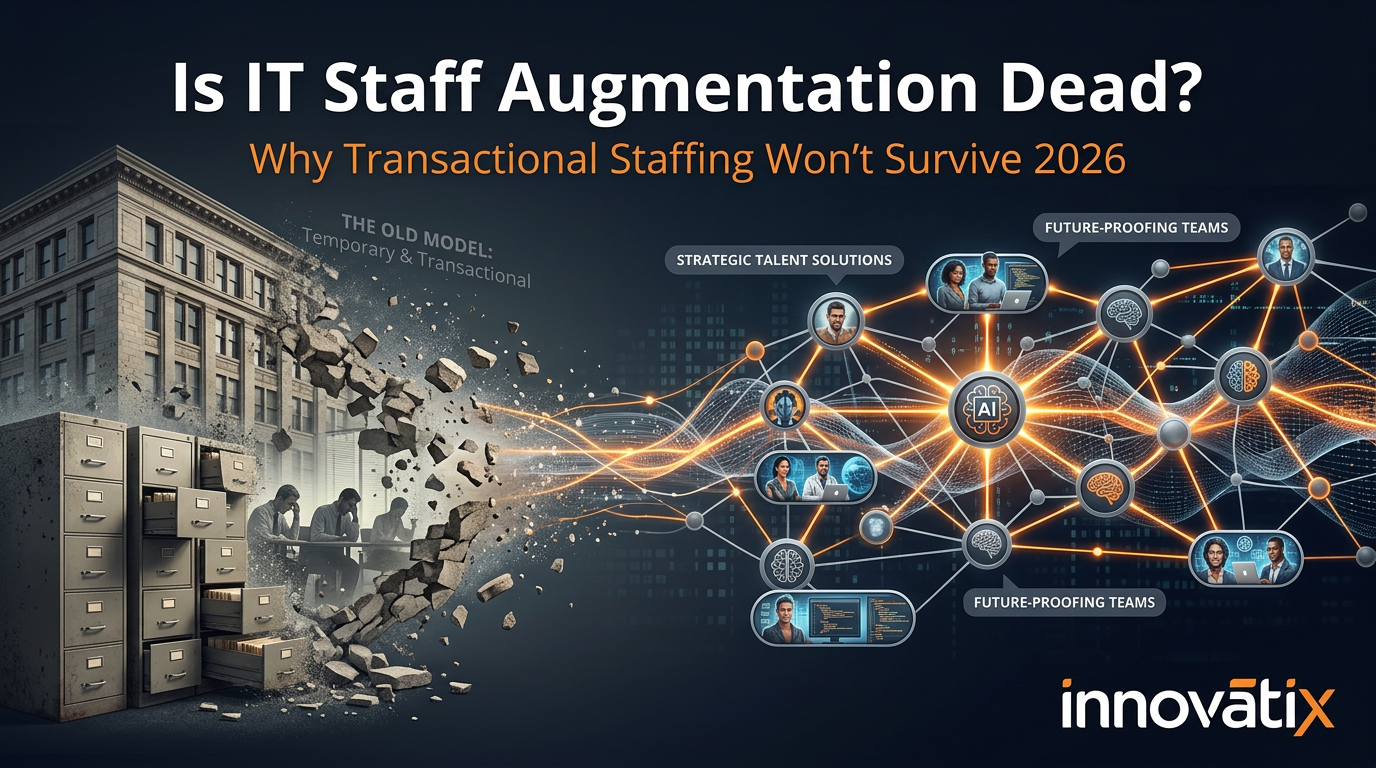
Is IT Staff Augmentation Dead? Why the ‘Transactional Staffing’ Model Won’t Survive 2026

I’m going to say something that might sound strange coming from someone with “recruitment” in their title: the version of staff augmentation most people think of — the transactional, fill-the-seat, send-us-a-resume model — is on life support. That does not mean that staff augmentation is dead. It isn’t. However, in the manner that most of the industry has been doing it over the last two decades? That model is collapsing under AI disruption, client consolidation, and a market that doesn’t reward middlemen anymore. The Numbers Don’t Lie SIA predicted that the U.S. IT staffing segment would fall by 2 percent in 2025, after a fall by 6 percent in 2024. The revenue is declining, penetration rates have gone down and sales reduced by 1.3 per cent quarter-over-quarter. The market, which is already huge at 183 billion, is increasing by only 2 per cent- and even that is almost exclusively to specialty, tech-enabled companies. In February, Bloomberg wrote that AI is posing a direct threat to the staffing industry as companies are in-sourcing recruitment. By the end of 2026, AI is estimated to do 80% of the transactional recruiting jobs. The clients can enjoy the same job boards, same LinkedIn Recruiter licenses, and advanced AI screening tools. The question that staffing companies are posing: why spend money on a staffing company when an algorithm will do it in less time? Whitepaper – Rethinking the Resume: Why Skills-Based Hiring is No Longer Optional in 2026 This whitepaper outlines the essential transition from traditional, pedigree-based resumes to a skills-based hiring model to remain competitive and equitable in the 2026 digital economy. Download Whitepaper What’s Actually Dying The paradigm in which a client makes a phone call with a description of the job, a recruiter performs a search with a keyword, and three resumes are sent, and a margin is collected is what is becoming extinct. Board member Jeff Harris of IT staffing company Tential, explained to the American Staffing Association: “The market share out there is diminishing to the point where companies that simply wish to be transactional and fill orders are finding it less appealing. He added further: “Most of those companies will most likely disappear within the next ten years. An insider that is raising the alarm. I see it daily. The clients are reducing the number of vendors of five or six companies to one or two. The survivors provide more than resume delivery services – market intelligence, workforce planning, skills validation and problem-solving capabilities not available to the client team. The Threats Are Coming from Every Direction Clients are also establishing their own talent platforms internally and are direct sourcing tools that are entirely agency-free. It was admitted by the chief economist at ASA Noah Yosif: “Staffing firms are experiencing an increased competition on the solution side and they will require putting in a much greater effort to create that value. StaffingHub noted that winning agencies are not expanding but are intensifying in current markets – as volume driven growth without a margin discipline is a death sentence. The winners in 2026 aren’t the biggest. They’re the most specialized. What’s Replacing It Staff augmentation isn’t dead — but it’s evolved into something the old model wouldn’t recognize. The companies that have been successful today are not vendors but strategic talent partners. Here’s what that looks like from my desk. In the case of a client calling Innovatix, it does not begin with a job description. It starts with a problem. Perhaps their cloud migration is lagging behind since they are unable to locate DevOps engineers who have experience with Terraform. Perhaps an MLOps specialist should be hired on a 90-day sprint by their AI team. It is our task to comprehend the challenge, find the right solution to it, which has been solved by vetted professionals, and integrate them at an appropriate speed to move the needle. We provide market insights clients don’t have. We recommend salary rates of niche jobs. We do not match keywords but practical tests to validate skills. That is where the distinction lies between a staffing vendor and a talent partner – and between being taken off the vendor list and being invaluable. The Firms That Will Disappear Generalist firms are volume and markup based and are dying out of the runway. Margins are shrinking, customers are moving, recruiters are overworking doing the job that AI can do in a short period of time. When you say that you fill positions, the clients will come to the conclusion that technology can do it less expensively. The companies which survive will pose more difficult questions: how can we build a hybrid team of permanent employees and augmented experts? How is the market of LLM engineers in Q3? What do we do to develop an AI-ready workforce without busting our budget on headcount? Those need partners who are knowledgeable about technology, rather than recruitment. Why I’m Actually Optimistic Here’s the counterintuitive part: this shakeout is good for firms like ours. It clears space for companies that invest in specialization and genuine expertise. At Innovatix, every recruiter on my team understands the technology our clients build. We don’t match keywords — we understand architectures, deployment pipelines, and project lifecycles. Staff augmentation isn’t dead. The lazy version of it is. And for the firms willing to evolve, the opportunity has never been bigger. Whitepaper – Rethinking the Resume: Why Skills-Based Hiring is No Longer Optional in 2026 This whitepaper outlines the essential transition from traditional, pedigree-based resumes to a skills-based hiring model to remain competitive and equitable in the 2026 digital economy. Download Whitepaper

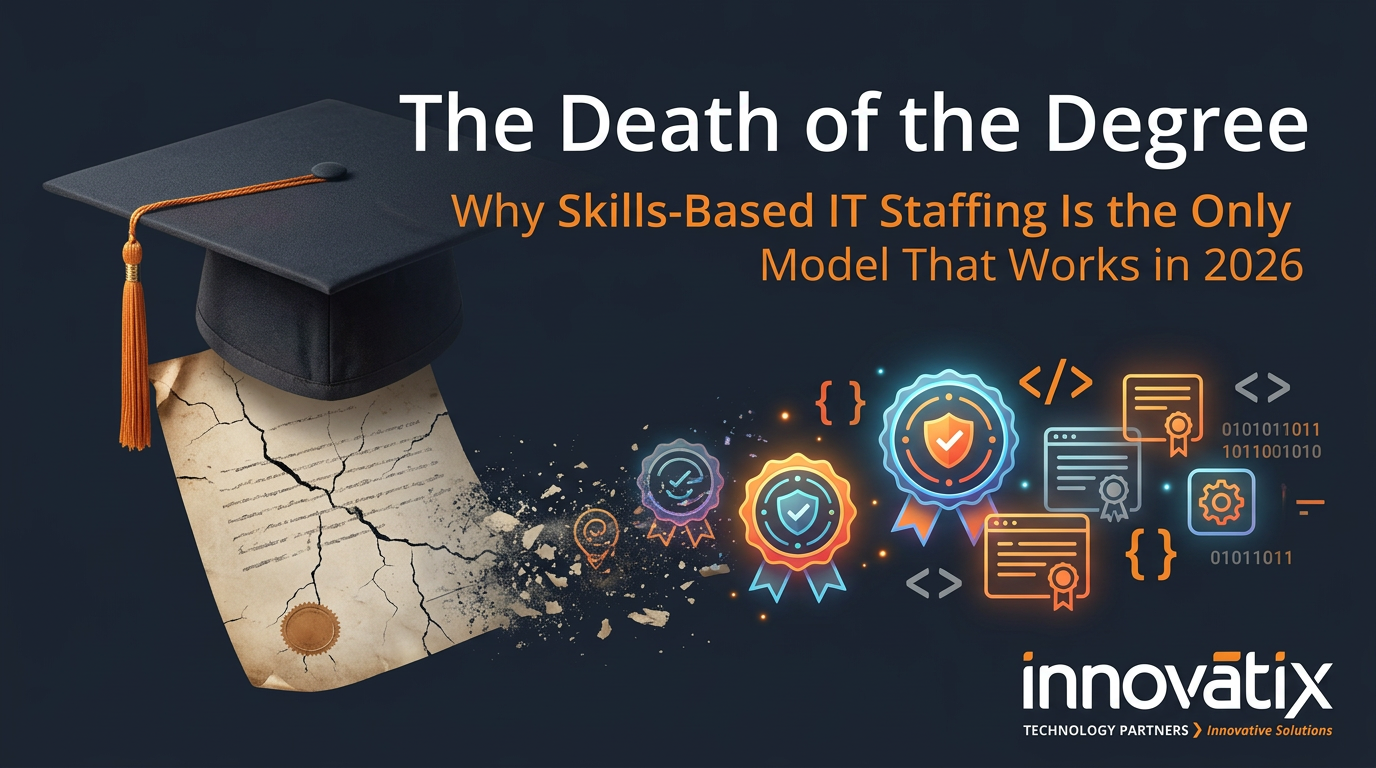
The Death of the Degree: Why Skills-Based IT Staffing Is the Only Model That Works in 2026

A month ago, I rejected a candidate with a master’s degree from a well-known institution. At the same time, I placed a self-taught developer without a degree into a senior cloud architect position at a Fortune 500 company. The developer had built three production Kubernetes clusters, was certified in both AWS, and had a GitHub portfolio that spoke louder than any degree. That would never have happened two years ago. The client required a bachelor’s degree. Today, that’s no longer included in almost all job postings I receive. The shift is wide-reaching and based on data, fundamentally altering the way I do my job. Why Degree Requirements Are Disappearing Approximately 70% of employers now use skills-based hiring practices. IBM, Google, Delta Air Lines, and Bank of America have eliminated degree requirements for a substantial portion of their positions. The U.S. federal government dropped degree requirements with the 2026 Merit Hiring Plan, allowing candidates to demonstrate qualifications via certification, apprenticeships, or proven ability. The most significant impact on my recruitment desk is that skills-based searches increase the qualified talent pool by 19 times compared to degree-based searches. This is according to Korn Ferry. With 72% of employers struggling to fill positions, limiting the pool of potential applicants by including a degree checkbox is more than outdated – it’s counterproductive. According to Harvard Business School and the Burning Glass Institute, while many companies announced they would drop degree requirements, only 0.14% of actual hires were influenced by this decision. The difference between announcing the elimination of degree requirements and implementing this change is vast. Organizations that truly transform their screening process to focus on skills – and not simply remove a line from a job posting – are the ones experiencing results. Whitepaper – Empowering Businesses with Strategic IT Staffing: Innovatix Technology Partners’ Approach Discover how Innovatix Technology Partners helps businesses build agile, future-ready IT teams through a strategic staffing approach designed for today’s digital economy. Download Whitepaper Transformations on the Recruitment Floor My screening process looks significantly different from what it was eighteen months ago. I previously began with education and years of experience. Now, I start with what the candidate can do. Can they describe a deployment pipeline to me? Can they troubleshoot a failing microservice under pressure? Has he/she contributed to open-source projects that demonstrate real-world problem-solving? Increasingly, candidates in our pipeline possess AWS, Azure, or Google Cloud certifications instead of traditional degrees. Many constructed portfolios by attending boot camps, freelancing, and contracting. A good portion of the strongest placements I’ve made this year originated from individuals who transitioned from entirely different fields – bringing new perspectives and a drive to prove themselves. The data on retention supports these findings. According to Korn Ferry, skills-based hires retain 34% longer. A WiCyS study released this month indicated that the utilization of skills-based hiring increased retention by 18%, decreased hiring time by 16%, and resulted in over $125,000 per employee saved due to reduced turnover. These are not slight increases – they are transformative. Why This Matters for IT Staffing Specifically The rapid pace of technology makes a degree earned five years ago a poor indicator of current technical capabilities. Most universities didn’t teach Terraform, LangChain, MLOps tooling, or Kubernetes at scale when my candidates’ attended classes. Clients desperately need skills acquired in the field, not in lecture halls. Staff augmentation and skills-based hiring converge at this point. When a client needs a DevOps engineer who can develop and implement a CI/CD pipeline on Azure within two weeks, they don’t care about the individual’s educational background. They care about whether the individual has successfully implemented the pipeline before, can document that implementation, and can start work on Monday. I have this discussion with clients approximately ten times a week. How We Are Changing Our Approach at Innovatix We’ve transformed our recruitment methodology to focus on validating each candidate’s competence. Each candidate undergoes a customized skills assessment directly related to the position they’re applying for, not a generic test. We examine their GitHub repository, portfolio projects, certifications, and references from previous contracts. A degree is a “nice to have,” but not a filter for us. As a result, our time-to-hire has decreased, client satisfaction ratings have improved, and the professionals we hire perform at a rate equal to or better than those we hire traditionally. This is what our quarterly reviews of successful placements indicate. LinkedIn’s 2026 Skills Study supports what we’ve been observing: in virtually all hiring discussions, practical capabilities and adaptability exceed traditional credentials. Clients seek individuals who can perform tasks today, learn the next item tomorrow, and collaborate effectively with distributed teams. A diploma doesn’t evaluate these factors. While degrees still hold value, they are no longer the primary barrier in recruitment. I wish to emphasize it here. I emphasize that education is not irrelevant. A strong academic foundation can be beneficial. However, using a degree as a binary pass/fail filter in the recruitment process for IT talent is dying, and it should. That practice is dying, and it should. This exclusionary practice excludes excellent talent, lengthens the hiring process, and fails to assess on-the-job performance. We have experienced the positive impact of the expansion of our recruitment requirements in Innovatix. You get those who solve problems in a different way, who carry with them determination and ability, and who provide performance results that cannot be assured only by education. When recruiting, you start by checking a degree box, you are not recruiting by excellence, you are weeding out the most talented. There is talent available. You simply need to be prepared to seek them out in the correct manner. Whitepaper – Empowering Businesses with Strategic IT Staffing: Innovatix Technology Partners’ Approach Discover how Innovatix Technology Partners helps businesses build agile, future-ready IT teams through a strategic staffing approach designed for today’s digital economy. Download Whitepaper

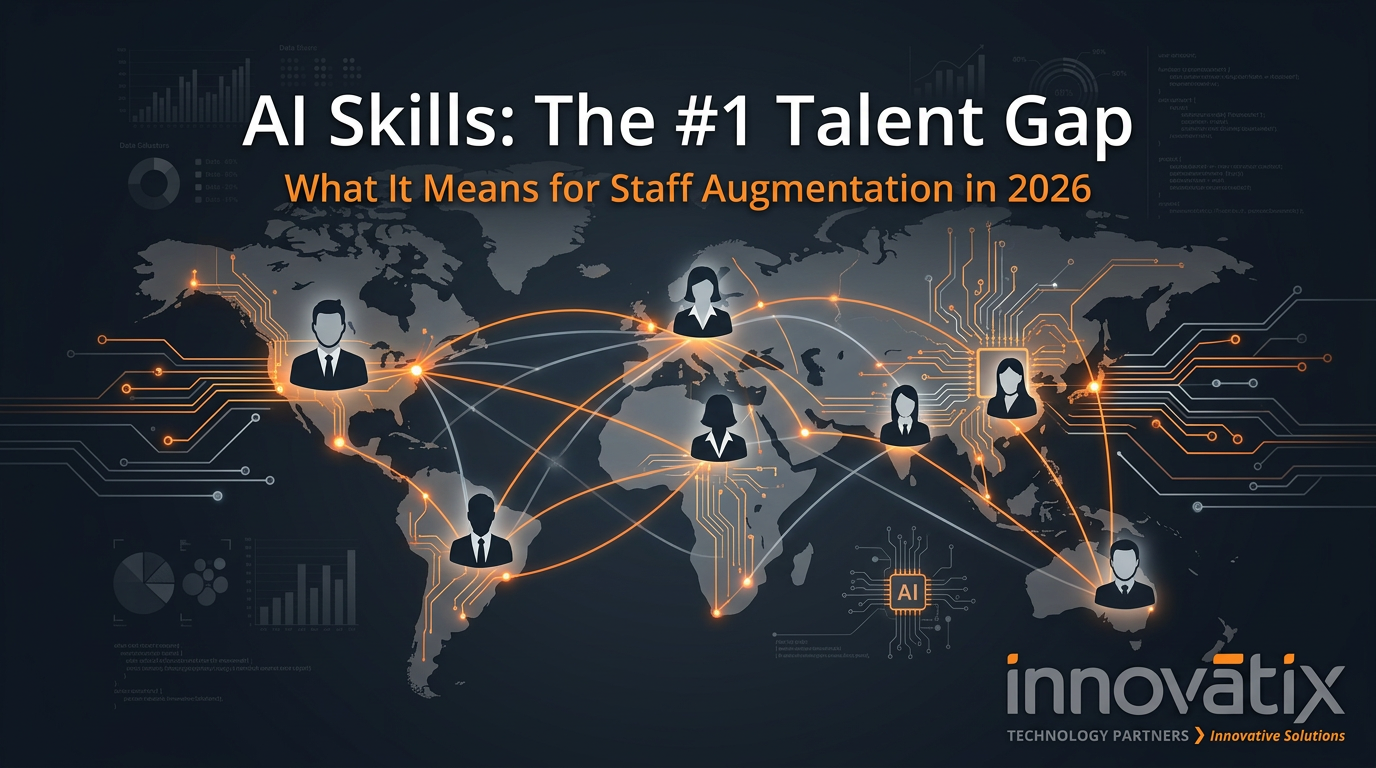
AI Skills: The #1Talent Gap —What It Means for Staff Augmentation In 2026

I spend my days on the front lines of IT hiring — screening candidates, managing client intake calls, negotiating rates, and building the talent pipelines that keep projects moving. I’ve been doing this work for over fifteen years, and I can tell you honestly, the market has never felt like this. ManpowerGroup just published their 2026 Talent Shortage Survey — 39,000 employers across 41 countries. The finding that grabbed my attention wasn’t surprising, but seeing it confirmed at this scale was sobering: AI skills have officially overtaken engineering, IT, and every other technical discipline as the single hardest capability to source globally. Not second on the list. First. By a clear margin. As someone who leads staffing services at an IT firm, this isn’t an abstract trend. It’s the reality I’m navigating every single week. The Numbers Behind the Scramble Seventy-two percent of employers worldwide report difficulty filling roles. AI Model and Application Development tops the shortage list at 20%, with AI Literacy at 19%. Traditional IT and Data skills — the roles I built my career sourcing — have dropped to seventh place. I’ve watched that decline happen in real time across my own req board over the past eighteen months. Senior AI engineers now command $140,000 to $200,000, with specialized LLM and MLOps roles pushing well past that. TechTarget reports a 170% surge in generative AI postings. The largest enterprises — those with 1,000 to 5,000 employees — are struggling most, with 75% unable to fill AI positions. From a staffing desk, that translates directly: requisitions that used to close in four weeks now sit open for three months. Clients call me frustrated because their AI roadmaps are stalled. They don’t lack budget or ambition. They lack people. Whitepaper—Outcome-Based Staff Augmentation: Shifting from Billable Hours to Deliverable Milestones This whitepaper outlines a strategic shift from traditional hourly billing to an “Outcome-Based Staff Augmentation” model, which aligns vendor incentives with business goals by focusing on deliverable milestones and measurable results. Download Whitepaper Why the Old Playbook Doesn’t Work Anymore Here’s what I see on the hiring manager side. They post a role. Hundreds of applications flood in — most from candidates who’ve added “AI” to their LinkedIn profiles but can’t walk through a model deployment in an interview. The handful of genuinely qualified people are fielding five or six competing offers. By the time a hiring committee aligns, that candidate is gone. Traditional recruiting cannot keep pace when demand grows exponentially and the qualified talent pool grows linearly. I’ve had this conversation with dozens of hiring managers this quarter. The math doesn’t work — and that’s precisely why more of them are turning to staff augmentation. Why Staff Augmentation Is the Practical Answer There was a time when augmentation was seen as a stopgap — something you did when you needed a warm body fast. That perception has completely flipped. In 2026, 65% of tech leaders are actively building their workforce strategy around specialized contract talent. It’s not Plan B anymore. For many of our clients, it’s the primary approach. When a client needs an MLOps engineer to get a model into production, I’m not starting a three-month recruitment cycle. I go to our vetted bench — professionals who’ve delivered this exact work across multiple industries — and embed someone in that team within days. That speed is the difference between a quarterly target met and a project that slips another cycle. The American Staffing Association and LinkedIn recently found that contract workers are picking up AI skills 46% faster than the broader professional population. That tracks with what I see daily. Augmented professionals stay relentlessly current because their next engagement depends on it. They’re not coasting — they’re sharpening their skills between every project. The Conversations I’m Having with Clients When a hiring manager reaches out about their AI talent gap, I don’t start with a sales pitch. I start with a question: what is this vacancy actually costing you? If three open ML engineer roles are holding up a product launch, the cost isn’t recruiter time — it’s lost revenue, delayed go-to-market, and competitors pulling ahead. Staff augmentation lets you act immediately. Bring in specialized AI talent, embed them alongside your permanent team, maintain full oversight, and start clearing the backlog. If the fit is right, many clients convert augmented professionals to full-time. It’s a low-risk model that gives both sides a chance to evaluate before committing long-term. ManpowerGroup’s CEO Jonas Prising framed it well: “AI is not replacing jobs, it is reshaping work.” From where I sit, the companies that pair smart augmentation with internal upskilling are the ones building teams that can actually keep up. Don’t Wait for the Market to Cool Down This shortage is not resolving itself next quarter. It’s going to tighten as more organizations move from AI pilots to production. Every week I see new clients entering the market for AI talent who weren’t there six months ago. At Innovatix, our staffing practice is built for this reality. We specialize in matching deeply skilled AI and technology professionals with the teams that need them — at a speed traditional hiring pipelines cannot match. If your AI initiatives are waiting on talent, I’d welcome that conversation. Whitepaper—Outcome-Based Staff Augmentation: Shifting from Billable Hours to Deliverable Milestones This whitepaper outlines a strategic shift from traditional hourly billing to an “Outcome-Based Staff Augmentation” model, which aligns vendor incentives with business goals by focusing on deliverable milestones and measurable results. Download Whitepaper

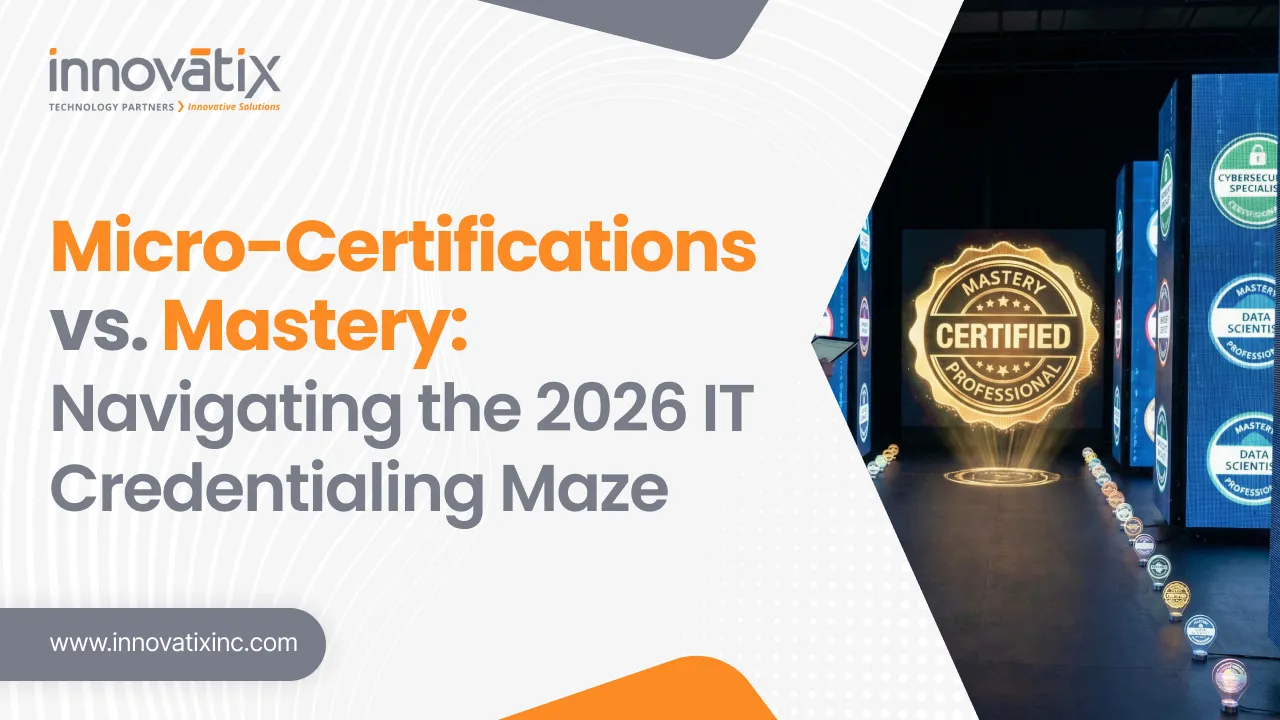
Micro-Certifications vs. Mastery: Navigating the 2026 IT Credentialing Maze

The IT landscape of 2026 is no longer a slow-moving river; it is a high-velocity rapid. As Artificial Intelligence, quantum-ready security, and platform engineering redefine the workplace, the way we prove our worth to employers has fundamentally shifted. Gone are the days when a single, four-year degree or one “gold standard” certification could carry a career for a decade. Today, professionals are caught between two powerful currents: the precision of micro-certifications and the depth of traditional mastery. Navigating this maze requires more than just collecting badges—it requires a strategy. The Rise of the “Skill Sprint”: Micro-Certifications In 2026, “Skills Velocity” is the new corporate currency. Micro-certifications—often called nano-degrees or digital badges—have exploded because the shelf life of technical knowledge has collapsed. Agility Over Architecture: These are laser-focused, competency-based credentials that can be earned in weeks rather than months. If a company suddenly adopts a new Agentic AI framework or a specific cloud-native security tool, a micro-certification allows a developer to bridge that gap immediately. The “Stackable” Resume: Modern hiring managers often look for a “stack” of complementary skills. For instance, a base in Python combined with micro-credentials in Prompt Engineering and RAG (Retrieval-Augmented Generation) pipelines tells a much more specific story than a generic “Software Developer” title. Immediate ROI: Because they are often cheaper and less time-intensive, micro-certifications offer a low-risk way to pivot or “test drive” a new niche without the financial burden of a full-scale master’s program. Whitepaper—Outcome-Based Staff Augmentation: Shifting from Billable Hours to Deliverable Milestones This whitepaper outlines a strategic shift from traditional hourly billing to an “Outcome-Based Staff Augmentation” model, which aligns vendor incentives with business goals by focusing on deliverable milestones and measurable results. Download Whitepaper The Enduring Power of Mastery While the “sprint” is essential for staying current, “Mastery” remains the anchor of a high-level IT career. Comprehensive certifications—think CISSP for security, or Professional Cloud Architect for infrastructure—provide a breadth of knowledge that micro-credentials simply cannot replicate. Context is King: Mastery isn’t just about knowing how to use a tool; it’s about understanding the why behind the architecture. It provides the systemic thinking required for leadership and high-stakes decision-making. A Trusted Filter: In a world flooded with digital badges, traditional heavy-hitting certifications act as a rigorous filter. They signal a level of discipline, long-term commitment, and foundational theory that AI-driven tools cannot yet automate or replace. Global Mobility: While some micro-credentials are brand-specific, “Mastery” certifications often carry more weight across international borders and regulated industries (like defense or healthcare), where compliance and deep-rooted standards are non-negotiable. Navigating the Maze: Which Path Is Yours? Choosing between these two isn’t an “either/or” scenario; it’s a “when/how” strategy. The most successful IT professionals in 2026 are using a hybrid approach to build a T-shaped skill set: deep mastery in one core area, with a broad horizontal bar of micro-certifications. The 2026 Strategy: Use Mastery to build your “floor” (your career foundation) and Micro-Certifications to build your “ceiling” (your competitive edge). If you are a junior developer, focus on a foundational “Mastery” credential (like a CCNA or an Associate Cloud cert) to get your foot in the door. If you are a mid-to-senior professional, use micro-certifications to “up-skill” into emerging fields like AI Governance or Green Ops to stay indispensable. Looking Ahead The 2026 credentialing maze doesn’t have a single exit. Whether you choose the path of the specialist or the agile generalist, the only real risk is standing still. The “maze” is actually a ladder; you just have to decide which rungs you’re going to climb first. Whitepaper—Outcome-Based Staff Augmentation: Shifting from Billable Hours to Deliverable Milestones This whitepaper outlines a strategic shift from traditional hourly billing to an “Outcome-Based Staff Augmentation” model, which aligns vendor incentives with business goals by focusing on deliverable milestones and measurable results. Download Whitepaper

Top 12 IT Jobs in 2026 (and Why They’ll Matter More Than Ever)

Technology is moving fast, and so are the roles needed to build, secure, and guide it. As AI, automation, and cloud reshape businesses, some IT roles are becoming especially valuable. Here are the top 12 IT jobs in 2026, what they do, why they matter, and the core skills you’ll need if you want to pursue them. Artificial Intelligence (AI) / Machine Learning (ML) Engineer What they do: AI/ML Engineers design, build, and deploy models that power intelligent systems—recommendation engines, chatbots, fraud detection, predictive maintenance, computer vision, and more. By 2026, many products will have AI “under the hood,” and these engineers make that possible. Key responsibilities: Build and train ML models using large datasets Deploy models to production (often via APIs or cloud platforms) Optimize performance, latency, and cost Collaborate with data scientists, product teams, and MLOps engineers Core skills: Python (NumPy, pandas, scikit-learn), plus frameworks like TensorFlow or PyTorch Strong math/statistics (linear algebra, probability, optimization) Experience with cloud ML platforms (AWS Sagemaker, Google Vertex AI, Azure ML) Understanding of MLOps: model versioning, monitoring, and retraining Who it’s ideal for: People who enjoy math, experimentation, and turning models into real-world products. Whitepaper: Exploring the Choices of IT Staff Augmentation IT staff augmentation can be categorized into two main models: onsite and offsite. Each of these models has its benefits and potential challenges. Download our comprehensive whitepaper on choices of IT Staff Augmentation to learn these in detail. Download Whitepaper Cybersecurity Specialist / Analyst / Engineer What they do: Cybersecurity professionals protect systems, data, and people from attacks. With AI-boosted threats, remote work, and more connected devices, security will be one of the most critical IT functions in 2026. Key responsibilities: Monitor networks and systems for suspicious activity Respond to and investigate incidents and breaches Conduct security assessments, penetration tests, and vulnerability scans Implement and maintain security controls, policies, and compliance standards Core skills: Knowledge of networks, operating systems, firewalls, SIEM tools Familiarity with standards and frameworks (NIST, ISO 27001, SOC 2) Scripting (Python, Bash, PowerShell) for automation Understanding of cloud security (IAM, encryption, zero trust) Who it’s ideal for: Analytical, detail-oriented people who like solving puzzles and thinking like both attacker and defender. Cloud Architect / Cloud Engineer What they do: Cloud Architects and Engineers design and manage scalable, reliable infrastructure on platforms like AWS, Azure, and Google Cloud. As more companies go “cloud-first” and run AI workloads, demand for cloud skills will stay high. Key responsibilities: Design cloud architectures for applications and data platforms Migrate on-premise systems to the cloud Optimize for security, cost, and performance Use Infrastructure as Code (IaC) to automate deployments Core skills: Deep understanding of at least one major cloud provider Networking, storage, compute, containers (Docker, Kubernetes) IaC tools (Terraform, CloudFormation, Pulumi) Security and cost management (identity, resource policies, budgeting) Who it’s ideal for: Those who enjoy big-picture systems thinking and building robust technical foundations. Data Scientist / Data Analyst What they do: Data Scientists and Analysts help organizations make sense of data and turn it into decisions, experiments, and strategy. Even with AI tools automating parts of the workflow, the need for humans who can ask the right questions and interpret results will remain strong. Key responsibilities: Collect, clean, and analyze data from various sources Build statistical models and data visualizations Design and evaluate experiments (A/B testing) Communicate insights and recommendations to stakeholders Core skills: SQL, Python or R, and data visualization tools (Tableau, Power BI, Looker) Statistics: hypothesis testing, regression, experimentation For Data Scientists: ML basics (classification, clustering, time series) Business understanding and communication skills Who it’s ideal for: Curious problem-solvers who like numbers and storytelling. DevOps Engineer / Site Reliability Engineer (SRE) What they do: DevOps Engineers and SREs ensure software is delivered quickly, reliably, and safely. They sit between development and operations, automating everything from testing to deployment to monitoring. Key responsibilities: Build CI/CD pipelines for automated testing and deployment Monitor performance, availability, and reliability of systems Automate operational tasks (scaling, backups, failover) Work with developers to make systems more resilient Core skills: Linux, networking, and cloud infrastructure CI/CD tools (GitHub Actions, GitLab CI, Jenkins, CircleCI) Containers and orchestration (Docker, Kubernetes) Observability tools (Prometheus, Grafana, Datadog, New Relic) Scripting (Python, Bash, Go) Who it’s ideal for: Engineers who like automation, performance tuning, and keeping complex systems stable under pressure. Data Engineer What they do: Data Engineers build the pipelines and infrastructure that make analytics and AI possible. They move, transform, and organize data so it’s accurate, reliable, and ready for use. Key responsibilities: Design and maintain data pipelines (batch and real-time) Build and manage data warehouses/lakes Ensure data quality, governance, and security Work closely with data scientists and analysts Core skills: Strong SQL and data modeling Big data tools (Spark, Kafka, Flink) and ETL/ELT platforms (Airflow, dbt) Cloud data services (BigQuery, Snowflake, Redshift, Databricks) Programming (Python/Scala) and knowledge of APIs Who it’s ideal for: People who like building robust systems and working behind the scenes to make data useful at scale. Product Manager (Technical / AI) What they do: Technical and AI Product Managers define what gets built and why. They sit at the intersection of business, engineering, and users—especially important as companies roll out AI-powered products and features. Key responsibilities: Define product vision, roadmap, and success metrics Gather and prioritize requirements from users and stakeholders Work with engineering, design, and data teams to deliver features Ensure AI features are useful, ethical, and aligned with strategy Core skills: Product thinking: problem definition, prioritization, trade-off decisions Technical literacy (APIs, data, AI capabilities and limitations) Communication, stakeholder management, and user research Understanding of AI product risks (bias, privacy, explainability) Who it’s ideal for: People who love both tech and business, and enjoy coordinating teams to deliver real value. UX/UI & Immersive Experience Designers What they do: UX/UI Designers create intuitive digital experiences; immersive designers extend this to AR, VR, and mixed reality. By 2026, many products will blend traditional interfaces with voice, gesture, and spatial computing. Key responsibilities: Research user needs, behaviors,

Aiyden Parakh October 30, 2025 No Comments

The Silent Tax of a Bad Tech Hire: Calculating the Morale Debt You Can’t Afford

Every CFO knows the sting of a bad hire. There’s the recruitment cost—typically 20-30% of the annual salary. There’s the onboarding investment, the training hours, and eventually, the severance package. But these visible expenses are just the tip of the iceberg. Beneath the surface lurks a far more insidious cost that rarely appears on any balance sheet: morale debt. In the tech industry, where talent is scarce and competition is fierce, morale debt can silently corrode your organization from within, driving away your best performers and creating a toxic cycle that compounds over time. Like financial debt, morale debt accumulates interest—and if left unchecked, it can bankrupt your team’s productivity, innovation, and culture. Understanding Morale Debt: The Hidden Liability Morale debt is the accumulated psychological and emotional toll that a problematic employee inflicts on their team. While financial debt has clear numbers—principal, interest rates, payment schedules—morale debt operates in the shadows, manifesting through decreased engagement, quiet quitting, and eventual turnover. When you make a bad tech hire, you’re not just paying their salary; you’re extracting a tax from every team member who has to compensate for their shortcomings, endure their toxicity, or watch leadership fail to act. This tax compounds daily, accumulating until the cost far exceeds what you would have paid to make the right hire in the first place. Exploring the Choices of IT Staff Augmentation IT staff augmentation can be categorized into two main models: onsite and offsite. Each of these models has its benefits and potential challenges. Download our comprehensive whitepaper on choices of IT Staff Augmentation to learn these in detail. Download Whitepaper The Anatomy of a Bad Tech Hire Before we can calculate the cost, we need to understand what constitutes a “bad hire” in the tech world. They typically fall into three categories: The Technical Underperformer This person lacks the skills they claimed to have. They struggle with basic tasks, require constant hand-holding, and deliver subpar code that others must review, debug, and often rewrite. They’re not necessarily malicious—just incompetent for the role. The Cultural Misfit Technically competent but culturally toxic. They might be brilliant coders who undermine team collaboration, dismiss others’ ideas, create an atmosphere of fear or competition, or refuse to align with company values. The HBS reveals that toxic workers can have a devastating ripple effect on their peers, making these individuals often the most dangerous because their technical contributions can blind management to their destructive impact. The Deadweight Neither technically proficient nor culturally aligned, these hires somehow slip through the cracks and remain, doing the bare minimum to avoid termination. They’re the embodiment of mediocrity, contributing little while consuming resources and setting a low bar for team expectations.   The Compounding Interest of Morale Debt Week 1-4: The Honeymoon Period Initially, the team gives the new hire the benefit of the doubt. Senior developers allocate extra time for onboarding, assuming this investment will pay off. The morale impact is minimal, though the opportunity cost of diverted attention begins accruing immediately. Morale Tax: Low (1-2% of team capacity) Month 2-3: The Recognition Phase Red flags emerge. Code reviews reveal consistent quality issues. Deadlines slip. Meetings become more contentious. Top performers begin spending more time fixing problems than creating solutions. Frustration bubbles beneath the surface, but team members remain professional, hoping the situation improves. Morale Tax: Moderate (5-10% of team capacity) Month 4-6: The Resentment Builds The bad hire is now clearly established. High performers resent carrying extra weight. They begin questioning leadership’s judgment and wonder if their own contributions are even noticed. Some start updating their LinkedIn profiles. Water cooler conversations shift from project excitement to venting sessions. Morale Tax: Significant (15-25% of team capacity) Month 7+: The Exodus Begins Your best engineers, tired of compensating for the weak link, start leaving. Exit interviews mention “team dynamics” and “leadership concerns.” The remaining team members inherit even more responsibility, accelerating burnout. The bad hire remains, oblivious or indifferent to the chaos they’ve created. Morale Tax: Critical (30-50% of team capacity or higher) Quantifying the Unquantifiable: A Framework for Calculating Morale Debt While morale debt doesn’t appear on financial statements, we can develop a framework to estimate its cost: 1. Productivity Dilution For every hour a high performer spends fixing a bad hire’s code, reviewing their work multiple times, or in contentious meetings, that’s an hour not spent on innovation, feature development, or technical debt reduction. Calculation: If three senior engineers (at $150,000 salary) each lose 10 hours per week dealing with a bad hire, that’s 30 hours × 52 weeks × $75/hour = $117,000 annually in lost productivity. 2. Opportunity Cost of Lost Innovation Tech teams thrive on momentum and creativity. A bad hire disrupts this flow, forcing the team into reactive mode. Features get delayed, product roadmaps suffer, and market opportunities slip away. Calculation: If a delayed feature launch costs you even 100 customers at $1,000 annual contract value, that’s $100,000 in lost revenue—conservatively. 3. Recruitment and Replacement Costs When good employees leave because of morale issues, you face the full recruitment cycle again—but now you’re replacing your best talent, not your worst. Calculation: Replacing a senior engineer costs approximately 1.5-2x their annual salary when considering recruitment fees, onboarding, and productivity ramp-up time. For a $150,000 engineer, that’s $225,000-$300,000 per departure. 4. Knowledge Drain Every engineer who leaves takes institutional knowledge, client relationships, and system expertise with them. The learning curve for replacements can take 6-12 months. Calculation: Immeasurable in dollars but manifests in slower development cycles, repeated mistakes, and lost competitive advantage. 5. Cultural Erosion Perhaps the most insidious cost is the normalization of mediocrity. When leadership tolerates poor performance, it signals to the team that excellence doesn’t matter. Standards drop, engagement plummets, and your culture transforms from high-performance to just-getting-by. Calculation: Priceless—and potentially company-ending.   The Psychological Toll: Why Top Performers Care Most Counterintuitively, bad hires hurt your best employees the most. Mediocre performers might not notice or care about a struggling teammate, but high achievers do—and it devastates them. High performers are intrinsically motivated by: Craftsmanship: They take pride in quality work and are personally offended by sloppy

©2026 Innovatix Technology Partners, a Macrosoft, Inc. Company. All Rights Reserved.