



Customer communications are one of those things that never seem to belong to just one department. Marketing gets to craft the message, IT handles the technology behind it, Operations is in charge of delivery, and Legal or Compliance review on whatever goes out.
Each team has its own important role, but what happens when ownership is divided across departments? Who is accountable for the communication experience as a whole? The question matters because nowadays customers are judging companies on the quality of every interaction they receive.
For enterprises managing thousands of customer communications across all sorts of channels, effective governance becomes a priority. This is where a Customer Communications Management (CCM) Center of Excellence (CoE) can make a difference.
Whitepaper—5 Common CCM Modernization Mistakes and How to Avoid Them
This whitepaper outlines the five most common pitfalls enterprises face when migrating from legacy Customer Communications Management (CCM) systems and provides actionable strategies to ensure a seamless, omnichannel digital transformation.
Customer Communications Are Everyone’s Responsibility
In a large corporation, a single customer message can bounce around from one team to another before reaching its recipient. Marketing lays down the tone, IT keeps the CCM platform running, Operations handles all the behind-the-scenes work, and Legal makes sure everything is good to go from a regulatory standpoint.
Now the problem isn’t that people are scattered across different teams; that’s just how things go in a large organization. The real problem arises when there isn’t a clear connection between all those teams.
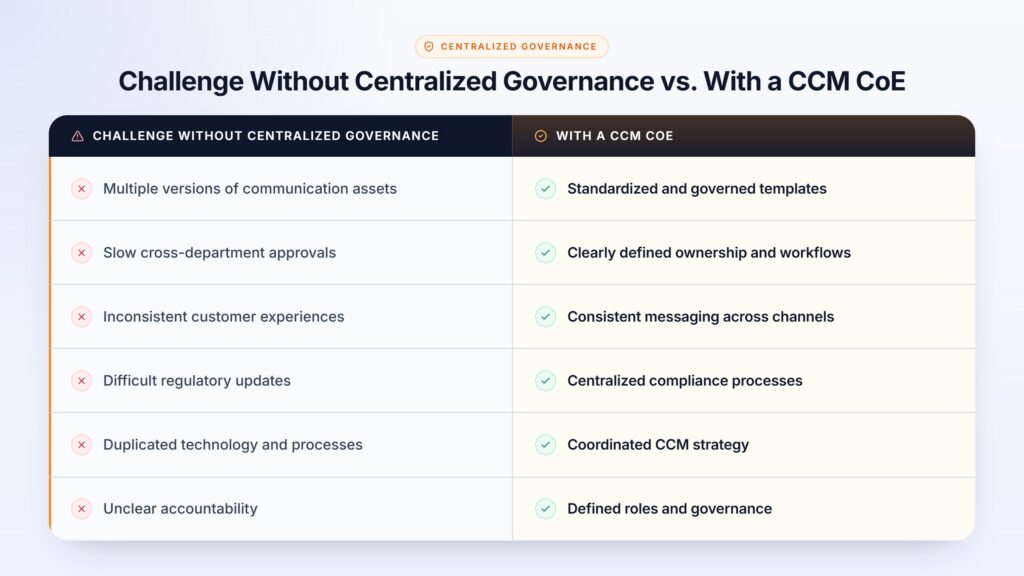
Without clear ownership and governance in place, things can go sideways really fast. Organizations can end up with:
- Duplicate or outdated templates
- Inconsistent messaging across channels
- Lengthy approval processes
- Siloed communication workflows
- Difficulty implementing regulatory or business changes
- Unclear accountability when communication errors occur
Innovatix Technology Partners identifies departmental fragmentation between functions such as Marketing, Legal, and IT as a significant CCM challenge and positions a Communication Center of Excellence as a way to establish standards across corporate communications.
What Is a CCM Center of Excellence?
A CCM Center of Excellence is essentially a collaborative framework that brings together the right stakeholders who make enterprise communications happen, and sets the standards, accountability and processes for all of them to work by.
It is not about creating a brand-new department that does everything and takes power away from the teams that already exist. That’s not what it is about – it is about creating a central framework that lets those teams work together towards the same communication goals.
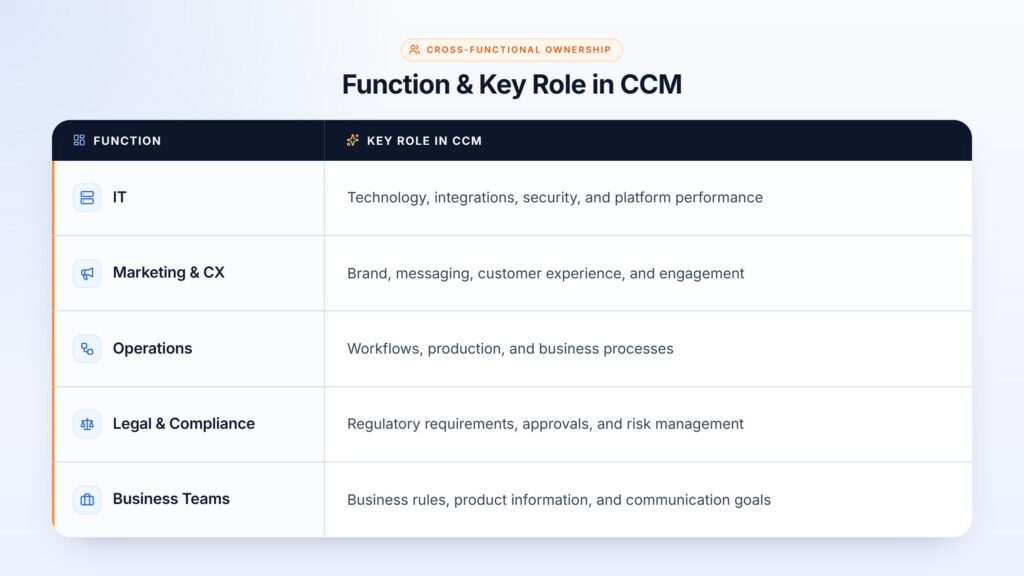
The idea is simple: by getting all the relevant responsibilities connected, the customer starts to perceive one organization, rather than a bunch of separate departments that don’t seem to be coordinating with one another.
What Should a CCM Center of Excellence Own?
A CoE that gets everything right will own governance across the whole communication workflow, not just be in charge of overseeing the CCM platform.
1. Communication Standards
The CoE can establish standards for brand identity, messaging, what accessibility means, how we make it personal for each customer, and how consistent we are across channels. That way, we have got a solid foundation for all communications across the business.
2. Template and Content Governance
Larger companies can accumulate a whole heap of templates over the years. Without any kind of governance in place, duplicate, outdated or rarely used assets can make maintenance a real pain and add to the overall complexity of the organization.
A Centre of Excellence (CoE) can define who gets to create and approve communication assets, who updates them, and who is in charge of retiring when they are done; all of which can help cut down on the so-called “communication debt” (as Innovatix puts it) that includes outdated templates and siloed data sources.
3. Compliance and Risk Management
Compliance shouldn’t be treated as a final hurdle to clear before communication is released. Governance can build compliance into the communication lifecycle from the get-go by setting up proper approval processes, keeping an eye on what is happening with data, and giving people the right access controls.
This becomes especially important in highly regulated industries such as insurance, healthcare, and financial services.
4. Workflow and Technology Governance
A CCM CoE can also help identify all the manual bottlenecks, disconnected systems and unnecessary handoffs that are clogging up the workflow. By tying CCM in with CRM, ERP, data sources and digital channels, organizations can start to set up more streamlined communication workflows.
Why Does a CCM Center of Excellence Matter?
The value of a CoE goes way beyond just making sure everything is properly governed. It can directly influence how quickly and consistently an enterprise communicates with its customers.
Then there is the customer experience side of things. A study from BCG found that two-thirds of customers have had at least one time where they got a personalized message from a company that was inaccurate or way too intrusive, with some of them even deciding to stop dealing with that company because of it.
What that shows us is that it is not just about sending out more targeted messages to customers; getting personalization and communication right takes more than that. You need accurate data, the right sort of content, a standard set of rules and most importantly good governance to make sure people are treated right. A CCM CoE gives you the framework you need to get all those things working together in the right way.
Summing Up
The question of who exactly owns customer communications shouldn’t get a one size fits all answer with IT, marketing, or operations getting all the glory.
Customer communications influence brand perception, regulatory compliance, operational efficiency, and customer experience simultaneously. That means it is an enterprise-wide responsibility, and it needs an operating framework that acknowledges that fact.
A CCM Center of Excellence provides that structure by bringing stakeholders together, establishing accountability, standardizing communication practices, and creating a foundation for continuous improvement.
As CCM continues to evolve from a back-office document function into a strategic component of customer experience, organizations that establish clear governance will be way ahead to deliver consistent, compliant, and meaningful communications.
Whitepaper—5 Common CCM Modernization Mistakes and How to Avoid Them
This whitepaper outlines the five most common pitfalls enterprises face when migrating from legacy Customer Communications Management (CCM) systems and provides actionable strategies to ensure a seamless, omnichannel digital transformation.