



Customer Communications Management (CCM) was a simple service for decades. The enterprise engine was the one that produced large volumes of billing statements, structured policy documents and standardized notices. These systems are designed for high throughput printings and heavy on-premises architecture, and they’re based on rigid templates.
But in 2026, the bar is set very high for enterprise communication. Digital-first interactions are no longer accepted – they are expected to be contextually intelligent, deeply personal, and conversational in nature, and on dozens of digital touchpoints.
Legacy CCM platforms are simply not suited to this environment. They drag down organizations with their slow pace of IT development, they lock data in operational silos, and they incur massive technical debt with their high maintenance costs. Even worse, attempting to make an old, print-centric batch engine do modern omni-channel experiences leads to disjointed messaging, incorrect formatting and disjointed customer experiences.
These obvious conflict areas aside, enterprise leaders find the idea of a CCM move to be terrifying. Business disruption, compliance violation and the Herculean effort to recreate thousands of complex (legacy) templates can halt modernization efforts.
However, moving away from legacy CCM doesn’t have to be like a logistical nightmare. With an organized and strategic blueprint, your company can make the transition to a cloud-native, modern communication architecture that reduces costs, speeds time to market, and fundamentally improves the customer experience.
Whitepaper: The AI-Powered CCM Revolution Delivering Hyper-Personalization at Scale
This whitepaper reveals how cutting-edge AI technologies are transforming CCM to deliver hyper-personalization at scale, driving deeper customer engagement, operational efficiency, and measurable business growth.
The Strategic 6-Step Migration Blueprint
The following six steps outline the definitive methodology for modernizing your enterprise CCM infrastructure, ensuring minimal operational risk and maximum time-to-value.
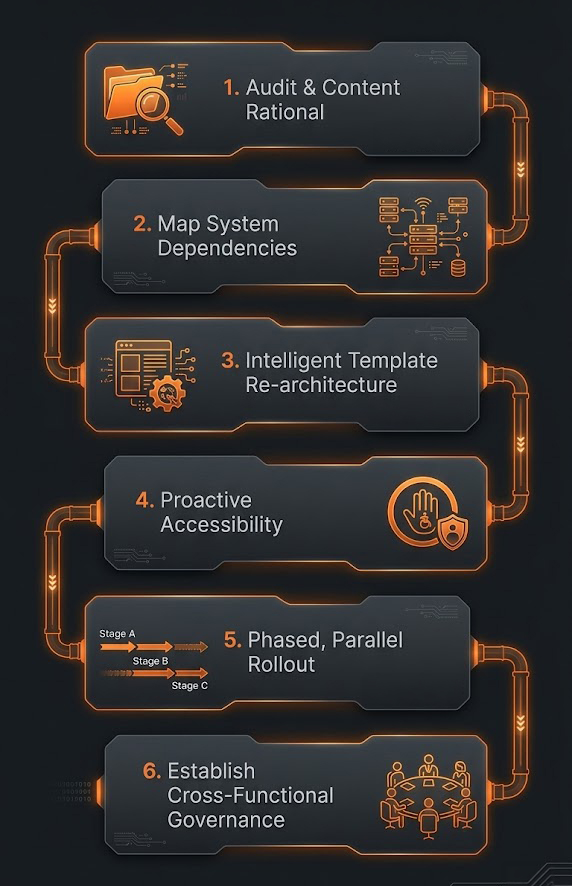
Step 1: Execute a Content Audit and Rationalization Strategy
The most critical issue with any technology modernization initiative is considering data migration as a straightforward “lift-and-shift” process. Legacy CCM instances end up with lots of digital junk after 10, 20 years of operation. Thousands of templates, variants and localized one-offs are easily out of date and stored in organizations routinely.
Before transferring the single bit of information, approach your migration as if you were doing a deep clean. Review all your communication products and ask yourself the question, do this template(s) support our business goals and our customer experience strategy?
- Find Active Assets: Discover the key communications driving your business forward, for example the main onboarding sequence, transactional invoices or the vital notices.
- Consolidate and De-duplicate: Search for very similar templates produced by various departments for nearly identical geographical areas. Compose them into one master template that is dynamic.
- Remove the Rot: Remove workflows that are broken, outdated templates, and messaging that no longer meets brand standards.
By compressing your template volume at the source, your migration roadmap becomes radically simplified, installation expenses are decreased, and you’ll avoid moving old template construction mistakes to an unblemished new system.
Step 2: Map Upstream and Downstream System Dependencies
Customer communications are not in isolation. Your legacy CCM software is probably embedded in core enterprise applications such as relational databases, mainframes, claims processing applications and CCM CRMs and ERPs.
Technical documentation is only a partial reflection of your migration—teams develop workarounds over time that you won’t capture if you’re simply documenting the migration in print. When you cut a data connection that you haven’t mapped, or simply dismiss an implicit approval gate, your entire outbound communications system can come to a halt.
Prior to breaking ground, create a comprehensive cross-functional dependency map:
- Trace the Data Lineage: Annotate exactly where the data is coming from (e.g. a CRM field), how it is flowing into the CCM application and where it is pushed out (e.g. archive server or email relay).
- Interview Frontline Teams: Have a conversation with legal, risk, compliance and customer service. Manual validation workflows and compliance sign-offs, which take place just prior to a document going out, are not often illustrated in technical diagrams.
- Determine Delivery Paths: Ensure all of the channels to endpoints (print vendors API, SMS gateway, interactive web portal or mobile app push notification service) are identified.
Step 3: Shift from Static Templates to Intelligent Re-architecture
Moving away from your legacy system presents an opportunity of a lifetime and a generation to redesign the way communications are built. Legacy CCM platforms use a lot of flat, static layout files. If a business rule is updated or a regulatory disclaimer must be updated, the developer will need to manually open hundreds of unique templates and make modifications line by line.
The new CCM designs are based on object-oriented, dynamic document design. Rethink how you built your communications and break up them down into modular elements:
- Centralize Shared Elements: Extract and place elements like headers, footers and brand logos, and legal disclaimers in a separate and centralized content block that is used globally. A disclaimer is easily updated in the central repository, and is propagated automatically to all relevant communications immediately when there are changes.
- Embed Conditional Logic: Personalize with advanced conditional logic engines, injecting variable text, conditional logic and targeted offers based on real-time customer behaviour, tier status and geographical location.
- Take advantage of Automation Tools: Make use of up-to-date migration tools that incorporate Artificial Intelligence (AI), Machine Learning (ME), and Natural Language Processing (NLP). These tools can read legacy print streams and flat files, automatically pull out content and business logic, and move it to clean, reusable components, and save thousands of manual development hours.
Step 4: Prioritize Accessibility and Regulatory Compliance From the Start
Regulatory compliance and digital accessibility are no longer “late stage” checkboxes to check right before go-live in 2026. But, for example, major changes in regulation, such as the recently implemented European Accessibility Act (EAA) stipulate strict digital accessibility requirements in international markets. It is a huge risk for an enterprise to be subject to litigation, large financial penalties and reputational damage if they do not construct compliant communications from the ground up.
Reactive design of accessible customer communications means that you have to pay twice to fix the same system. Create a compliant foundation in the architecture stage:
- Native Accessible Formats: Make sure your new platform is able to natively create accessible formats including fully responsive, screen-reader-friendly HTML outputs and tagged PDF/UA files.
- Audit Trails and Version Control: Ensure automated versioning, internal approval processes with tracking and comprehensive audit trails, complying with rigorous standards in regulated industries such as finance, insurance, and healthcare.
- Built-in Compliance Portals: Give legal and compliance teams a secure space in the new system to review, edit and approve regulatory disclaimers—without coding or tickets from IT.
Step 5: Implement a Phased, Parallel Rollout Strategy
The “Big Bang” approach—where an enterprise attempts to flip a single switch to turn off a legacy platform and activate a new cloud system overnight—is an unnecessarily high-risk venture. It creates intense operational stress, opens the door to catastrophic blind spots, and overwhelms support teams.
A calculated, incremental rollout strategy drastically reduces operational risk. Choose a controlled, low-stakes communication channel, operational team, or document type to serve as your pilot project—such as digital onboarding emails or low-volume monthly statements.
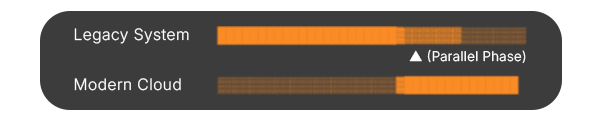
Run your legacy platform and your new cloud-native solution in parallel for a set window. This allows you to rigorously test data integrations, template performance, and output quality against live operational metrics without disrupting the entire business. Gather feedback from this initial phase, optimize your workflows, and systematically scale the rollout across the rest of your enterprise communications.
Step 6: Make Data Migration a Shared, Cross-Functional Effort
A common misconception is that a CCM migration is strictly an IT department problem. When technology transitions are left entirely to technical infrastructure teams, the resulting system may be functionally sound but operationally detached from the business units that rely on it daily.
Customer communication touches every major organ of an enterprise. Therefore, a successful migration requires an integrated, cross-functional steering committee from day one:
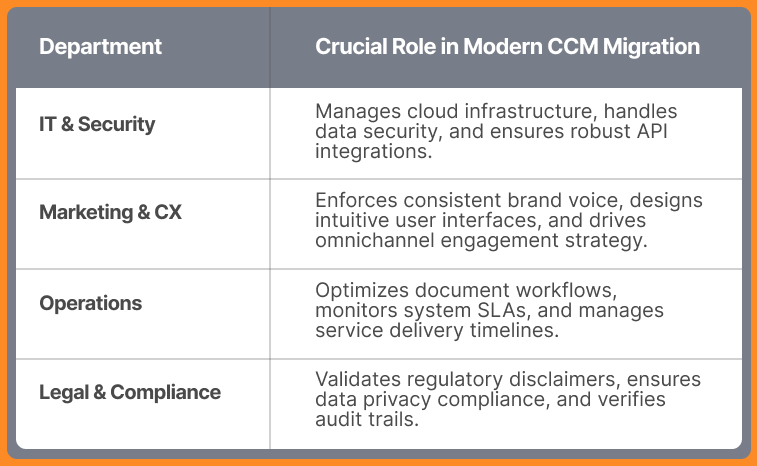
When you bring these diverse voices to the table early, project alignment clicks into place far faster. The final result isn’t just a technical upgrade—it is a powerful, nimble engine that democratizes communication creation, allowing business users to safely author content while IT maintains oversight of the underlying data infrastructure.
Conclusion: The Long-Term ROI of Modernization
It’s no small task to move away from a legacy CCM platform, but to remain tied to legacy, print-centric infrastructure is far more dangerous and expensive. The winners in 2026 will be the enterprises that are able to respond, adapt and communicate in moments, create new digital touchpoints in days not months, and communicate with their customer with relevance and personalisation in real time.
With a content rationalisation strategy based on a thorough approach, dependency mapping, modular template design, native compliance and cross-functional governance, you can remove decades of technical debt from your business. Modern cloud-based customer communications management not only scales effortlessly, but also reduces operational costs and transforms every customer communications touchpoint into a chance to foster meaningful, long-term customer loyalty.
Whitepaper: The AI-Powered CCM Revolution Delivering Hyper-Personalization at Scale
This whitepaper reveals how cutting-edge AI technologies are transforming CCM to deliver hyper-personalization at scale, driving deeper customer engagement, operational efficiency, and measurable business growth.