



Enterprises across the globe are all familiar with technical debt, the expense of keeping outdated code, systems, and workarounds operational when it makes future changes an absolute nightmare. But there is another type of accumulated complexity that can quietly put the brakes on an organization: communication debt.
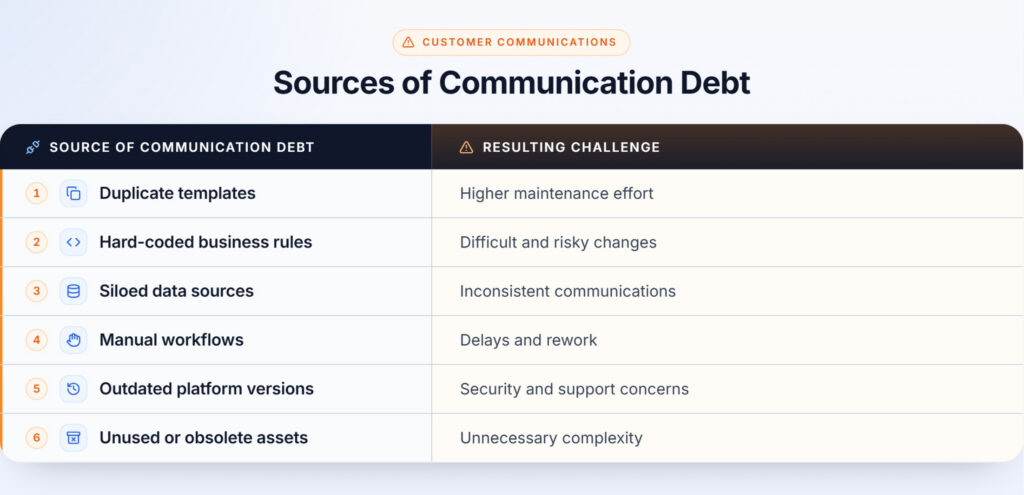
In Customer Communications Management, communication debt can pile up through outdated templates, duplicated assets, poorly organized data, manual processes, embedded business rules, and aging integrations. The systems may still work, but every change becomes an operational liability. And the price you pay for this isn’t just in IT costs either, it’s a loss of business agility.
Deloitte’s 2026 Global Technology Leadership Study estimates that technical debt accounts for 21% to 40% of organizational IT spending, showing just how expensive accumulated technology complexity can become. CCM environments can develop a similar drag when years of communication complexity go unmanaged.
Whitepaper – Beyond Document Generation: Engineering Customer Communications Ecosystem
This whitepaper examines the potential of Customer Communications Management (CCM) to be a high-performance communication ecosystem, instead of merely a collection of documents.
What Is Communication Debt?
Communication debt is the accumulated complexity within an organization’s customer communication ecosystem that makes communications harder to manage, change, and scale. It can include:
- Duplicate or outdated templates
- Hard-coded business logic
- Disconnected data sources
- Manual approvals and production steps
- Legacy platform dependencies
- Unused communication assets
- Inconsistent processes across business units
How Does Communication Debt Accumulate?
Communication debt rarely appears to be one major problem. It builds gradually as organizations make small decisions that seem reasonable at the time.
A new business requirement leads to another template. A regional team creates its own variation. A regulatory update gets hard coded into a document. An old template remains active because no one is certain whether it is still needed.
Over time, those decisions create a much more complicated CCM environment.
How Legacy CCM Turns Small Changes into Big Projects
The real impact of communication debt becomes visible when the business needs to change something. Consider a seemingly simple requirement: update a regulatory disclosure across customer communications.
In a well-governed CCM environment, the organization may update a reusable content component or governed rule, validate the output, and deploy the change.
In a heavily indebted environment, the same request may require teams to identify every affected template, trace dependencies, locate embedded business logic, coordinate with multiple departments, manually make updates, conduct extensive testing, secure approvals, and then manage deployment.
A simple business change has become a technology project. That friction directly affects enterprise agility. Instead of responding quickly to regulatory requirements, product launches, pricing changes, or new customer needs, teams spend valuable time navigating the complexity accumulated inside the communication environment.
This is the same principle behind technical debt: the longer complexity remains unmanaged, the more expensive every future change becomes.
Research from Pega found that 68% of IT decision-makers surveyed said legacy systems and applications were preventing their organizations from fully embracing modern technologies. While the research addresses enterprise technology broadly, the underlying lesson applies to CCM as well: legacy dependencies can constrain the organization’s ability to adopt new capabilities.
The Hidden Business Cost of Communication Debt
Communication debt is easy to classify as an IT problem, but its consequences extend across the business.
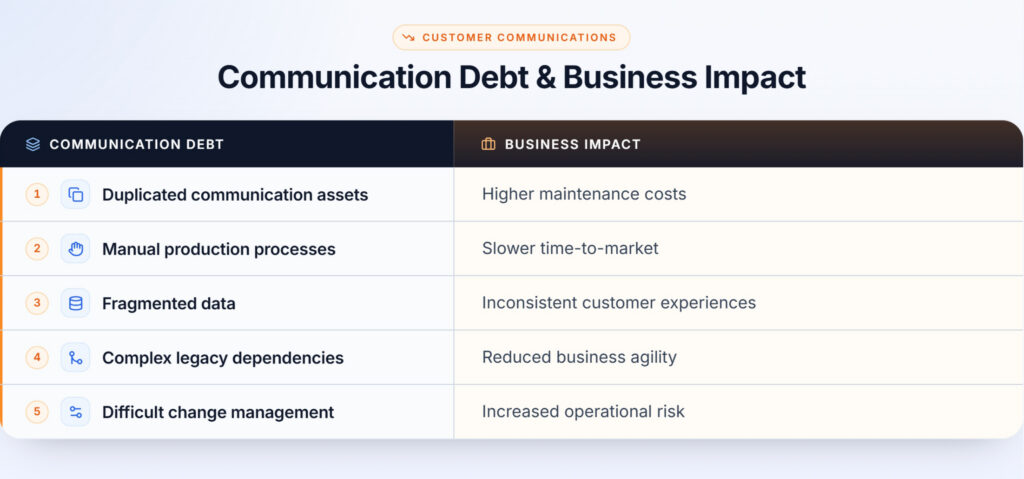
There is also a customer-experience cost. Smart Communications’ 2026 Customer Experience Benchmark found that 63% of consumers would switch providers if communications failed to meet their expectations. This makes the reliability and consistency of communications more than an operational concern. For enterprises, communication quality can influence retention and customer trust.
The real cost of communication debt, therefore, is not just what an organization spends maintaining legacy CCM. It is what the accumulated complexity prevents the organization from doing quickly, consistently, and confidently.
How Can Enterprises Pay Down Communication Debt?
Paying down communication debt does not necessarily mean replacing everything at once. In fact, modernization is more effective when organizations first understand what they have and determine what still delivers value.
A practical approach starts with four steps:
Inventory: Identify templates, workflows, integrations, data sources, and business rules across the CCM environment.
Rationalize: Retire obsolete assets, consolidate duplicates, and eliminate unnecessary complexity before modernization.
Modernize: Redesign valuable communications and workflows for modern CCM platforms and digital channels rather than blindly replicating legacy structures.
Govern: Establish standards for template ownership, content reuse, approvals, updates, and retirement so communication debt does not accumulate again.
Innovatix’s CCM modernization services follow this broader philosophy, combining workflow enhancement, inventory rationalization, platform modernization, and migration to help reduce communication debt and improve operational agility.
Whitepaper – Beyond Document Generation: Engineering Customer Communications Ecosystem
This whitepaper examines the potential of Customer Communications Management (CCM) to be a high-performance communication ecosystem, instead of merely a collection of documents.