


In an era defined by rapid digital transformation, enterprises find themselves managing millions of customer touchpoints across a fragmented web of channels—from traditional print statements to real-time SMS alerts, interactive web portals, and mobile application notifications. Upgrading the underlying infrastructure behind these communications through a Customer Communications Management (CCM) migration is no longer just an IT project; it is a critical business imperative.
But, with organizations scaling their migrations to include vast template libraries and billions of operational data points, a dangerous trend starts to become apparent: the “lift-and-shift” trap. Companies, in trying to beat the migration deadline, tend to see communications merely as code segments, totally discarding the tone of a brand that is personalized, compliant and empathetic, which is what customers expect.
A migration of CCM is a process that demands a fine balance. Your automated, high-volume communications must not sacrifice the customer experience and you need to use industrial-strength automation to deal with the complexity of data.
Whitepaper: The AI-Powered CCM Revolution Delivering Hyper-Personalization at Scale
This whitepaper reveals how cutting-edge AI technologies are transforming CCM to deliver hyper-personalization at scale, driving deeper customer engagement, operational efficiency, and measurable business growth.
The Core Challenge: Why Scale Threatens the Human Experience
The number of assets to be migrated from a legacy to a new environment can be overwhelming for a large financial institution, insurer or utility company. It is not unusual to find thousands of “legacy” templates, many years of accumulated business logic, and very non-optimal data mappings.
Without a deliberate, human-centric migration strategy, massive automation projects introduce several points of failure:
- Sterile Communication Blocks: Over-rationalizing content to fit universal templates can wash out conditional paragraphs meant to provide localized clarity or empathetic phrasing during sensitive events (e.g., claims processing or debt collections).
- Contextual Disconnects: Automated translation or layout formatting tools can inadvertently shift vital disclosures or branding elements, leading to a confusing user experience.
- Operational Bottlenecks: If business users and customer experience (CX) designers cannot easily manage or tweak templates after the migration without relying on IT, the agility of your customer communication stalls.
Scalability without compromising on your customer experience objectives requires enterprise class CCM software that can connect technical performance with easy-to-use, intuitive human design.
The Industry Benchmarks: Quadient and OpenText
When evaluating the global landscape of enterprise-grade CCM solutions, two platforms consistently lead the industry in their ability to manage complex migrations at scale while preserving high-tier customer experiences: Quadient Inspire and OpenText Exstream.
1. Quadient Inspire: Agility and Journey-Centric Delivery
Quadient Inspire is a business-user empowering, digital channel agile and fast centralized CCM hub. In all major industries it’s known for eroding the IT bottleneck, enabling content authors, who are not technically skilled, to safely manage and update templates within a controlled environment.
- InspireXpress: This migration accelerator leverages artificial intelligence (AI), machine learning (ML), and natural language processing (NLP) to understand, extract, and re-create legacy templates from legacy platforms. According to Quadient, its structured approach can shorten the analysis time considerably and can even help in reducing the overall migration timelines by up to 50%.
- Integrated Journey Mapping: Quadient natively integrates communication templates with the interactive customer journey maps. This way, an employee can view the effect of a physical letter or email on a particular stage of the customer journey, and the human element will always be kept in mind when designing templates.
2. OpenText Exstream: Robust Governance and Enterprise Scale
OpenText Exstream is a highly reliable engine for organizations with complex data environments, large volumes of data to be processed in batch and robustness requirements for regulatory compliance. It is very good at converting high volume transactional data and transforming it into structured, omnichannel, guaranteed communications.
- Architectural Rigor: OpenText Exstream is designed to “fit in” with current enterprise architecture and seamlessly connect with enterprise systems, including built-in integration with Document Management Systems (DMS) and Enterprise Content Management (ECM) architectures, such as InfoArchive – the long-term records governance solution.
- Core Core Ecosystem Connectors: It includes integration accelerators for specific use cases in various verticals (Guidewire, Duck Creek in the insurance world, for example) to reduce the risk of data mapping failures when migrating transactional communications.
Comparing the Two Powerhouses
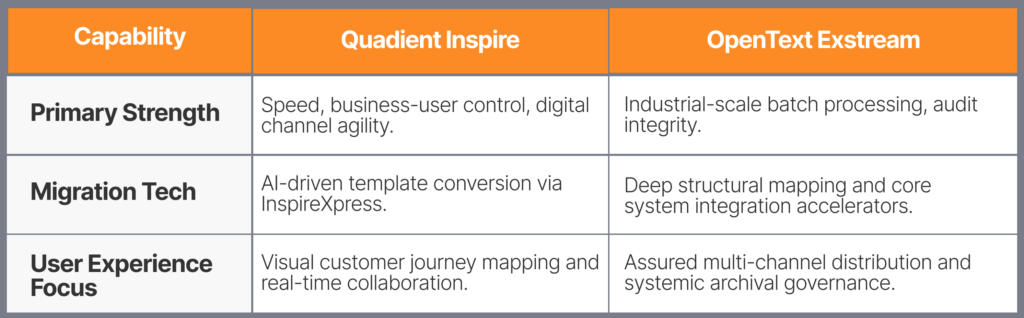
Both systems demonstrate that enterprise-sized migrations don’t have to be devoid of personalization or flexibility. It depends on your current infrastructure, your in-house staffing structure and your long term omni-channel delivery aspirations.
A Four-Step Framework for a Human-Centric Migration
The best way to roll out a CCM migration at enterprise level, but still maintain contact with the end user is to adopt a blueprint with a structured and phased approach.
Step 1: Intelligent Inventory and Consolidation
here’s a critical need to conduct a thorough review of your communication ecosystem before you begin any file transfers. Legacy systems tend to have unnecessary, obsolete, and insignificant templates. With the discovery capabilities in state-of-the-art platforms, you can cluster similar communications families, identify duplicate blocks of content and remove obsolete variations. This unification reduces the amount of your template library and thus manual review time later on.
Step 2: Establish the Customer Journey Baseline
Track all communication to the corresponding customer touchpoint. A billing statement isn’t only an accounting record, it’s a brand interaction. Pose questions: Are there clear next steps outlined in this notice? Do they have a reassuring tone in an emergency claim? Your migration team will be able to focus on readability of your layouts and maintain your clarity of call to action by having these benchmarks in place at the start.
Step 3: Phased Migration by Document Family
Don’t use a big-bang cutover (BBCO) that will jeopardize regulated, high-volume transactions. Rather, plan the migration in a controlled manner using document families. Test with low-risk, high-volume templates to verify data pipelines and integration points. After your automated systems hit the necessary operations benchmarks, shift to the more complex highly-regulated documents.
Step 4: Parallel Validation and Visual Quality Assurance
Automated migrations have a good chance of migrating raw fields accurately, but they can disrupt text wraps, tables, or even go so far as to cut off critical disclosures. Implement strict parallel processing. Simultaneously run both your legacy and target systems and compare results down to the pixel level for layout consistency, language accuracy and compliance visibility across all channels.
Why the Right Partner Makes the Difference
The hands that direct the tool are as powerful as the tool. Quadient and OpenText offer the world-class features that are required to change the way your customers work, but to get it right for the end-user on a large scale takes deep domain knowledge, understanding of existing legacy data models, and a commitment to delivering a great user experience.
An in-house migration effort, particularly for enterprise-level migrations, can result in long migration projects, budget deficits and disjointed lines of communication with customers as a result of the lack of certified and specialized engineering resources. To steer clear of these pitfalls, business seek to trusted systems integrators who understand the ways to harmonize modern code with human-centric communication layout.
Conclusion
In order to scale the enterprise CCM migration, one has to go beyond simple data ingestion and template translation. The real modernization is about creating a communication ecosystem that is agile and end consumer friendly. Organizations can trust their data workflows with industry-leading software solutions such as Quadient and OpenText, enabling multi-channel deployment and endowing business users with the power to maintain clear, modern and personal content.
Innovatix Technology Partners is the best Quadient and OpenText implementation partner for CCM services to achieve such complex modernizations successfully. With decades of collective expertise in legacy modernization, workflow automation, and intelligent content governance, Innovatix guarantees your enterprise can expand its communication infrastructure seamlessly, securely, and effectively — while maintaining the human element at the core of your brand.
Whitepaper: The AI-Powered CCM Revolution Delivering Hyper-Personalization at Scale
This whitepaper reveals how cutting-edge AI technologies are transforming CCM to deliver hyper-personalization at scale, driving deeper customer engagement, operational efficiency, and measurable business growth.