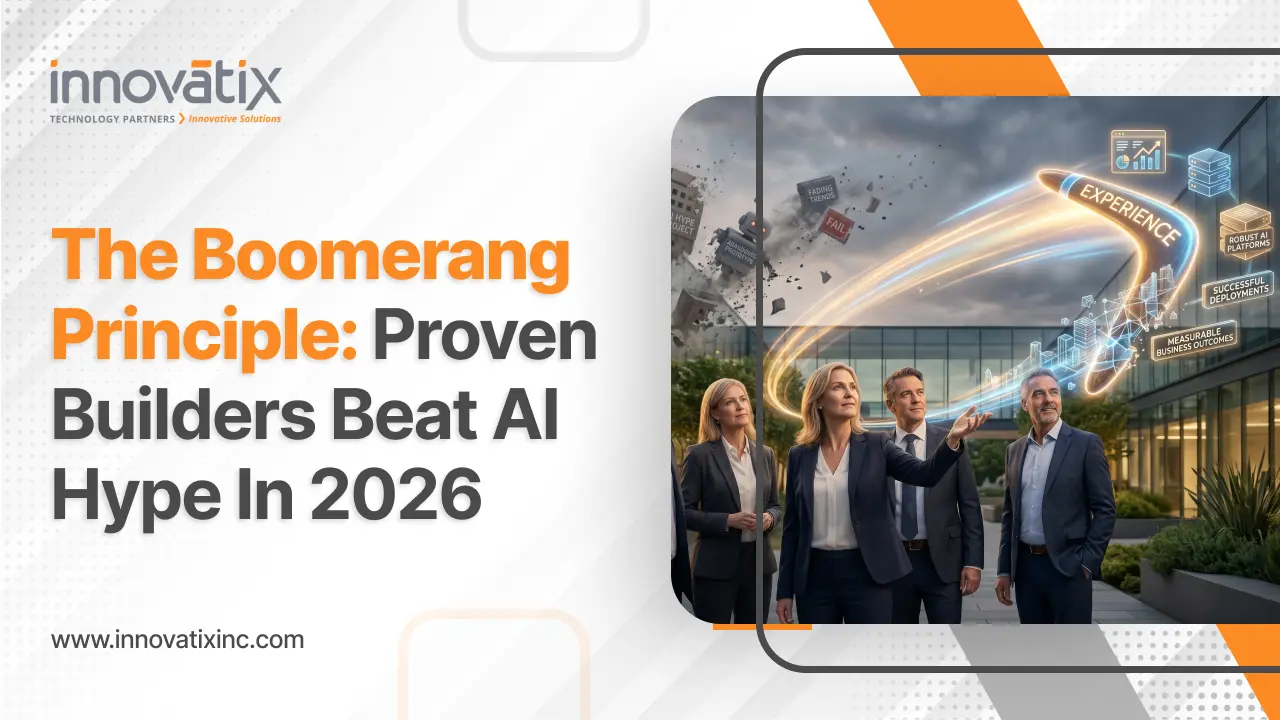
The Boomerang Principle: Proven Builders Beat AI Hype in 2026

A recent Forbes column on “Boomerang” hiring just made the strongest case I’ve witnessed for how Enterprises should actually invest in technology. Bryan Robinson in his recent article for Forbes argues that in 2026, the best career strategy is not to move onto the next big thing as it’s like a Boomerang: going back to a company you already know. The reasoning behind the statement is not very difficult to follow. In a competitive market, it is not the novel approach that prevails but rather the talent and the knowledge. The condemnation of: Going Backwards has faded over the years and the numbers also support this: Boomerang workers accounted for an estimated 35% of the hires in early 2025 compared to 31% in 2024. Companies are more likely to value stability over the excitement of a new and unknown experience. Reading that column as a technology leader, a different lesson takes the center stage. As hiring a boomerang is a smart strategy, the same principle is applicable to organizations adopting AI. We have been programmed to think that it is pragmatic to always go forward: the latest iteration, the buzziest framework, the startup initiated last quarter. However, the smartest move is to invest in “the Builders who already know the core issue and are quietly working to solve it.” Whitepaper—Agentic ROI: Moving from Time Saved to Direct Revenue Outcomes in 2026 This whitepaper explores the 2026 strategic shift from using AI for mere time-saving efficiency to leveraging autonomous Agentic AI for driving direct, measurable revenue outcomes. Download Whitepaper The Cost of Chasing “The New” The data demonstrates that hype chasing AI has proved counterproductive and the results are frightening. According to a report published by MIT, $30-40 Billion is the estimated expenditure on Generative AI in the enterprise and 95%of the organizations haven’t reported any measurable return while only about 5% of the pilots reported P&L impact. The RAND Corporation analysis estimates that the overall rate of failure of the broader AI project is more than 80% which is twice that of any non-AI technology project. S&P Global reported that a staggering 42% of the companies gave up most of their AI initiatives which is a dramatic increase from 17% in 2025. More than 40% of the “Agentic AI” projects will be scraped before the end of 2027 due to the rising cost as opposed to unclear value delivered, Gartner has forecasted. The lesson for executives is to learn that it is not the model that fails but the surrounding and environment (data readiness, integration of workflows, security controls, and not having clear business outcomes). That is the mundane engineering and domain knowledge that is glossed over by the hype. The end result is a slippery slope: a new pilot, a new press release, a new budget for the same foundations 6 months later. The Reality of Boomerang Hiring Map Robinson’s argument to the technology-buying decision making and it is perfectly applicable. No “New Hire Fog”: Your partner starts assisting you by delivering value from day one with his prior knowledge of your systems, your data, your workflows and your constraints. No discovery tax or time wastage in KT while the cool guy is finding out what you do! Low Ramp Cost – Fast Value: As businesses bring back the boomerang employees to rapidly onboard them and saving money on hiring, the seasoned technology partner does not charge you to learn your environment again. The knowledge of the institution is already paid for. Institutional Knowledge plus exposure beats Novelty: That’s the core of Robinson’s argument and the core issue of AI-related strategic decision making as well. The perfect boomerang worker explored the world and ended up with you in an enhanced capacity. Similarly, the technology partner has tackled real and complex problems and has integrated AI Technology into their process. Modernized base, enhanced firepower. Stability over Churn: The top AI Startups list might not be the same in 18 months. Funding rounds and layoff fatigue is real. It is a gamble resting your annual roadmap on novelty, a gamble you can’t control. As shown by the MIT’s own research, collaboration with pros worked better than “build it because it is cool” projects. A proven beat beats the new rhythm as confirmed by the research. AI is not a Trophy; It is a Tool. Quality of the model is not what distinguishes the 5% from the 95% but the approach. The winning AI Solutions tackle a specific and measurable issue and does the mundane task of integration so it works. Let’s take an example of a big insurance company that has been testing the variety of GenAI pilots for searching through the customer documents and analyzing the claims for more than a year. For instance, another large insurance company piloted several use cases like document search and claim analysis for customers spanning over more than a year. Both pilots are commended for their model-building skills but neither could be deployed to production due to the lack of integrated document repositories, workflows and compliance controls. Each of these pilots has impeccable models but they could not get to production because the underlying document repositories, workflow integrations and the compliance matrix is scattered across multiple departments. Rather than embarking on yet another standalone experiment, the companies instead worked with an experienced technology partner specializing in modernization that has experience with enterprise document ecosystems and operational workflows. And this partner adopted AI as a natural extension of its current workflow, instead of developing a brand-new document management system. This pragmatic endeavor not only saved the manual time needed for document review but also escalated information retrieval and brought AI from the “pilot” to “production” stage in fewer than previously estimated months. That’s where a firm like Innovatix Technology Partners becomes a part of the discussion. Comprising of a seasoned team that has long been known in the industry as Macrosoft, but has been rebranded for Enterprise Solutions in 2025. The team has worked

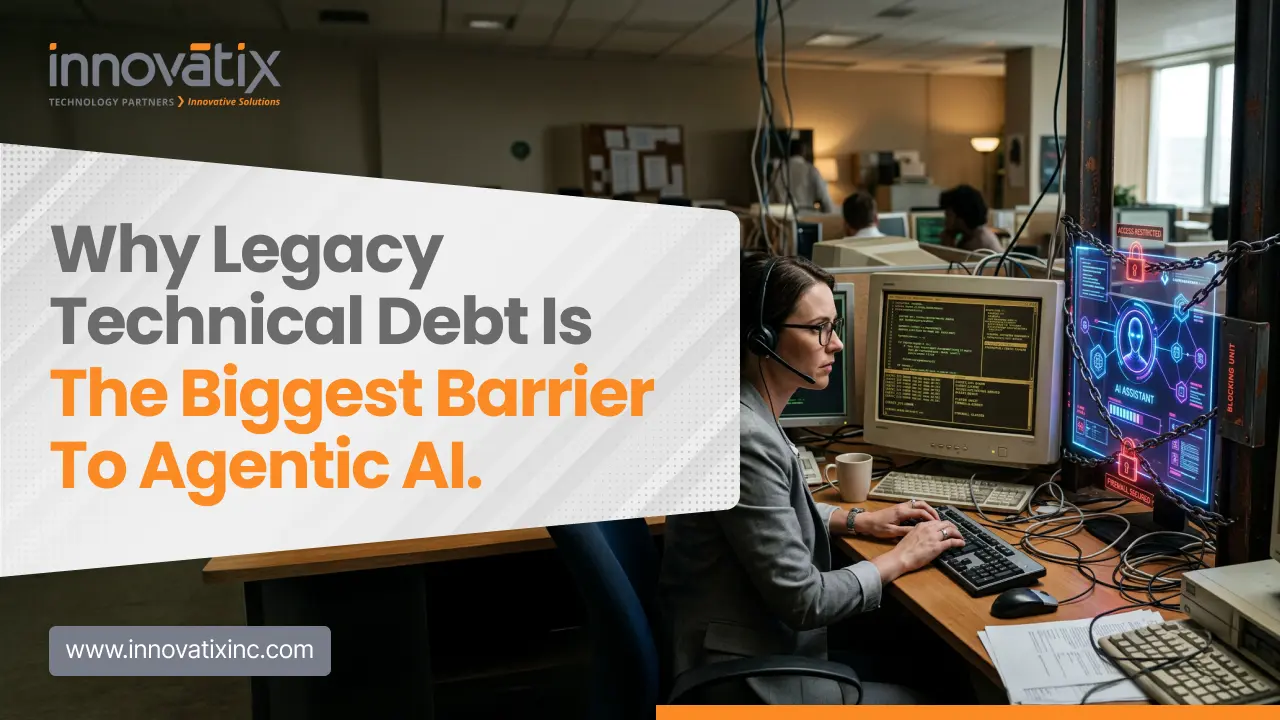
Why Legacy Technical Debt Is the Biggest Barrier to Agentic AI

Agentic AI is revolutionising enterprise operations by shifting from AI assistance to AI action. While traditional AI solutions react to queries, provide recommendations and insights, agentic systems act. They can plan, decide, act and continually refine complex processes with little to no human input, resulting in a new paradigm of business efficiency and agility. This is transforming the work of every function – finance, supply chain, compliance and customer – to name a few. AI is no longer simply assisting decision-making, it is actually taking part in the decision-making and execution, allowing for quicker and more efficient problem-solving and automated, intelligent business operations. But many companies are undertaking this change without realizing one thing. The greatest challenge for Agentic AI is not the technology. It is the underlying software and systems, disjointed processes, poor data quality, obscured and undocumented business rules, and technical debt. Until these are resolved, even the most cutting-edge AI projects can become costly proof-of-concept experiments. The Hidden Cost Most Enterprises Ignore Technical debt usually isn’t obvious at first – it creeps up on you. A hack that speeds the current sprint turns into a burden in the next quarter. An ad-hoc fix becomes next year’s risk. A system that “works” often becomes the obstacle to an AI project going beyond proof-of-concept. This is the reality of legacy technical debt. It usually comprises old systems built on unsupported or obsolete technologies, with business logic hardcoded into applications that are no longer understood, and monolithic designs with limited or no useful API interfaces. It also includes shadow processes powered by spreadsheets, manual escalation steps, point-to-point integration of systems that doesn’t scale, and siloed data with no common definitions or governance. Besides the business process-related inefficiencies, legacy technical debt also poses severe security risks, as legacy systems can often contain vulnerabilities that date back years. Equally important is knowledge loss, where business processes are only understood by long-tenured staff. This type of debt is not felt by most organisations until they embark on a modernization journey. It’s then that it is revealed, and nowhere more so than in AI. Whitepaper—Agentic ROI: Moving from Time Saved to Direct Revenue Outcomes in 2026 This whitepaper explores the 2026 strategic shift from using AI for mere time-saving efficiency to leveraging autonomous Agentic AI for driving direct, measurable revenue outcomes. Download Whitepaper How Agentic AI Is a Whole Other Beast Traditional AI supports decisions. Agentic AI challenges those – and takes action. Let’s look at a typical business use case such as managing stock levels. A traditional AI system may recognise low stock levels and suggest reordering. But an AI agent can do more. It can assess inventory levels, initiate the procurement process, update the enterprise resource planning (ERP) system, alert the finance department, monitor the vendor’s response and automatically escalate any exceptions – all without human intervention. That’s not a chatbot. That’s an independent worker in your organisation. If Agentic AI is to operate safely, accurately and reliably in this way, it needs: Reliable data in real time – not batch exports and inconsistent data from multiple sources Stable integration – not batch jobs, manual processes, or one-offs that are easily tripped up Clear business rules and logic – not complex logic hidden within decades-old COBOL code that no one understands Tightly controlled access – not broad access to poorly managed environments Complete auditability – where every action can be explained and justified to regulators, auditors and business stakeholders Sadly, this is not the case with legacy environments. That’s why delivering an AI agent into an enterprise doesn’t make things more efficient – it makes them worse. Rather than enabling smart automation, it can expose the flaws that are already hidden in it. Legacy systems and AI must work together to enable effective digital transformation. Five Ways Tech Debt Undermines AI Agents 1. Garbage In, Garbage Out: Garbage Autonomy AI agents can only be as good as the data. Traditional environments are often rife with redundancies, inconsistencies, ambiguous product definitions and reporting that uses departmental spreadsheets rather than governed data systems. In conventional analytics, bad data can lead to a flawed dashboard or report. In Agentic AI, the outcome is much worse – it results in bad actions. This might be an erroneous financial transaction, a compliance check that fails, or a mistake made directly to customers, all without human intervention. When AI is making decisions and taking actions, “garbage in, garbage out” could have greater consequences. 2. Systems Aren’t Designed for Real-Time Orchestration Legacy systems are typically built to do batch processing, scheduled exports, and point-to-point scripts, not real-time orchestration. Agentic AI requires rapid, dynamic, and ongoing system communications. It needs systems to interact in real time, rather than on a schedule or via fragile manual processes. When AI agents don’t have consistent access to critical systems, they end up making manual adjustments. These add more instability. The move to reduce operational risk introduces more risk, and creates one of the major challenges of integrating agentic AI with legacy infrastructure. 3. Embedded Business Logic Leads to Governance Gaps Legacy systems such as Visual FoxPro, COBOL, Classic ASP or heavily modified ERP systems hide many critical business rules that have been built up over decades. Often these applications were designed and built by people who are no longer employees of the company. So, nobody understands the decision-making process, or why some rules are still in place. This logic needs to be discovered, documented, validated and governable before an AI agent can take over decision-making. With this lack of insight, AI transformation is a black box layered on top of a black box. That is not modernization. It is innovation with uncontrolled risk. 4. Security Debt Turns into Enterprise-Risk Older systems frequently have inadequate authentication, unpatched security holes and access control based on a world that preceded the cloud, APIs and zero-trust security. Agentic AI needs to access a range of systems. But when this access is combined with poor security, the

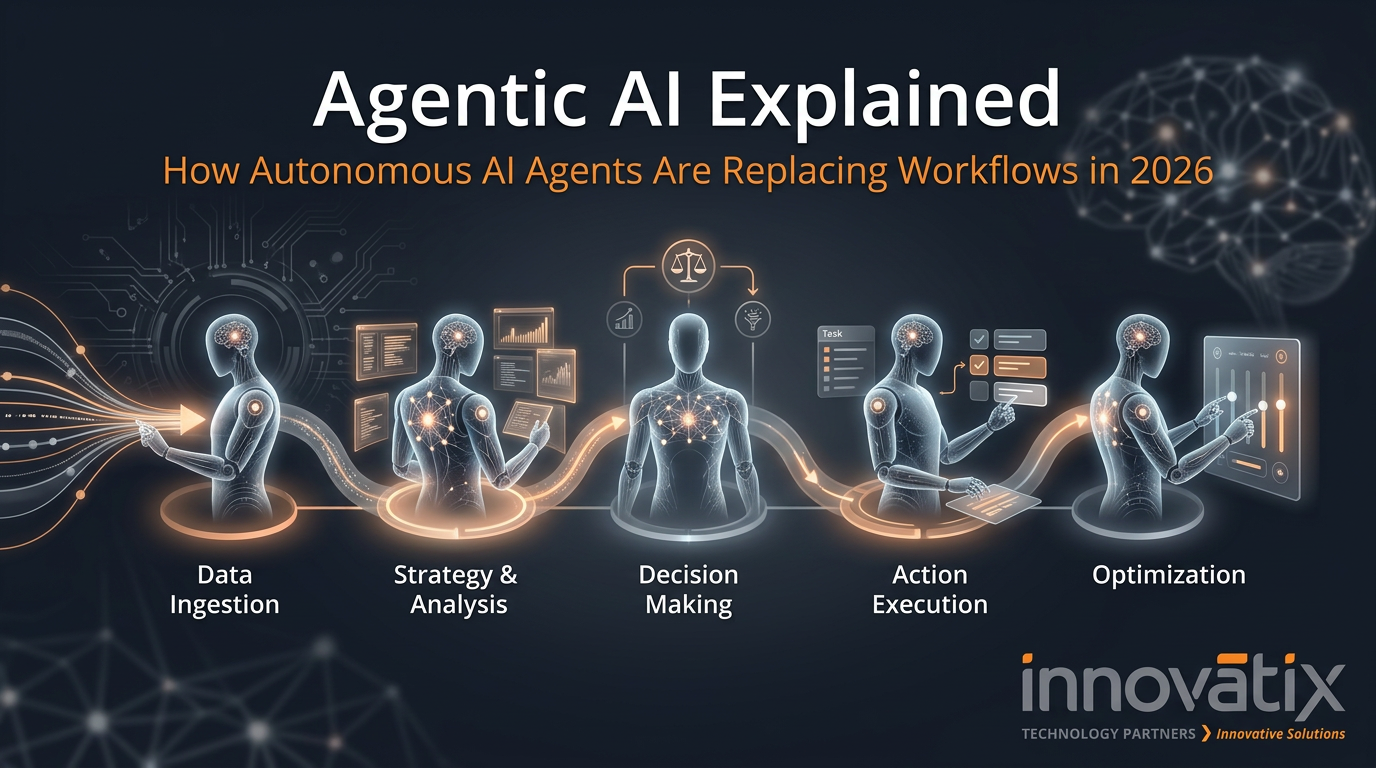
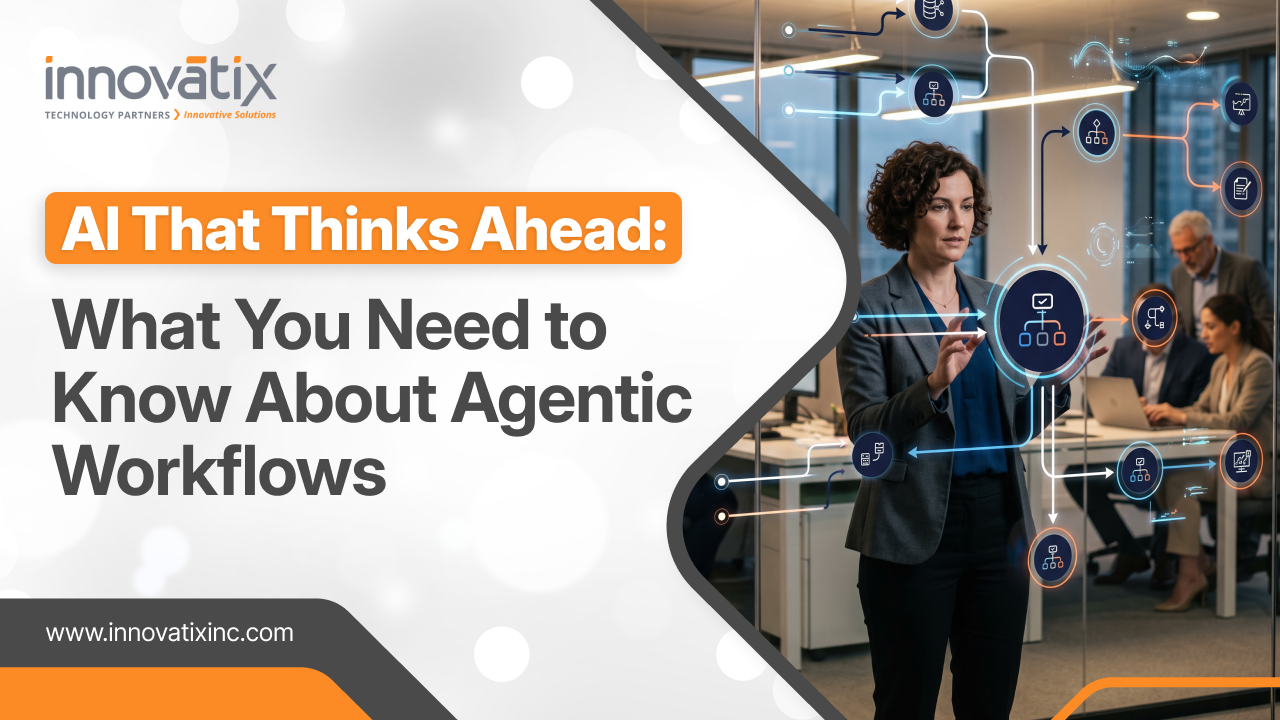
Agentic AI Explained: How Autonomous AI Agents Are Replacing Workflows in 2026?

I will be frank, I have heard enough keynotes and pitches at conferences to understand when a buzzword is nothing more than noise. However, agentic AI is not among them. It is a real one and already transforming the way we do business at Innovatix and how our clients consider going about getting business done. So now that I can separate out the jargon and explain to you what this really means, as a person running a technology company in the middle of it. What Exactly Is Agentic AI? Simply put, agentic AI is the artificial intelligence systems that do not merely answer your question, but takes action on your behalf. Imagine how it feels to ask a colleague to give advice, and giving them a project and telling them to get it done. It is that jump we are discussing. Conventional AI solutions – your chatbots, your copilots – are waiting until called upon. You ask, they answer. The AI as agentic turns that model. You give it an objective, and it plans how to get there, implements, corrects in case of failure, and produces results. It thinks, schemes and takes action. Autonomously. Not without reason, Multiagent Systems was included in the list of Top 10 Strategic Technology Trends of 2026 by Gartner. It is not a future event that we are discussing. Microsoft, Salesforce or ServiceNow are already delivering agentic capabilities into the platforms that millions of businesses use on a daily basis. Whitepaper – Vibe Coding: The Intent-First Development This whitepaper reveals the critical architectural shift from human-managed MLOps to self-evolving Agentic Autonomy, providing a blueprint for systems that move beyond simple assistance to independent, goal-driven action. Download Whitepaper Why This Matters More Than Previous AI Hype I am old enough in technology to recall when digital transformation was the term on all the slide decks. Then it was “cloud-first.” Then “generative AI.” Every wave was accompanied by true value, yet a lot of noise. The difference between agentic AI and other types of AI is that the former strikes at the most costly issue in any business: the workflow. All companies operate on workflows, approvals, escalations, data handoffs, compliance checks, onboarding sequences. A combination of email, spreadsheets, and a person with a feel in how things work holds most of them together. Once such an individual goes on vacation, the cycle is disrupted. The agentic AI substitutes that frailty with a robustness. A support ticket can be tracked by an AI agent, categorized, and the information in your CRM is retrieved, a reply is written, and the ticket is sent to the appropriate team, and all without a human touching it. Not because it is operating with a fixed set of script but because it knows where it is going to and it calculates the means by which it can achieve that. The PwC report on AI Predictions 2026 points out that organizations are now leaving the experimentation phase and shifting to the implementation of agentic workflows that can provide quantifiable business benefit. McKinsey refers to it as an inflection point – the point at which AI becomes more of an assistant than an actual partner.   What We’re Seeing on the Ground We have begun to apply agentic patterns to client projects in Innovatix Technology Partners, and the outcomes are impressive. An insurance client that had been receiving four handoffs in three departments as part of their claims intake process managed to have a single automated pipeline. The agents process document extraction, policy validation and routing. The humankind only interferes in edge cases and final approvals. Not science fiction. It is a production deployment, which is currently in operation. This is also occurring in the sphere of IT operations. Agentic AI can independently close common service desk tickets, fix issues, and even optimize infrastructure, which previously consumed hours of expert engineering time. As an example, Moveworks documents that companies with agentic IT support are solving problems within seconds, as opposed to days. The Human-in-the-Loop Still Matters I would like to be explicit on something: I am not referring to people replacement. I’m talking about freeing them. The most successful ones we have witnessed have humans in the loop to provide oversight, judgment and strategy- the things that human beings are good at. The agents are in charge of the monotonous, rule-laden implementation that wears people down. Recently, Axios outlined the concept of the human in the loop as one of the principles of responsible AI use in 2026, and I fully concur. The businesses that will succeed with agentic AI are the ones that leverage it to make their humans more productive, rather than the ones that leverage it to reduce the number of people and cross their fingers. What Should You Do About It? When you are a business leader reading this, this is my personal advice. Begin by determining the organizational workflows that are high volume, rule-based, and with many systems. And there are your golden parachutes. There is no need to revolutionize everything in one go, select one process, pilot it, measure the outcome, and build on it. The technology is sufficiently developed to implement today. The question is not, is agentic AI working? Whether you will adopt it earlier than your competitors. That’s what we are talking to our clients about at this point and I would be pleased to talk to you as well. Whitepaper – Vibe Coding: The Intent-First Development This whitepaper reveals the critical architectural shift from human-managed MLOps to self-evolving Agentic Autonomy, providing a blueprint for systems that move beyond simple assistance to independent, goal-driven action. Download Whitepaper

Allen Shapiro January 23, 2026 No Comments

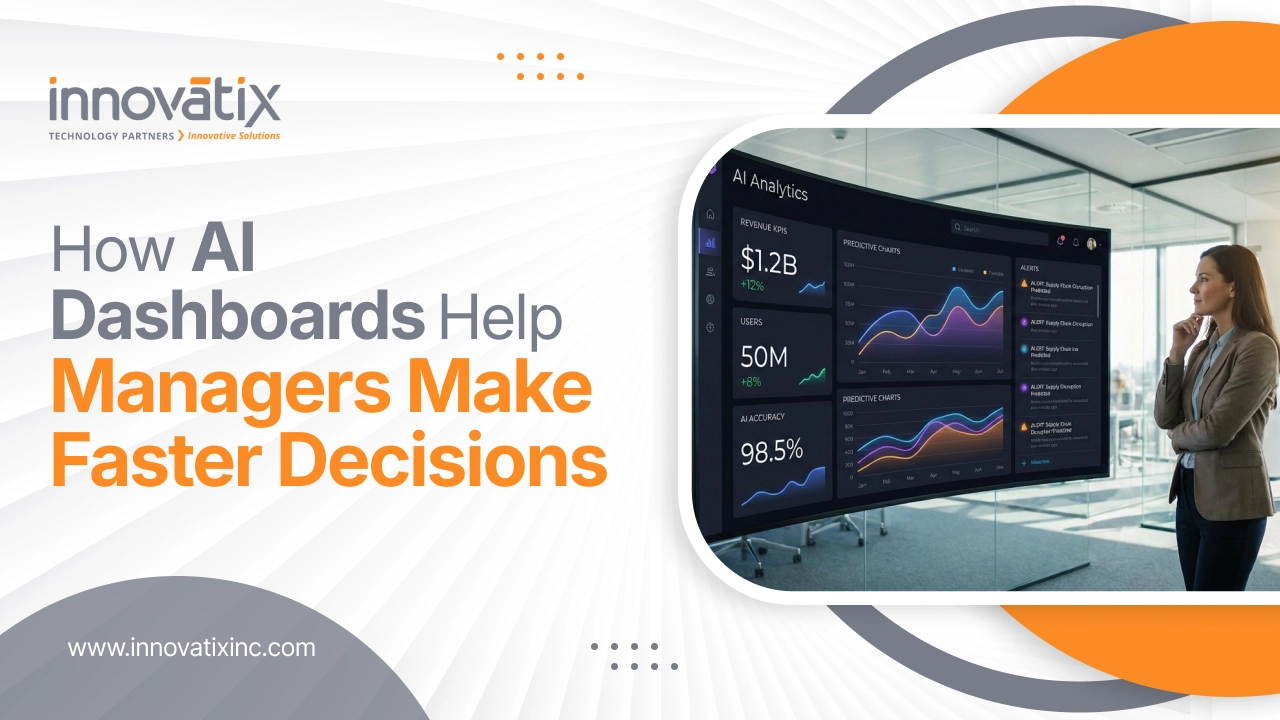
How AI Dashboards Help Managers Make Faster Decisions

Dashboards have become the control centre for modern managers in the era of data-driven leadership. When such dashboards are driven by artificial intelligence, the distinction between slow and deliberate and fast, confident decision-making can be a few minutes, or even a few seconds long. 1. The AI Dashboard, So What? A conventional dashboard displays pre-fetched measurements in graphs, tables, and gauges. An AI-powered dashboard lays over visualization machine-learning models, natural-language processing, and automatic insight generation. The outcome is a system that does not just indicate what has already happened, but why and what might happen next. Key AI Capabilities and Their Value Predictive Analytics What it does: Forecasts future trends such as sales performance or customer churn. Manager benefit: Enables proactive planning instead of reactive decision-making. Natural Language Generation (NLG) What it does: Automatically produces narrative summaries and explanations. Manager benefit: Saves time on report creation and improves clarity for non-technical stakeholders. Automated Insight Engines What it does: Detects anomalies, outliers, and hidden correlations. Manager benefit: Highlights emerging risks and opportunities without manual analysis. Real-Time Data Streaming What it does: Continuously ingests and analyzes live data. Manager benefit: Enables immediate responses to critical events as they occur. Whitepaper: Transforming the Enterprise Through Intelligent Migration This whitepaper outlines how Innovatix Technology Partners uses a structured migration framework and a proprietary suite of automation tools—such as SpecGenerator and Code Morph—to help enterprises modernize legacy systems into secure, scalable, and cloud-ready architectures. Download Whitepaper 2. Speeding the Decision Loop One of the most significant advantages of AI-powered dashboards is their ability to dramatically compress the decision loop—the time between data generation, insight discovery, and managerial action. By automating analysis and embedding intelligence directly into the visualization layer, AI dashboards enable faster, more informed, and more confident decision-making. 2.1 From Data to Insight in Minutes In traditional reporting environments, data must often be extracted from multiple systems, cleaned, transformed, analyzed, and manually summarized before insights reach decision-makers. This process can take hours or even days, causing insights to arrive too late to influence outcomes effectively. AI dashboards fundamentally change this dynamic. They continuously ingest data from disparate sources, apply machine-learning models in real time, and surface insights the moment patterns emerge. Instead of waiting for scheduled reports, managers receive up-to-date intelligence whenever they access the dashboard. Research from Forrester Wave™ 2 (2023) highlights the impact of this shift: organizations that implemented AI-driven dashboards reduced their time to insight from an average of eight hours to less than 30 minutes—representing a 75 percent reduction. This acceleration allows leaders to respond to market shifts, operational disruptions, and customer behavior changes while they are still unfolding. Beyond speed, this immediacy enhances decision quality by ensuring that actions are based on current, relevant data rather than outdated snapshots. 2.2 Rapid What-If Scenario Forecasting AI dashboards also empower managers to explore potential outcomes through interactive what-if scenario analysis. By embedding predictive models directly into the dashboard interface, users can test assumptions and simulate decisions without relying on analysts or offline tools. For example, a retail manager can instantly evaluate how a 5 percent price increase might affect revenue, margins, and demand elasticity. Similarly, supply chain leaders can model the impact of delayed shipments, alternative suppliers, or demand spikes in real time. These simulations provide immediate feedback on potential risks and trade-offs. This capability transforms scenario planning from a periodic, resource-intensive exercise into a continuous and exploratory process. Decisions that once required days of analysis and back-and-forth communication can now be evaluated in minutes, enabling faster experimentation and more agile strategy execution. 2.3 Contextual Recommendations and Intelligent Alerts In addition to generating insights on demand, AI dashboards proactively guide managerial attention through contextual recommendations and intelligent alerts. AI engines continuously monitor key performance indicators, behavioral patterns, and historical baselines to detect anomalies or emerging risks. When predefined thresholds are breached—or when unexpected correlations appear—the system automatically notifies relevant stakeholders. These alerts are not limited to static rule-based triggers; they often include contextual explanations and suggested actions, helping managers understand not only what is happening, but why it matters. According to Gartner projections, by 2025, 75 percent of executive dashboards will incorporate AI-based alerting capabilities to support real-time risk mitigation. This shift reflects a growing need for systems that prioritize attention and reduce cognitive overload, allowing leaders to focus on the most critical issues at the right moment. By combining real-time monitoring with intelligent recommendations, AI dashboards move decision-making from a reactive posture to a proactive one—enabling managers to intervene earlier, reduce uncertainty, and maintain operational control. 3. Accuracy & Confidence Boost Beyond speed, AI-powered dashboards significantly enhance the accuracy and reliability of managerial decisions. By reducing human bias and automating insight discovery, these systems help leaders act with greater confidence and consistency. 3.1 Reducing Human Error and Bias Human interpretation of data is inherently susceptible to cognitive bias, fatigue, and oversight—particularly when datasets are large or complex. AI dashboards mitigate these risks by applying consistent, algorithmic reasoning across all data points, ensuring that patterns and anomalies are evaluated objectively. According to a McKinsey Global Institute (2023) study, organizations that adopted AI-assisted, data-driven decision-making improved analytical accuracy by an average of 10 to 25 percent compared with human-only analysis. This increase in precision translates directly into better forecasts, fewer costly mistakes, and stronger confidence in strategic choices. 3.2 Automated Insight Generation AI dashboards also remove the need for managers to manually search for hidden relationships within data. Model-driven insight engines continuously analyze incoming information and automatically surface meaningful correlations, trends, and anomalies as they emerge. As a result, insights are delivered proactively rather than discovered reactively. In practice, platforms such as Salesforce Einstein Analytics report that AI-generated insights have reduced the time sales teams spend on analysis by up to 30 percent. This allows managers to focus less on data exploration and more on decision-making and execution. 4. Examples of AI Dashboard Tools and Their Business Impact Leading analytics platforms have embedded artificial intelligence directly into their dashboards, enabling organizations

James Anderson January 16, 2026 No Comments

Why LLM Ingestion is the Key to Success in GEO Efforts in 2026

If you are reading this, you’ve likely survived the great SEO upheaval of 2024-2025. We all watched “10 blue links” slowly faded into the background, replaced by direct, conversational answers from AI. Today, in 2026, the battleground isn’t just about ranking on the first page of Google; it’s about being the answer delivered by the AI and the citations. Welcome to the era of Generative Engine Optimization (GEO). And if you want to win in this new landscape, you need to master one critical concept: LLM Ingestion. What is LLM Ingestion? In the early days of search, we waited for spiders to crawl our sites. We hoped they would parse our HTML correctly and index our keywords. LLM Ingestion is the evolution of that process, but it is far more active and structured. It refers to the strategic process of formatting, structuring, and delivering your content so that it is easily consumed (“ingested”) by Large Language Models (LLMs) like GPT-6, Claude, and Gemini. It isn’t just about having text on a page. It’s about data accessibility. In 2026, this often involves using standards like the IAB Tech Lab’s LLM Content Ingest API, which allows brands and publishers to directly feed high-quality, attributed content to model providers. It’s the difference between hoping an AI reads your book and handing the AI a structured summary of the plot, characters, and key themes. When we talk about ingestion, we are talking about two distinct pathways: Training Data Ingestion: Getting your content into the foundational training sets of the next model iteration. This is the long game. RAG (Retrieval-Augmented Generation) Accessibility: Ensuring your content is retrievable in real-time when an AI queries its live database to answer a user’s question. To dominate the IT landscape in 2026, stop thinking of AI as a search engine and start viewing it as a digital pre-sales consultant. Whitepaper: Do You Need Automation or AI? A Practical Guide to Smarter Workflows This whitepaper is a practical guide to help you determine whether your business challenges require straightforward automation or genuine artificial intelligence—and how to strategically implement the right solution for smarter, more effective workflows. Download Whitepaper Here is how these two ingestion pathways apply when selling complex tech solutions:   1. Training Data Ingestion (The “Category Definition”) Think of this as Thought Leadership & Market Positioning. This is the “long game” of teaching the foundational models (GPT-6, Gemini) how to think about your industry. When the model is being trained on millions of whitepapers and tech blogs, you want it to learn your methodology as the standard. The B2B Goal: When a CTO asks for a high-level strategy, the AI should explain the concept using your framework and language. The Tactic: Publish “Definitive Guides” and long-form technical reports. These act as textbooks for the AI, embedding your brand into its core intuition.   2. RAG Accessibility (The “Technical Validation”) Think of this as Documentation & Spec-Sheet Accuracy. This is the “open-book exam.” When a developer asks specific questions like “Does this API support GraphQL?” or “What is the SLA?”, the AI cannot rely on memory; it retrieves this info from your site in real-time. The B2B Goal: Elimination of hallucinations. You need the AI to quote your current specs and compliance data (e.g., SOC2 status), not outdated info. The Tactic: Treat your documentation as a marketing asset. Use clean semantic HTML and schema markup so the AI can instantly parse and serve your technical specs without error.   Which one to pick in 2026? The answer is both. They are mutually exclusive, yet having only one won’t serve the purpose. So I suggest a hybrid approach. Training Data is the Consultant’s Expertise: They recommend you because they studied your success stories in school (the AI “knows” you are a leader). RAG is the Consultant checking the Spec Sheet: They verify your specific feature set by looking up your live documentation during the meeting.   Why GEO is Equally Important as SEO in 2026 You might be asking, “Is SEO Irrelevant?” No, but it has changed. Traditional SEO is still vital for navigational queries (e.g., “login to Facebook” or “buy Nike Air Max size 10”). But for informational and commercial investigation queries—the “how,” “why,” and “best X for Y” questions—users are turning to generative engines. AI Mode is being set default by major search engines also, in turn making GEO more relevant and inevitable. In 2026, GEO is the new Share of Voice. If a user asks an AI, “What is the best CRM for a mid-sized dental practice in Germany?”, the AI doesn’t give a list of links. It gives a synthesized answer. If your brand isn’t part of that answer, you don’t exist. Even your current customers think you are not up to the mark. Being invisible to the AI is equivalent to being on Page 5 of the old SERPs. The goal is always to be available for AI to fetch your content and give citation based on your content. SEO gets you the click; GEO gets you the mention. In a world where “zero-click searches” are the norm, that mention is your primary brand touchpoint. AI Search visibility is coming up as the norm to check if your website is visible to the world.   Why Should We Do LLM Ingestion? LLM Ingestion is the most direct lever we have to influence GEO. Here is why it is non-negotiable for your 2026 strategy: 1. Accuracy and Control When an LLM scrapes the open web, it often “hallucinates” or conflates facts. By actively managing LLM ingestion (via APIs or structured data feeds), you provide the canonical truth about your brand and the services you offer. If also often values the feedback of the user to produce better answers, so the right information you are able to give to the LLM via ingestion makes your AI visibility to increase further. You reduce the risk of the AI making up features you don’t have or quoting outdated

Jeen P Xavier November 6, 2025 No Comments

The Evolving Developer Role: From Doing to Directing with AI

The landscape of software development is undergoing a profound transformation, driven by the rapid advancements in Artificial Intelligence. What was once a domain primarily focused on the meticulous craft of writing code line by line is now shifting towards a more strategic, high-level approach. AI is increasingly automating routine coding tasks, ushering in an era where the developer’s role is evolving from “doing the work” to “directing the work.” This paradigm shift empowers developers to focus on innovation, complex problem-solving, and architectural design, leveraging AI as a powerful co-pilot and a tool for efficiency. The Dawn of Automation: AI as a Coding Co-Pilot For decades, software development has been characterized by a significant amount of repetitive and boilerplate coding. From setting up basic project structures to writing standard CRUD (Create, Read, Update, Delete) operations, developers have spent considerable time on tasks that, while essential, often lack creative challenge. Enter AI. Tools like GitHub Copilot and other AI-powered coding assistants are revolutionizing this aspect of development. These intelligent systems can generate code snippets, suggest completions, and even refactor existing code, dramatically accelerating the development process. A recent study highlighted the significant impact of AI on developer productivity, finding that programmers utilizing AI could code an impressive 126% more projects per week. This isn’t about replacing human ingenuity but augmenting it. AI handles the mundane, allowing developers to offload the heavy lifting of routine code generation. This newfound efficiency translates into faster development cycles, quicker prototyping, and the ability to deliver features at an unprecedented pace. Whitepaper: Latest Trends in Web Technologies Our comprehensive whitepaper, “Latest Trends in Web Technologies,” is your essential guide to understanding the cutting-edge innovations transforming how web applications are built and experienced. Download Whitepaper Shifting Focus: From Code Creator to Architectural Visionary With AI taking on the burden of routine coding, the developer’s role is naturally ascending to a higher plane of abstraction. The emphasis is moving away from the granular details of syntax and implementation towards the broader strokes of software architecture, high-level design, and strategic problem-solving. Developers are becoming more akin to architects and orchestrators, guiding AI tools to build robust and scalable systems. This shift demands a different skill set. Instead of being solely proficient in a particular programming language, developers now need to excel in: High-Level Design: Conceptualizing the overall structure of a software system, defining its components, and understanding how they interact. Creativity and Ideation: Brainstorming innovative solutions to complex business problems and envisioning new functionalities. Problem-Solving: Deconstructing intricate challenges and devising elegant, efficient solutions that AI can then help implement. System Integration: Understanding how various AI-generated components and existing systems can be seamlessly integrated. As Ariel Katz, CEO of Sisense, an AI-powered embedded analytics company, notes, “It’s not just about automating tasks; it’s about enabling developers to think and work at a much higher level and focus on the strategic aspects of their projects.” This sentiment underscores the idea that AI is not a threat to developers but an enabler, freeing them to engage in more impactful and intellectually stimulating work. The Rise of “Vibe Coding” and Democratized Development The increasing capabilities of AI are also giving rise to phenomena like “vibe coding,” where developers, and even non-developers, can describe their desired outcomes in natural language, and AI takes the lead on implementation. This democratizes development, making it accessible to a wider audience and allowing individuals with strong domain knowledge but limited coding expertise to contribute to software creation. Furthermore, AI is playing a crucial role in democratizing business analytics integration. By leveraging AI with APIs, developers can embed powerful analytics directly into applications without needing deep expertise in business intelligence, SQL, or data modeling. This fosters a more integrated approach where data insights are a fundamental part of the application experience, leading to more informed decision-making across organizations. Tackling Technical Debt and Enhancing Code Quality Technical debt, the accumulation of suboptimal code that slows down future development, is a persistent challenge in software engineering. AI offers a powerful solution to this problem. By automating code refactoring, identifying and fixing bugs, and suggesting best practices, AI tools can significantly reduce technical debt. This not only improves the maintainability and scalability of software but also frees up developers to work on new features and innovations rather than constantly patching old code. Beyond reducing technical debt, AI also contributes to enhancing overall code quality. AI-powered code review tools can identify potential vulnerabilities, enforce coding standards, and suggest optimizations, leading to more secure, efficient, and reliable software. This proactive approach to quality assurance is a game-changer for development teams. Challenges and the Human Element While the benefits of AI in software development are undeniable, it’s crucial to acknowledge the challenges and the enduring importance of the human element. Some experts caution that an over-reliance on AI could lead to a degradation of fundamental coding skills and a lack of understanding of the underlying technology. This highlights the need for developers to maintain a strong foundational knowledge while embracing AI as a tool. The future of development will undoubtedly involve a strong human-AI collaboration loop. Even in highly automated scenarios, human validation and feedback remain critical. Developers will need to effectively communicate with AI, understand its outputs, and provide the necessary guidance to ensure the generated code aligns with project requirements and ethical considerations. The Anthropic Economic Index research, for instance, found that even in “automation” scenarios with their Claude Code agent, “Feedback Loop” patterns, where human validation is required, were nearly twice as common as on their general Claude.ai platform. Ethical considerations surrounding AI-generated code are also paramount. Questions about ownership, bias, and potential vulnerabilities introduced by AI need to be addressed as these tools become more sophisticated and integrated into critical systems. The Evolving Skillset for the AI-Powered Developer The developer of tomorrow will be a hybrid professional, adept at both traditional programming principles and the art of AI orchestration. Key skills for this evolving role include: Prompt Engineering: The ability to craft effective prompts and instructions

Can We Trust AI? The Fight Against Hallucinations & Bias

Artificial Intelligence (AI) has swiftly moved from science fiction to a core part of our daily lives. From powering search engines to driving cars and diagnosing diseases, AI systems influence decisions that affect millions. Yet, alongside this progress comes a pressing question: Can we trust AI? A major challenge to trust in AI lies in two key issues — hallucinations and bias. In this blog, we’ll dive deep into what these issues are, why they matter, and what is being done to combat them. Understanding Hallucinations in AI What Are AI Hallucinations? In the context of AI, particularly large language models (LLMs) like GPT-4 or Google’s Gemini, a “hallucination” refers to the generation of output that is incorrect, misleading, or made-up. For example, an AI might confidently assert that “Albert Einstein won the Nobel Prize in Chemistry,” when in reality, Einstein won in Physics. These hallucinations can occur in text, images, or even audio generated by AI. Why Do Hallucinations Happen? Risks of Hallucinations The Problem of Bias in AI What Is AI Bias? AI bias occurs when AI systems produce results that are unfairly prejudiced due to underlying prejudices in their training data or design. For example, an image recognition system might misidentify people of certain ethnicities more frequently, or a recruiting AI might favor candidates of a particular gender. Sources of Bias Consequences of AI Bias Combating Hallucinations & Bias: The Ongoing Fight 1. Improving Data Quality 2. Model Evaluation & Testing 3. Human-in-the-loop Systems 4. Algorithmic Improvements 5. Transparency & Accountability The Road Ahead: Responsible AI No AI system is perfect — but perfection isn’t the goal. Rather, the focus must be on responsible development and deployment. This includes: Conclusion So, can we trust AI? The answer is: we can, if we remain vigilant. Trust in AI is not about blind faith, but about ensuring robust safeguards, ongoing scrutiny, and ethical commitment. With every step to minimize hallucinations and bias, we bring AI closer to being a trustworthy partner in shaping our future.  

AI Governance: Frameworks for Responsible Generative AI Deployment

The rapid ascent of Generative Artificial Intelligence (AI) is fundamentally transforming industries—from automating content creation to turbocharging code development, knowledge management, and personalized customer interactions. As adoption soars, the call for robust AI governance and ethical frameworks has never been more urgent. This blog explores the evolving ethical GenAI landscape, best-practice frameworks for responsible generative AI deployment, and how top generative ai companies lead the way in balancing innovation with accountability. The Growth & Governance Imperative According to Gartner, more than 80% of enterprises will have used Generative AI APIs or deployed GenAI-enabled applications by 2026, a dramatic jump from less than 5% in 2023. This surge underlines the growing need for well-structured governance models that address risks like bias, inaccuracies, security breaches, and privacy issues. McKinsey’s latest global survey further reveals that over 75% of organizations now use AI in at least one business function. Yet only 1% of leaders consider their deployments mature—fully integrated, ethical, and delivering substantial business outcomes. The biggest barrier? Lack of clear leadership and robust governance. What is AI Governance? AI governance refers to the guardrails, policies, and processes that ensure AI systems are safe, ethical, transparent, and in compliance with regulatory standards. In the context of generative AI, governance covers not just technical robustness, but also the social and ethical implications of content generation, data privacy, and system usage. Building Blocks: Frameworks for Responsible GenAI To safely realize the productivity, promise of GenAI, organizations must deploy governance frameworks grounded in: ·        Ethical Principles & Transparency ·        Risk Management & Compliance ·        Stakeholder Involvement ·        Continuous Monitoring, Audit, and Feedback Loops ·        Employee and Customer Training Lessons from Top Generative AI Companies The top generative ai companies—such as Microsoft, OpenAI, Google, and AWS—have pioneered robust frameworks: The Ethical GenAI Landscape The ethical GenAI landscape is shifting rapidly. Recent research from Stanford HAI’s 2025 AI Index Report shows that nearly 90% of notable AI models now come from industry, not academia. This industry-led innovation makes it even more critical for organizations to adopt rigorous, transparent, and responsible practices. Failure to operationalize ethical AI can lead to project failures, security breaches, and reputational loss—costs that far outweigh the investment in robust governance. Guide to Ethical AI Implementation A practical Guide to Ethical AI Implementation should include: Conclusion As generative artificial intelligence reshapes the digital landscape, organizations must act now—establishing comprehensive governance frameworks for responsible generative ai deployment. By learning from the top generative ai companies and embedding a culture of continuous improvement, transparency, and ethical responsibility, businesses can drive innovation and mitigate risk. Want to learn more about deploying GenAI solutions responsibly? Contact the experts at Innovatix Technology Partners!  

From Prompt Engineering to Fine-Tuning: Mastering LLM Customization

In recent years, Large Language Models (LLMs) like GPT-4, BERT, and others have revolutionized the field of natural language processing (NLP). These models, trained on vast amounts of data, can generate human-like text, perform complex language understanding tasks, and assist in various applications, from chatbots to content creation. However, customization is key to unlocking their full potential in specific domains or tasks. In this blog, we will explore the journey of mastering LLM customization — starting from prompt engineering to advanced fine-tuning techniques. Understanding LLMs: A Quick Primer Before diving into customization, it’s important to grasp what LLMs are. These models are deep neural networks trained on diverse datasets to understand and generate language. They learn patterns, syntax, semantics, and context from data, enabling them to create coherent and contextually relevant text. Yet, the base models are generic. You need customization strategies to make them work optimally for your specific needs—be it legal document summarization, medical diagnosis assistance, or creative writing. Stage 1: Prompt Engineering — The Power of Asking Right Prompt engineering has emerged as the most accessible and immediate way to customize LLMs without altering the model. What is Prompt Engineering? Prompt engineering is the art and science of crafting input prompts that guide the model to produce desired outputs. Since LLMs‘ completions depend heavily on the input prompt, small wording, format, or context changes can significantly impact the results. Techniques and Tips for Effective Prompt Engineering Strengths and Limitations Prompt engineering requires no retraining or additional data and can be quickly iterated. However, it may not always guarantee consistency or perfectly tailored outputs, especially for highly specialized tasks. Stage 2: Few-Shot and Zero-Shot Learning — Teaching Through Examples Few-shot learning extends prompt engineering by giving the model a few examples within the prompt to illustrate the task. Zero-shot learning means the model attempts the task without explicit examples, relying on pre-trained knowledge. Practical Usage Stage 3: Fine-Tuning — Customizing the Core Fine-tuning is necessary for deeper and more reliable customization. It means taking the pre-trained LLM and training it further on a domain-specific or task-specific dataset. Why Fine-Tuning? How Does Fine-Tuning Work? Popular Fine-Tuning Methods Stage 4: Embedding and Retrieval Augmented Generation Another customization technique that is related involves integrating LLMs with external knowledge bases through embeddings and retrieval. This approach combines the generative power of LLMs with real-time knowledge and is useful for up-to-date or proprietary information. Best Practices for Mastering LLM Customization The Future of LLM Customization As LLMs evolve, so do customization techniques. Emerging trends include: Conclusion Mastering LLM customization is a journey from simple prompt crafting to sophisticated fine-tuning. Each stage offers more control, precision, and specialization, enabling businesses and researchers to harness the true potential of these powerful models. Whether you’re a developer, data scientist, or AI enthusiast, understanding and applying these techniques will be your gateway to building intelligent, tailored language applications. Leveraging robust AI platforms like Innovatix’s cutting-edge LLM services can significantly accelerate your journey from prompt engineering to fine-tuning, empowering you to create highly customized and impactful AI solutions. Contact us today!

©2026 Innovatix Technology Partners, a Macrosoft, Inc. Company. All Rights Reserved.