


Over the last couple of years, enterprise AI has traditionally been a reactive, conversational style. Organizations were using Large Language Models (LLMs) to respond to inquiries, summarize long documents or compose regular emails. Although useful, these standard generative systems are basically passive: they depend on human instructions, then perform one step of output, and stop until the next instruction is given.
In today’s scenario, enterprise operations are no more passive AI models, but Agentic Workflows.
Agentic AI is not just about text generation or direct inputs; it’s about operating with goal-oriented autonomy. It analyzes complex objectives, breaks them down into logical steps, chooses the required tools, adapts to unforeseen, real-world factors and continually improves its results. The way agentic workflows work and how to safely architect them, is a critical strategic decision for modern technology leaders.
Whitepaper: The AI-Powered CCM Revolution Delivering Hyper-Personalization at Scale
This whitepaper reveals how cutting-edge AI technologies are transforming CCM to deliver hyper-personalization at scale, driving deeper customer engagement, operational efficiency, and measurable business growth.
What Are Agentic Workflows?
An agentic workflow is fundamentally an architectural pattern that treats an AI model as an autonomous agent that is responsible for accomplishing a particular task. It is not a single prompt and response process but a multi-step, iterative process.
An agentic AI system runs a continuous pipeline of operations when tasked with an objective, such as “Reconcile conflicting vendor invoices across system logs and issue adjustment notices”:
- Planning & Task Decomposition: The agent breaks down the global goal to logical sub-tasks.
- Tool Integration & Action: The system interacts with external tools, through query databases by using APIs, execute scripts or invoke enterprise software systems.
- Observation & Reflection: The agent makes observations about the outcome of its action and the desired end state.
- Iterative Refinement: When a mistake is made or a record is not found, the agent changes its plan and tries again to find another way instead of silently failing or hallucinating an answer.
The Four Pillars of Agentic Design
To upgrade from prompt engineering to real agency, software architects need to base themselves on four fundamental design patterns originally pointed out by AI researcher Andrew Ng:
- Reflection: Agent questions own intermediary work. For example, the model can be used to write a block of code, or to create an inventory report, and then check the output against specific parameters, to look for errors before returning the result.
- Tool Use: It is able to invoke external APIs, run web searches, query SQL databases, or communicate with legacy software systems to obtain real-time data.
- Planning: Agent dynamically generates sub-goal and changes operational sequence according to the contextual feedback in every step of the operational execution.
- Multi-Agent Collaboration: Complex tasks are divided up into specialized AI agents. The first can be an agent that collects data, the second one that checks compliance, and the third that synthesizes data and works managementally, as a digital team solving high-level problems.
Deterministic Automation vs. Probabilistic AI vs. Agentic Architecture
There is a difference between legacy automation, standard AI and agentic workflows, and it’s important for leaders to understand what is what so they can deploy the appropriate technology for the right business problem.
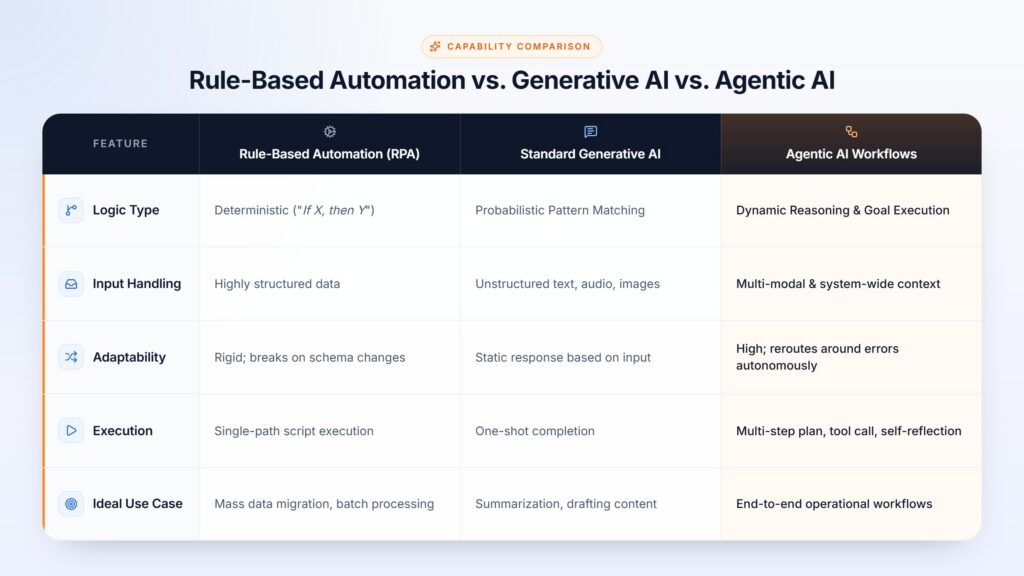
Traditional automation focuses on repetitive, rule-driven tasks, while single-turn generative AI is good for unstructured content creation. Agentic workflows combine these capabilities, leveraging the reasoning of decision making with automated cross-system execution.
Real-World Enterprise Applications
Agentic systems are moving out of research labs and into enterprise environments, driving efficiency across core domains:
1. Automated IT & Software Engineering
A software maintenance agentic workflow might continuously track the telemetry logs in the software, identify a surge in latencies from the database, trace the root cause of the bug to a specific software code commit, write the patch, regress test in a sandbox environment, and submit the patch for human review.
2. Supply Chain & Logistics Optimization
Agentic systems aren’t just an alert in the event of geopolitical conflicts, weather disruptions, or supplier delays. They analyze real-time shipping manifests, calculate alternate shipping routes, compare product levels of all regional warehouses, and create new procurement orders for manager review.
3. Financial Compliance & Customer Operations
Banking agentic workflows automate extensive Anti-Money Laundering (AML) due diligence. Retrieval of transaction records, cross-checking international regulatory watchlists, requesting missing documentation from 3rd party APIs and creating structured compliance audits are all done with an agentic system, which cuts investigation cycle times from days to minutes.
Strategic Governance: Keeping “Human-in-the-Loop”
The advantages of autonomous execution are great, but production deployment requires strict governance. Unconstrained agency poses real operational challenges, such as cascading failures, unconstrained loops in APIs, and data mutations.
Safe agentic workflows can be designed by setting up clear guardrails for operations:
- Role-Based Access Control (RBAC): Limit access of data schemas and external APIs that can be read or modified by an AI agent.
- Deterministic Guardrails: Use validation layers (such as Pydantic schemas or guardrail microservices) to enforce hard boundaries around the AI’s output space.
- Human-in-the-Loop (HITL) Checkpoints: Provide clear human checkpoints for important activities like initiating financial transactions or making external client communications or changing production databases.
Modernizing Infrastructure for Agentic Scale
To transition from experimental AI pilots to production-grade agentic architecture, it is crucial to integrate modern data platforms, strong software engineering, and secure API infrastructure. There can be significant friction when integrating probabilistic AI logic with existing IT systems designed for rule-based, predictable use.
This shift demands a high level of proficiency in executing modern software, integrating legacy systems, and enterprise AI engineering. Partner with Innovatix Technology Partners, the technology expert, to modernize your Enterprise technology stack and embrace intelligent automation. Innovatix Technology Partners offers cutting-edge consulting services for modern software development, legacy system modernization, and enterprise AI engineering, empowering companies to create secure, scalable, and intelligent workflows that meet their specific requirements.
The Path Forward
Agentic Workflows are the next paradigm shift in enterprise software. The transition from passive text creation to autonomous, goal-oriented operation opens up new horizons for operational speed, resilience and intelligence for organizations.
Tomorrow’s leaders will no longer just rely on the speed and predictability of AI to write more quickly—they will use agentic systems to think ahead, write with precision, and continually push their organizations forward.
Looking to transform your digital infrastructure, and unlock the full potential of agentic AI for your enterprise? Speak with technology experts from Innovatix Technology Partners today.
Whitepaper: The AI-Powered CCM Revolution Delivering Hyper-Personalization at Scale
This whitepaper reveals how cutting-edge AI technologies are transforming CCM to deliver hyper-personalization at scale, driving deeper customer engagement, operational efficiency, and measurable business growth.
Frequently Asked Questions (FAQs)
- How do agentic workflows differ from standard Robotic Process Automation (RPA)?
The difference between the two is that both automate business processes, but RPA is based on hard coded rules – “if X, then Y” – and is prone to failures when raw data formats or system interfaces change. Agentic workflows enable the use of probabilistic reasoning, meaning that they can process unstructured data, adjust to unexpected steps, self-correct errors, and make dynamic decisions to accomplish a predetermined goal, all powered by LLMs.
- What is the risk of an AI agent executing unwanted or incorrect actions?
Uncontrolled agency can cause unexpected API calls and/or wrong data changes. To address these, enterprise deployments incorporate hard guardrails, such as Human-in-the-Loop (HITL) checkpoints for critical actions such as payments or production database updates, constrained execution permissions, and schema validations.
- Can agentic workflows integrate with our existing legacy systems?
Yes. Agentic systems can interface with legacy databases, ERP/CRM systems, and integrate modern AI capability with legacy IT infrastructure, all without needing to overhaul the system, thanks to modern API wrapping, custom connectors and middleware engineering.
- How long does it typically take to deploy an enterprise-ready agentic workflow?
Typically, a PoC can be developed within 4-6 weeks depending on the complexity of the processes and the readiness of the system. The complete deployment to production, including security auditing, compliance testing, data platform setup and integration, can take anywhere from 8 to 16 weeks.