


I will be frank, I have heard enough keynotes and pitches at conferences to understand when a buzzword is nothing more than noise. However, agentic AI is not among them. It is a real one and already transforming the way we do business at Innovatix and how our clients consider going about getting business done.
So now that I can separate out the jargon and explain to you what this really means, as a person running a technology company in the middle of it.
What Exactly Is Agentic AI?
Simply put, agentic AI is the artificial intelligence systems that do not merely answer your question, but takes action on your behalf. Imagine how it feels to ask a colleague to give advice, and giving them a project and telling them to get it done. It is that jump we are discussing.
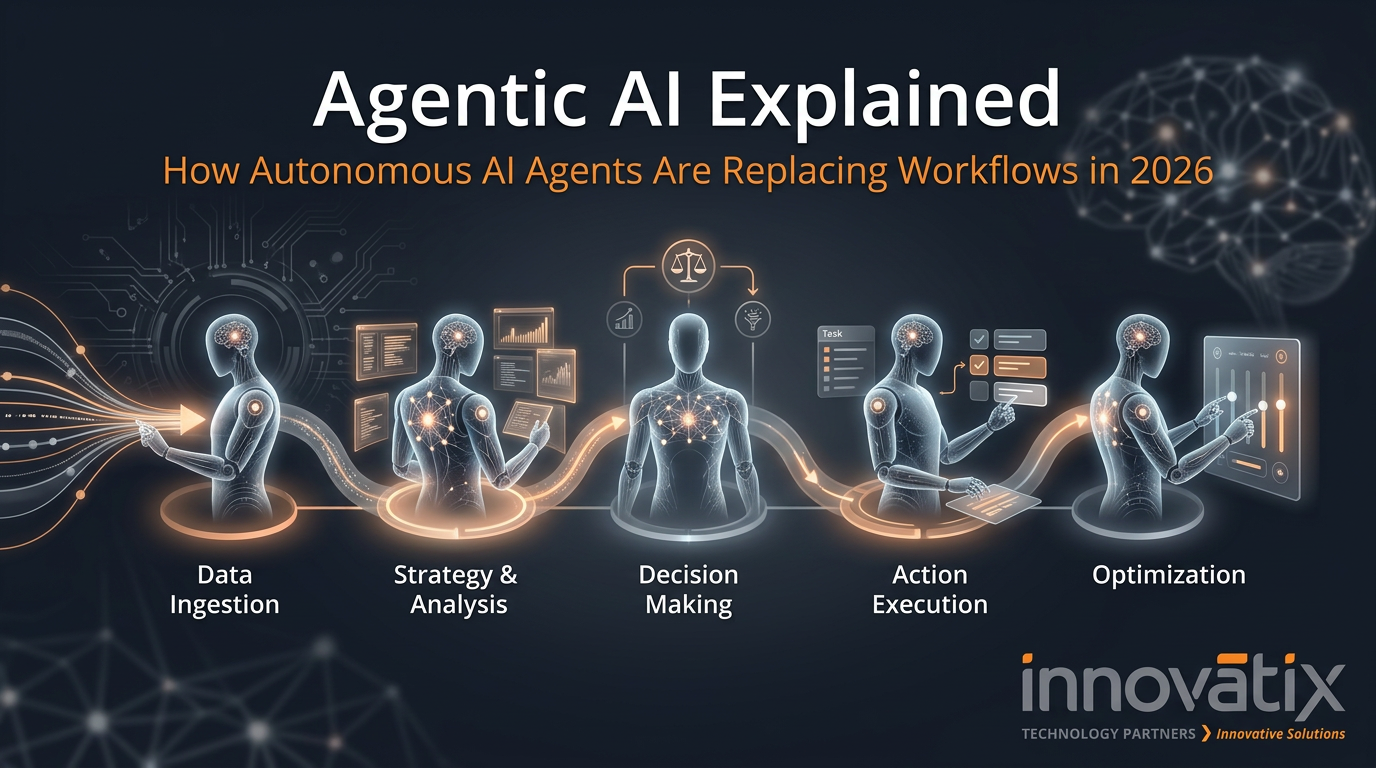
Conventional AI solutions – your chatbots, your copilots – are waiting until called upon. You ask, they answer. The AI as agentic turns that model. You give it an objective, and it plans how to get there, implements, corrects in case of failure, and produces results. It thinks, schemes and takes action. Autonomously.
Not without reason, Multiagent Systems was included in the list of Top 10 Strategic Technology Trends of 2026 by Gartner. It is not a future event that we are discussing. Microsoft, Salesforce or ServiceNow are already delivering agentic capabilities into the platforms that millions of businesses use on a daily basis.
Whitepaper – Vibe Coding: The Intent-First Development
This whitepaper reveals the critical architectural shift from human-managed MLOps to self-evolving Agentic Autonomy, providing a blueprint for systems that move beyond simple assistance to independent, goal-driven action.
Why This Matters More Than Previous AI Hype
I am old enough in technology to recall when digital transformation was the term on all the slide decks. Then it was “cloud-first.” Then “generative AI.” Every wave was accompanied by true value, yet a lot of noise. The difference between agentic AI and other types of AI is that the former strikes at the most costly issue in any business: the workflow.
All companies operate on workflows, approvals, escalations, data handoffs, compliance checks, onboarding sequences. A combination of email, spreadsheets, and a person with a feel in how things work holds most of them together. Once such an individual goes on vacation, the cycle is disrupted.
The agentic AI substitutes that frailty with a robustness. A support ticket can be tracked by an AI agent, categorized, and the information in your CRM is retrieved, a reply is written, and the ticket is sent to the appropriate team, and all without a human touching it. Not because it is operating with a fixed set of script but because it knows where it is going to and it calculates the means by which it can achieve that.
The PwC report on AI Predictions 2026 points out that organizations are now leaving the experimentation phase and shifting to the implementation of agentic workflows that can provide quantifiable business benefit. McKinsey refers to it as an inflection point – the point at which AI becomes more of an assistant than an actual partner.
What We’re Seeing on the Ground
We have begun to apply agentic patterns to client projects in Innovatix Technology Partners, and the outcomes are impressive. An insurance client that had been receiving four handoffs in three departments as part of their claims intake process managed to have a single automated pipeline. The agents process document extraction, policy validation and routing. The humankind only interferes in edge cases and final approvals.
Not science fiction. It is a production deployment, which is currently in operation.
This is also occurring in the sphere of IT operations. Agentic AI can independently close common service desk tickets, fix issues, and even optimize infrastructure, which previously consumed hours of expert engineering time. As an example, Moveworks documents that companies with agentic IT support are solving problems within seconds, as opposed to days.
The Human-in-the-Loop Still Matters
I would like to be explicit on something: I am not referring to people replacement. I’m talking about freeing them. The most successful ones we have witnessed have humans in the loop to provide oversight, judgment and strategy- the things that human beings are good at. The agents are in charge of the monotonous, rule-laden implementation that wears people down.
Recently, Axios outlined the concept of the human in the loop as one of the principles of responsible AI use in 2026, and I fully concur. The businesses that will succeed with agentic AI are the ones that leverage it to make their humans more productive, rather than the ones that leverage it to reduce the number of people and cross their fingers.
What Should You Do About It?
When you are a business leader reading this, this is my personal advice. Begin by determining the organizational workflows that are high volume, rule-based, and with many systems. And there are your golden parachutes. There is no need to revolutionize everything in one go, select one process, pilot it, measure the outcome, and build on it.
The technology is sufficiently developed to implement today. The question is not, is agentic AI working? Whether you will adopt it earlier than your competitors.
That’s what we are talking to our clients about at this point and I would be pleased to talk to you as well.
Whitepaper – Vibe Coding: The Intent-First Development
This whitepaper reveals the critical architectural shift from human-managed MLOps to self-evolving Agentic Autonomy, providing a blueprint for systems that move beyond simple assistance to independent, goal-driven action.