


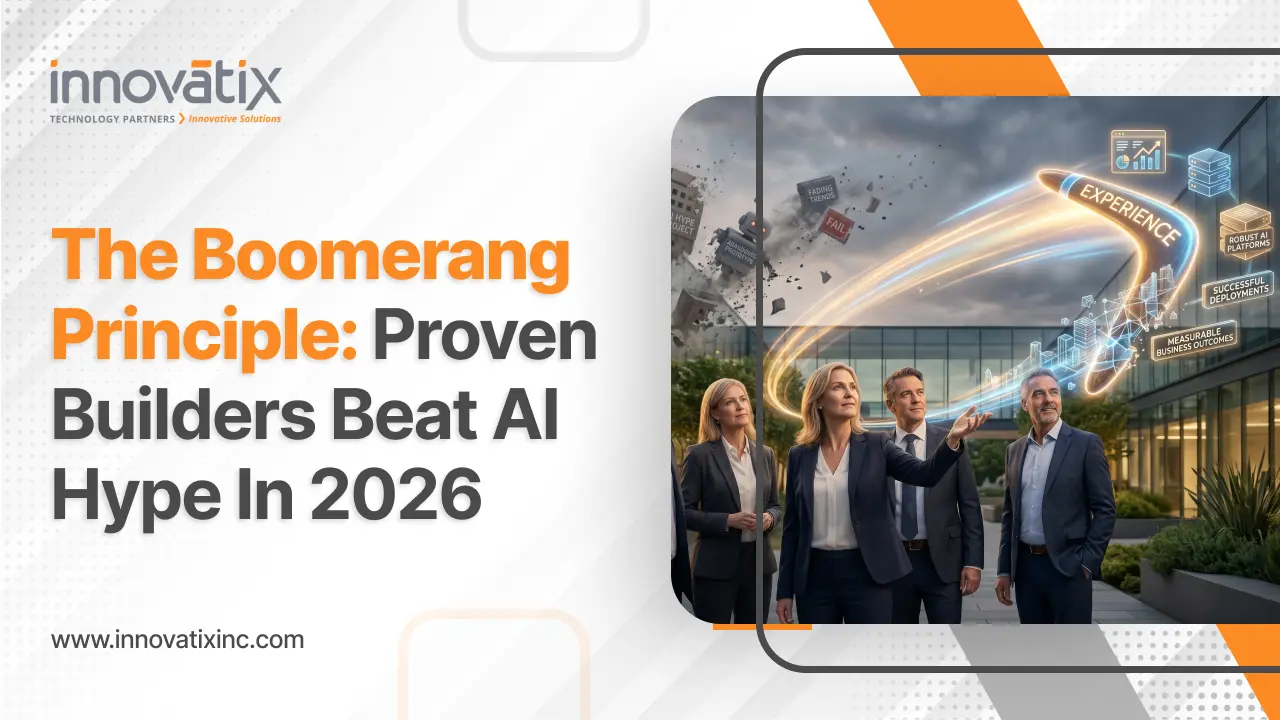
A recent Forbes column on “Boomerang” hiring just made the strongest case I’ve witnessed for how Enterprises should actually invest in technology.
Bryan Robinson in his recent article for Forbes argues that in 2026, the best career strategy is not to move onto the next big thing as it’s like a Boomerang: going back to a company you already know. The reasoning behind the statement is not very difficult to follow. In a competitive market, it is not the novel approach that prevails but rather the talent and the knowledge. The condemnation of: Going Backwards has faded over the years and the numbers also support this: Boomerang workers accounted for an estimated 35% of the hires in early 2025 compared to 31% in 2024. Companies are more likely to value stability over the excitement of a new and unknown experience.
Reading that column as a technology leader, a different lesson takes the center stage.
As hiring a boomerang is a smart strategy, the same principle is applicable to organizations adopting AI. We have been programmed to think that it is pragmatic to always go forward: the latest iteration, the buzziest framework, the startup initiated last quarter. However, the smartest move is to invest in “the Builders who already know the core issue and are quietly working to solve it.”
Whitepaper—Agentic ROI: Moving from Time Saved to Direct Revenue Outcomes in 2026
This whitepaper explores the 2026 strategic shift from using AI for mere time-saving efficiency to leveraging autonomous Agentic AI for driving direct, measurable revenue outcomes.
The Cost of Chasing “The New”
The data demonstrates that hype chasing AI has proved counterproductive and the results are frightening.
According to a report published by MIT, $30-40 Billion is the estimated expenditure on Generative AI in the enterprise and 95%of the organizations haven’t reported any measurable return while only about 5% of the pilots reported P&L impact. The RAND Corporation analysis estimates that the overall rate of failure of the broader AI project is more than 80% which is twice that of any non-AI technology project. S&P Global reported that a staggering 42% of the companies gave up most of their AI initiatives which is a dramatic increase from 17% in 2025. More than 40% of the “Agentic AI” projects will be scraped before the end of 2027 due to the rising cost as opposed to unclear value delivered, Gartner has forecasted.
The lesson for executives is to learn that it is not the model that fails but the surrounding and environment (data readiness, integration of workflows, security controls, and not having clear business outcomes). That is the mundane engineering and domain knowledge that is glossed over by the hype. The end result is a slippery slope: a new pilot, a new press release, a new budget for the same foundations 6 months later.
The Reality of Boomerang Hiring
Map Robinson’s argument to the technology-buying decision making and it is perfectly applicable.
No “New Hire Fog”: Your partner starts assisting you by delivering value from day one with his prior knowledge of your systems, your data, your workflows and your constraints. No discovery tax or time wastage in KT while the cool guy is finding out what you do!
Low Ramp Cost – Fast Value: As businesses bring back the boomerang employees to rapidly onboard them and saving money on hiring, the seasoned technology partner does not charge you to learn your environment again. The knowledge of the institution is already paid for.
Institutional Knowledge plus exposure beats Novelty: That’s the core of Robinson’s argument and the core issue of AI-related strategic decision making as well. The perfect boomerang worker explored the world and ended up with you in an enhanced capacity. Similarly, the technology partner has tackled real and complex problems and has integrated AI Technology into their process. Modernized base, enhanced firepower.
Stability over Churn: The top AI Startups list might not be the same in 18 months. Funding rounds and layoff fatigue is real. It is a gamble resting your annual roadmap on novelty, a gamble you can’t control.
As shown by the MIT’s own research, collaboration with pros worked better than “build it because it is cool” projects. A proven beat beats the new rhythm as confirmed by the research.
AI is not a Trophy; It is a Tool.
Quality of the model is not what distinguishes the 5% from the 95% but the approach. The winning AI Solutions tackle a specific and measurable issue and does the mundane task of integration so it works.
Let’s take an example of a big insurance company that has been testing the variety of GenAI pilots for searching through the customer documents and analyzing the claims for more than a year. For instance, another large insurance company piloted several use cases like document search and claim analysis for customers spanning over more than a year. Both pilots are commended for their model-building skills but neither could be deployed to production due to the lack of integrated document repositories, workflows and compliance controls.
Each of these pilots has impeccable models but they could not get to production because the underlying document repositories, workflow integrations and the compliance matrix is scattered across multiple departments. Rather than embarking on yet another standalone experiment, the companies instead worked with an experienced technology partner specializing in modernization that has experience with enterprise document ecosystems and operational workflows. And this partner adopted AI as a natural extension of its current workflow, instead of developing a brand-new document management system. This pragmatic endeavor not only saved the manual time needed for document review but also escalated information retrieval and brought AI from the “pilot” to “production” stage in fewer than previously estimated months.
That’s where a firm like Innovatix Technology Partners becomes a part of the discussion. Comprising of a seasoned team that has long been known in the industry as Macrosoft, but has been rebranded for Enterprise Solutions in 2025. The team has worked with the mission critical and complicated systems for businesses. They are not manufacturing AI as a marketing gimmick but have incorporated AI in their workflows and have harnessed its power to enhance their competency.
Consider OpenParser AI, Innovatix’s document intelligence and contract lifecycle management (CLM) solution. It is not about ‘AI for AI’s sake”. It is the perfect example of an AI solution targeted towards a problem that every business suffers from: the unstructured documents and contracts that cannot be searched, read and acted on within a strict time constraint. OpenParserAI Is the next generation of Document Management System powered by Retrieval Augmented Generation (RAG) architecture and enterprise-grade controls and workflows. It is this kind of nitty gritty and fundamental integration that fails the 95% and that’s why the systems stall.
Question of Basic Math for Leadership
Strip away the philosophy and the case comes down to the three measurable numbers that every CIO and CFO monitors.
Time: With a partner having a proven track record, the discovery tax is eliminated and you can effectively avoid the “Pilot Purgatory” – a series of projects that are continually delayed, continually underfunded and hence, never see the end. You can see results while others are still experimenting.
Money: Industry estimates calculate the cost of an AI Project failure at millions of dollars. Experience dictates the purchase of results, not the learning curve.
Risk: You can eliminate a tangible risk by not betting your product roadmap on a trend that analysts believe a significant number of companies will drop within two years.
Sometimes the best move is to walk backwards.
Robinson concludes his column with the comment that career doesn’t always go straight. Technological Innovation Strategy is the same. It is not always the hottest new vendor and the latest model on the slide that will make you an industry leader. Boomerang is an unconventional and yet effective strategy: with the support of builders that grasp your problem can also solve it as they have done, consciously and quietly over the years but this time by employing AI.
Playing it safe in the turbulent times and evolving business landscape is pragmatic and smart.
Think. Prompt. Know.
Whitepaper—Agentic ROI: Moving from Time Saved to Direct Revenue Outcomes in 2026
This whitepaper explores the 2026 strategic shift from using AI for mere time-saving efficiency to leveraging autonomous Agentic AI for driving direct, measurable revenue outcomes.