


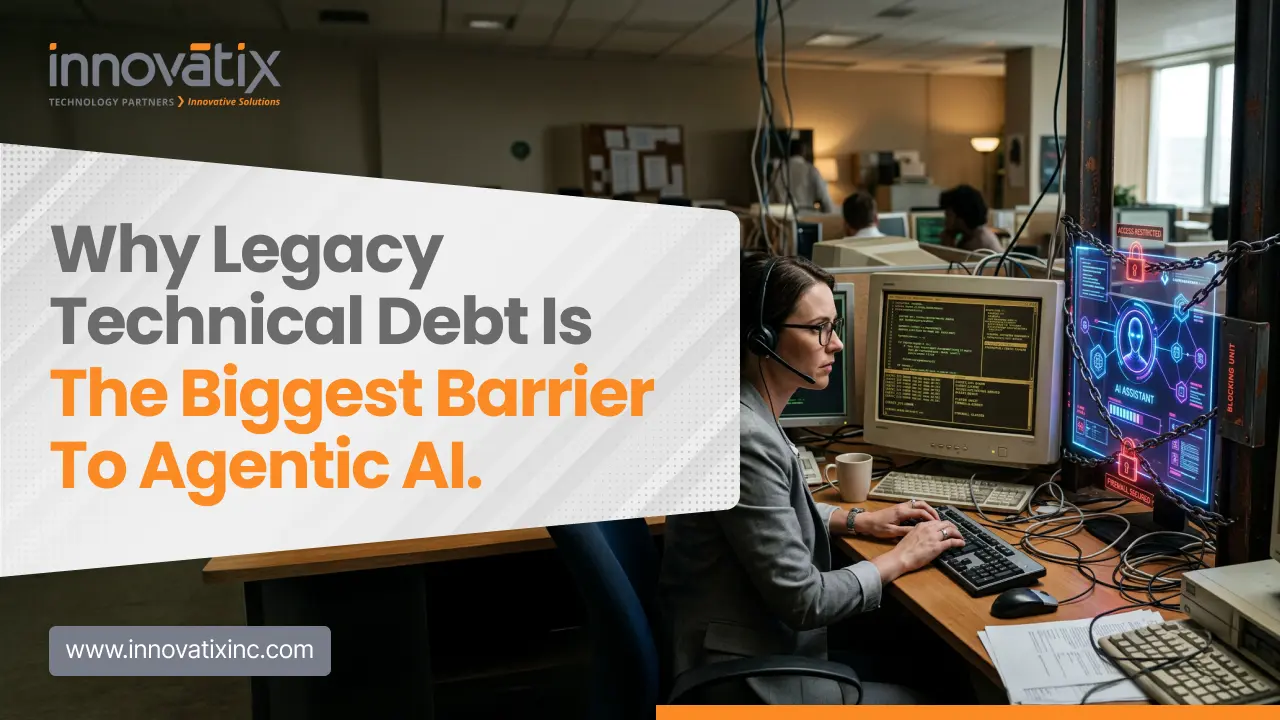
Agentic AI is revolutionising enterprise operations by shifting from AI assistance to AI action. While traditional AI solutions react to queries, provide recommendations and insights, agentic systems act. They can plan, decide, act and continually refine complex processes with little to no human input, resulting in a new paradigm of business efficiency and agility.
This is transforming the work of every function – finance, supply chain, compliance and customer – to name a few. AI is no longer simply assisting decision-making, it is actually taking part in the decision-making and execution, allowing for quicker and more efficient problem-solving and automated, intelligent business operations. But many companies are undertaking this change without realizing one thing.
The greatest challenge for Agentic AI is not the technology. It is the underlying software and systems, disjointed processes, poor data quality, obscured and undocumented business rules, and technical debt. Until these are resolved, even the most cutting-edge AI projects can become costly proof-of-concept experiments.
The Hidden Cost Most Enterprises Ignore
Technical debt usually isn’t obvious at first – it creeps up on you. A hack that speeds the current sprint turns into a burden in the next quarter. An ad-hoc fix becomes next year’s risk. A system that “works” often becomes the obstacle to an AI project going beyond proof-of-concept.
This is the reality of legacy technical debt. It usually comprises old systems built on unsupported or obsolete technologies, with business logic hardcoded into applications that are no longer understood, and monolithic designs with limited or no useful API interfaces. It also includes shadow processes powered by spreadsheets, manual escalation steps, point-to-point integration of systems that doesn’t scale, and siloed data with no common definitions or governance.
Besides the business process-related inefficiencies, legacy technical debt also poses severe security risks, as legacy systems can often contain vulnerabilities that date back years. Equally important is knowledge loss, where business processes are only understood by long-tenured staff.
This type of debt is not felt by most organisations until they embark on a modernization journey. It’s then that it is revealed, and nowhere more so than in AI.
Whitepaper—Agentic ROI: Moving from Time Saved to Direct Revenue Outcomes in 2026
This whitepaper explores the 2026 strategic shift from using AI for mere time-saving efficiency to leveraging autonomous Agentic AI for driving direct, measurable revenue outcomes.
How Agentic AI Is a Whole Other Beast
Traditional AI supports decisions. Agentic AI challenges those – and takes action.
Let’s look at a typical business use case such as managing stock levels. A traditional AI system may recognise low stock levels and suggest reordering. But an AI agent can do more. It can assess inventory levels, initiate the procurement process, update the enterprise resource planning (ERP) system, alert the finance department, monitor the vendor’s response and automatically escalate any exceptions – all without human intervention.
That’s not a chatbot. That’s an independent worker in your organisation.
If Agentic AI is to operate safely, accurately and reliably in this way, it needs:
- Reliable data in real time – not batch exports and inconsistent data from multiple sources
- Stable integration – not batch jobs, manual processes, or one-offs that are easily tripped up
- Clear business rules and logic – not complex logic hidden within decades-old COBOL code that no one understands
- Tightly controlled access – not broad access to poorly managed environments
- Complete auditability – where every action can be explained and justified to regulators, auditors and business stakeholders
Sadly, this is not the case with legacy environments. That’s why delivering an AI agent into an enterprise doesn’t make things more efficient – it makes them worse. Rather than enabling smart automation, it can expose the flaws that are already hidden in it. Legacy systems and AI must work together to enable effective digital transformation.
Five Ways Tech Debt Undermines AI Agents
1. Garbage In, Garbage Out: Garbage Autonomy
AI agents can only be as good as the data. Traditional environments are often rife with redundancies, inconsistencies, ambiguous product definitions and reporting that uses departmental spreadsheets rather than governed data systems.
In conventional analytics, bad data can lead to a flawed dashboard or report. In Agentic AI, the outcome is much worse – it results in bad actions. This might be an erroneous financial transaction, a compliance check that fails, or a mistake made directly to customers, all without human intervention.
When AI is making decisions and taking actions, “garbage in, garbage out” could have greater consequences.
2. Systems Aren’t Designed for Real-Time Orchestration
Legacy systems are typically built to do batch processing, scheduled exports, and point-to-point scripts, not real-time orchestration.
Agentic AI requires rapid, dynamic, and ongoing system communications. It needs systems to interact in real time, rather than on a schedule or via fragile manual processes.
When AI agents don’t have consistent access to critical systems, they end up making manual adjustments. These add more instability. The move to reduce operational risk introduces more risk, and creates one of the major challenges of integrating agentic AI with legacy infrastructure.
3. Embedded Business Logic Leads to Governance Gaps
Legacy systems such as Visual FoxPro, COBOL, Classic ASP or heavily modified ERP systems hide many critical business rules that have been built up over decades. Often these applications were designed and built by people who are no longer employees of the company. So, nobody understands the decision-making process, or why some rules are still in place.
This logic needs to be discovered, documented, validated and governable before an AI agent can take over decision-making. With this lack of insight, AI transformation is a black box layered on top of a black box. That is not modernization. It is innovation with uncontrolled risk.
4. Security Debt Turns into Enterprise-Risk
Older systems frequently have inadequate authentication, unpatched security holes and access control based on a world that preceded the cloud, APIs and zero-trust security. Agentic AI needs to access a range of systems. But when this access is combined with poor security, the risks grow exponentially.
This can lead to data breaches, security vulnerabilities, fraudulent transactions, compliance problems, audit problems and cybersecurity vulnerabilities. Security isn’t a post hoc consideration in AI adoption. It is a prerequisite. In the absence of robust security and vulnerability management, adopting AI is a risky proposition.
5. Debt Slows Innovation to a Crawl
The impact of technical debt on AI innovation are not visible on project schedules, but impact all phases of delivery.
You see it when:
- AI development works in isolated test environments but not at enterprise scale
- Roll-out times double from weeks to months as developers first need to fix the legacy systems
- Programmers are forced to maintain rather than develop smart automation
- Maintenance costs rise as infrastructure breaks down and needs fixing
- Competitors with modern platforms gain speed while legacy platforms are in maintenance mode
Technical debt in AI adoption is not just an IT problem. It is a business issue and a competitive liability, in terms of lost agility, increased costs and lost opportunities.
The Conflict Is Structural, Not Superficial
The clash between legacy systems and agentic AI is not a simple case of new technology vs. old technology. It’s two philosophies of operation head-to-head.
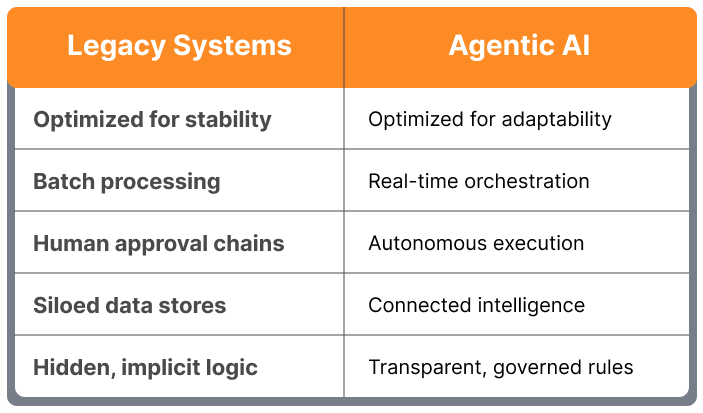
You can’t solve that problem with a new user interface or with artificial intelligence on top of a 1990s IT foundation. You need to modernise below the surface.
A Practical Path Forward
Replacing the system isn’t the solution. That’s costly, disruptive and not very effective. Instead, take an incremental approach to modernization with a focus on AI.
Prioritise the high-value workflows. Understand the business processes where autonomous execution will have the greatest value – claims approval, invoice approval, customer onboarding, compliance processes – and how they work before attempting automation.
Modernize the integration layer. Create robust API wrappers, orchestrators and abstractions for services. This minimises brittle dependencies, without full replacement.
Uncover and document hidden business logic. Make this a necessary prerequisite. Knowledge embedded in old applications is often more important (and risky if not handled properly) than the applications themselves.
Put data governance in place. Apply data ownership, definitions, validation and master data management. AI readiness is data readiness.
Build security controls. Perform access reviews, vulnerability scans and permission redesigns prior to deployment. Good AI governance begins now.
Partner with dual expertise. AI transformation needs AI architecture and legacy transformation. Companies that have separate workstreams for these constantly fall down in the cracks.
The Bottom Line
Agentic AI is not something an organisation can simply plug in or add onto pre-existing systems. It is a skill that companies need to develop – and its effectiveness is determined by the quality of the underlying infrastructure.
The key to success with Agentic AI is not the power of the AI model itself, but rather the preparedness of the surrounding environment. Outdated systems, disjointed processes, data accuracy, embedded business rules and technical debt can quickly turn an AI project from promising to chaotic. That is why it is critical that organisations have access to agents development services so that they can build and deploy smart agents to act in a prepared environment.
The companies that will dominate the next decade won’t be the first to implement AI. They will be the ones to clean up their mess first. They will transform their systems, improve their governance, enhance their data trust and ensure the stability needed for intelligent automation.
Innovatix Technology Partners is helping companies plan, execute and manage AI readiness, legacy-modernization and Agentic AI to deliver technical complexity to scalable intelligence and business impact.
Whitepaper—Agentic ROI: Moving from Time Saved to Direct Revenue Outcomes in 2026
This whitepaper explores the 2026 strategic shift from using AI for mere time-saving efficiency to leveraging autonomous Agentic AI for driving direct, measurable revenue outcomes.