G. N. Shah November 14, 2023 No Comments

The Role of a CTO in Navigating the AI Revolution: My Insights as a former CTO – G. N. Shah

The realms of Artificial Intelligence (AI) and Machine Learning (ML) have emerged as pivotal catalysts for technological innovation in recent times. These technologies have disrupted traditional business models and presented tremendous opportunities for innovation. As a tech leader and the former CTO, my experience in navigating the AI revolution. In this personal blog, I’ll delve into the insights and experiences I share from my tenure as a CTO regarding the challenges and opportunities presented by AI and Machine Learning as they transform the technological and business landscape. The Evolving Role of the CTO Let’s begin by reflecting on the evolving role of the Chief Technology Officer (CTO). Traditionally, the CTO’s role was primarily focused on overseeing technology infrastructure and ensuring the smooth operation of IT systems within an organization. However, with the emergence of AI and ML, the CTO’s responsibilities have expanded to include a broader and more strategic focus. The CTO is no longer just the guardian of technology; they are now the visionary, the strategist, and the driver of innovation. AI and ML have redefined how businesses operate, and it is the CTO’s responsibility to harness these technologies to drive business growth. Challenges And Paradigm Shifts I vividly recall the challenges that accompanied this paradigm shift. AI and ML were not just tools but agents of transformation, introducing complexities and opportunities that demanded a new mindset. Talent Acquisition: The scarcity of AI and ML talent was one of the early challenges. I emphasize the importance of building a skilled team with data science, machine learning, and deep learning expertise. Attracting and retaining top talent should be a top priority for CTOs. If you are a small or medium-sized company, you may seek help from a good partner. Data-Driven Decision-Making: The shift towards data-driven decision-making was a substantial change. I learned that CTOs must focus on data collection, storage, and analysis to derive actionable insights. As AI thrives on data, the CTOs must ensure data is collected and transformed into valuable insights. Integrating AI into Business Processes: AI is not just an IT concern but a core component of the business strategy. CTOs must work closely with other business leaders to integrate AI and ML into various processes and create a seamless, intelligent ecosystem. Balancing Innovation with Legacy Systems: One of the toughest tasks I found was to balance innovation with legacy systems. Many organizations had extensive IT infrastructure, and the challenge was integrating AI technologies while ensuring compatibility and security. Strategic Insights from My Experience Education And Continuous Learning I emphasize the importance of education and continuous learning in navigating the AI revolution. As a CTO, I reflect I had to become a student again. I immersed myself in AI and ML courses, attended conferences, and engaged with experts in the field. It is a constant journey of learning and adaptation. CTOs must encourage their teams to do the same. Training and upskilling are crucial to keep up with the rapid advancements in AI and ML. I believe that investing in employees’ education is an investment in the company’s future growth. Strategic Partnerships One key lesson I learned was the value of strategic partnerships. No one can do it all. CTOs must seek collaborations with other organizations, startups, or technology providers to complement their expertise. Strategic partnerships can open doors to cutting-edge AI solutions and talent that may not be readily available in-house. Fostering A Culture of Innovation CTOs have a pivotal role in shaping the culture of their organizations. My experience taught me that fostering a culture of innovation is essential. Innovation must be woven into the DNA of the company. This begins with the executive and trickles down to every team member. I encourage CTOs to create an environment where experimentation is not just allowed but encouraged, where failures are seen as learning opportunities, and where ideas can be freely shared and explored. Ethical Considerations in AI I would especially emphasize the importance of ethical considerations in AI development and deployment. I believe that CTOs should lead the charge in ensuring AI is developed and used responsibly. Ethical AI is not just a buzzword but a moral obligation. CTOs must ensure that AI systems are designed to be fair, transparent, and secure. Focus On Outcomes My experiences have led me to recognize the significance of focusing on outcomes rather than technology for its own sake. CTOs should be result-driven. AI and ML are tools to achieve business objectives. It is not about adopting AI for its own sake but for what it can help the organization succeed. Adaptability And Resilience The tech landscape is ever-changing, and CTOs must be adaptable and resilient. I must say there were moments of uncertainty and challenges, but adaptability and resilience are the key ingredients for success. CTOs must be ready to pivot, to iterate, and to evolve. The ability to adapt to change is what sets apart successful leaders in the AI era. Leveraging AI: The Benefits Adopting AI yielded significant benefits for Innovatix Technology Partners, a Macrosoft, Inc. company. It enabled us to automate repetitive tasks, increasing efficiency and cost savings. It also allowed us to gain deeper insights into our business operations and make better, data-driven decisions. Innovatix’s customer service improved significantly with AI. We are now offering personalized services and 24/7 support through AI chatbots. This feature resulted in increased customer satisfaction and loyalty. Lastly, AI gave Innovatix Technology Partners a competitive edge. It allowed us to innovate and offer new products and services that were impossible earlier. Final Thoughts The role of a CTO in navigating the AI revolution is both challenging and rewarding. My insights, drawn from my extensive experience as a CTO and now as the CEO of Innovatix Inc., shed light on the evolving nature of this role and the strategies needed to excel in the AI-driven landscape. It is a journey of continuous learning, strategic thinking, ethical responsibility, and a commitment to fostering a culture of innovation. As AI and ML

Top 5 Use Cases of RPA in the Healthcare Industry

In recent years, Robotic Process Automation (RPA) has been making waves in the healthcare industry. RPA has been instrumental in automating routine and time-consuming tasks, thereby allowing healthcare professionals to focus on more complex tasks that require their attention. In this blog, we will discuss the top use cases of RPA in the healthcare industry. In conclusion, RPA can be a game-changer for the healthcare industry, helping healthcare providers improve efficiency, accuracy, and compliance. By automating routine tasks, our robotic process automation services can help healthcare providers focus on more complex tasks, improving patient outcomes and reducing the risk of errors. At Innovatix, we are dedicated to helping our customers stay ahead of the game by leveraging the power of robotic process automation tools. Whether you’re in the healthcare industry or any other industry, we can work with you to determine the best course of action for your organization. Don’t wait any longer to start reaping the benefits of RPA – contact us today to talk to an RPA expert to custom-tailor your robotic process automation and intelligent automation venture.

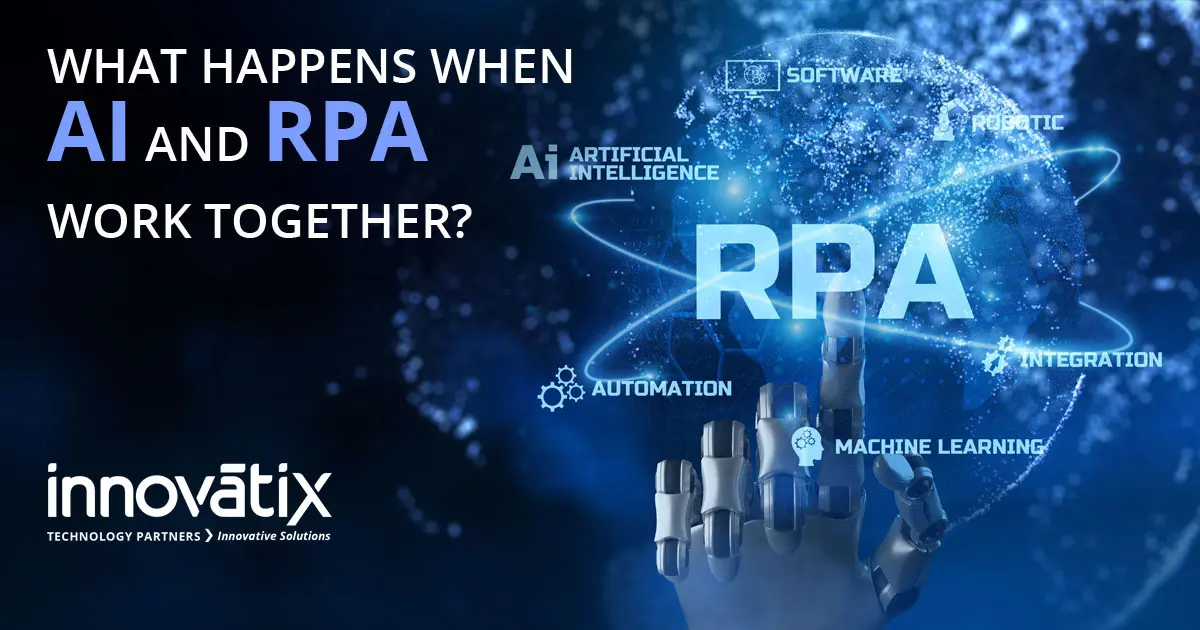
What Happens When AI And RPA Work Together?

WHAT ARE AI AND RPA? The study of systems that behave in ways that to a human observer appear intelligent is known as artificial intelligence. It is a technique used to solve simple or complex problems that are internal to more complex systems. To handle complex issues, AI uses techniques inspired by the intelligent behavior of humans and other animals. Robotic Process Automation is automation software that handles tedious, manual digital tasks, and transfers the work of a human worker to a digital worker. RPA is the use of computer software robots to complete routine, rule-based operations including entering the same information more than once, copying and pasting data, and filling out forms with the same information. By enabling employees to concentrate on work that is mission-critical, RPA solutions increase productivity while saving businesses time and money. RPA vs AI RPA is used to work with people by automating repetitive processes, AI is viewed as a form of technology to replace human labor and automate end to end. RPA employs organized inputs and reasoning, whereas AI generates its logic from unstructured inputs. Intelligent automation uses artificial intelligence technologies including machine learning, natural language processing, structured data interaction, and intelligent document processing, whereas RPA frequently focuses on automating repetitive and frequently rules-based procedures. WHAT HAPPENS WHEN AI AND RPA WORK TOGETHER? Artificial Intelligence and Robotic Process Automation are two different technologies, but they have a lot in common. RPA is only doing what the programmer tells, on the other hand an AI can teach itself. While AI is used to deal with insights from semi-structured and unstructured data in text, scanned documents, webpages, and pdfs, RPA interacts with structured data. AI can convert the data to a structured form for RPA to understand. That is RPA can automate the rule-based tasks and AI can fill the gap where RPA falls. The RPA tool “Automation Anywhere” allows the bot to self-learn through the IQ bots. By integrating the RPA techniques with AI, the bot can perform tasks such as recognizing unstructured data, learning from human feedback, etc.…  Therefore, the two technologies can support each other. The togetherness of these two technologies can eliminate human errors in the workplace and can make sure to reach correct results. Also, improve data management effectively and save cost and time. Converging AI and RPA will enable your business to automate more complex and help the humans work faster and smarter than before. BENEFITS OF RPA & AI Reduce operational risks by the human that are mundane are usually subjected to errors than when performed by software robots. RPA and AI help to reduce human errors in operations. Reduce data entry errors. Correct recording of the data is very important and at the same time is a laborious task. The combination of RPA&AI helps in automating data recording, and data entry and ensures it is without errors Quick Response has enabled the delivery of rapid services to customers 24*7 as well as performing the tasks within a few minutes which earlier consumed hours and days. Better and faster. The togetherness of RPA & AI has enabled systematic and quick operations in the front, middle and back offices. It makes for faster service delivery. Improved customer experience. The combination of RPA and AI has helped the organization to fasten the operation with a minimum error rate and error-free service to customers. The leading customers demand 24*7 instant service and quick response, which makes it easier with RPA and AI. Improved internal operation. Attendance tracking, record maintenance, timely submission of internal reports, and onboarding of new employees and others can be automated within the organization with the help of the togetherness of RPA and AI for smooth functioning. Increase output. RPA & ai works 24*7 without any variation in the service quality as per the customer demands. Therefore, RPA and AI are the perfect solutions to increase output. Better security. The virtual workforce assures security as there is no risk of an employee changing role or leaving the company and lowers the risk of data hacking. Scalability. RPA and AI are scalable technology such that you can scale up or down the operation based on the requirements of the customer or organization. Increase Accuracy. The main feature of RPA and AI is accurate and error-free service. So, it helped to eliminate the processing error to optimize business processes and map accurate business strategies. Improve Analytical Abilities. RPA and AI can gather quality data points that enhance the analytical abilities of the organization thus delivering better business forecasts. WHY DOES INNOVATIX PROPOSE RPA & AI? Robotic process automation and artificial intelligence have revolutionized the way business works. Companies in all sorts of industries or markets utilize RPA to automate tasks that require little or no involvement of human beings. Before on a mission to incorporate RPA in business, see which processes can be automated to give the most benefits. Brainstorm with the right RPA partner to figure out the impact of robotic process automation on people, procedures, and policies. Innovatix Technology Partner prefers AI builders. If you are betting on AI in the future, you must go with Microsoft AI builder the Microsoft power platform capability that provides AI models that are designed to optimize your business processes. Your company may apply intelligence to automate procedures and draw conclusions from data using power apps and power automation thanks to AI builder. This leads your business to success. We offer end-to-end RPA & AI services with strategy planning, deployment, and support. Our experienced team helps to automate and well-organize the business processes which have translated into enhancing productivity and efficiency.

How to Start Your Journey into AI with Transfer Learning

AI is coming – Transfer Learning provides a way to dip your corporation’s toe into the AI pool. Artificial Intelligence (AI) and Transfer Learning (TL) Artificial Intelligence (AI) it used to be the future.  But now, it is rapidly becoming the present. And businesses will either utilize it or be left behind. Obviously, it is in your best interest to learn how AI can work for your business.  That is where Transfer learning comes in. What is Transfer Learning (TL) Transfer Learning (TL) is a machine learning technique in which a data model is trained for one task in a large data set, then re-purposed and applied to a second, typically much smaller, data set.  It optimizes Machine Learning (ML), which enables businesses to achieve rapid progress and enhanced performance when applied to their business objective. The biggest impediment to beginning your first project is having enough normalized data to train a model.   Teaching an AI model is a laborious task typically taking dozens of computers, millions of data points and weeks of processing time.  Small Businesses want to leverage AI but don’t have the resources and skills to do this while still running their daily operations.  Even once trained, AI learning is never-ending but must continue to adapt as our world is ever changing. In simplest terms, Transfer Learning provides a way to take full advantage of AI, and gives your business an enormous competitive advantage How Can TL Be Applied to My Business and What Will it Do for Me? The first step in TL is to have a base network, data set and task where AI can be trained on effective decision making. Then that AI model is applied to a similar data set within your business. TL has been particularly applicable in both Natural Language Processing (NLP) and Vision/Image projects, because these models, having been run against enormous data sets over long periods of time, are highly reusable and well-defined.  This allows a business to apply the trained model, to its specific data which, with expert tuning, will generate similar results. TL can be enormously beneficial in specific areas, such as product cataloguing, image classification, purchase prediction, branding impact, and others.  As mentioned earlier, AI once was the future, but it is rapidly becoming the present.  And, as any competitive business knows full well, when the future becomes the present, the present becomes the past.  We strongly urge that you come along for the ride, by conducting a trial project, to find out first-hand what TL can do for you. How Does My Business Get started? The steps to get started are simple.  They involve a short series of virtual work sessions where our experienced Data Scientists learn about your key business objectives and available corporate data.  These work sessions start with Data Discovery and building of a Feasibility Plan.  We can then identify established proven TL model algorithms that can be applied to your business’s available data set. Bottom Line:  It’s quite obvious that the AI train is coming down the tracks. You have the opportunity to either get on board or be run over. Transfer Learning is a low risk, speedy way for your business to stay in the present – and maybe even move into the future. 

©2026 Innovatix Technology Partners, a Macrosoft, Inc. Company. All Rights Reserved.