


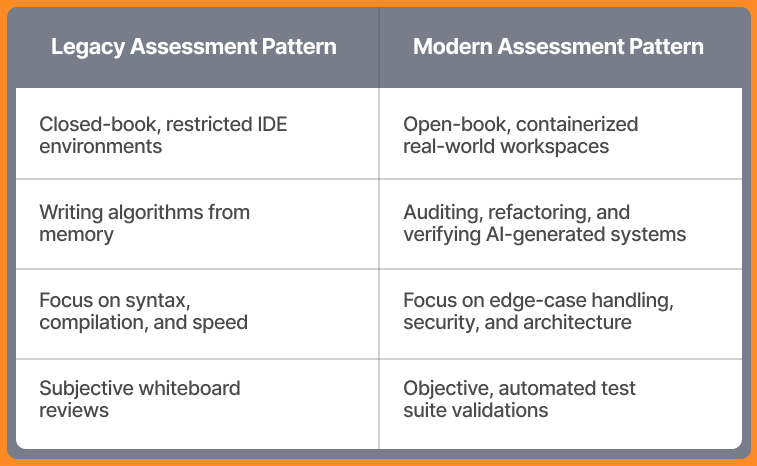
The fundamental nature of software engineering has shifted. For decades the premise of technical assessments has been that one could reliably predict a candidate’s engineering capacity by observing how well he or she could write a syntactically correct, clean code under time pressure. We constructed a complete hiring system centered on whiteboard sessions, LeetCode puzzles and timed take-home tests to check syntax memory and problem-solving skills in puzzles.
Then there was Generative AI.
The capability of solving a LeetCode medium and hard problems in seconds is available today with large language models (LLMs). These tools, such as GitHub Copilot and Cursor, and automated coding agents, have been woven into the modern developer’s Integrated Development Environment (IDE). These systems don’t just fill in the blanks in lines of code, they also build complete microservices, create full test suites, and refactor legacy code bases based on natural language prompts.
Traditional screening methods break down if any candidate is able to produce syntactically correct code given a good prompt. A technical hiring manager is in a predicament: how do you gauge a developer’s real ability using the tools they are using, which may be concealing their inabilities?
The solution is not to forbid the use of generative tools. In an actual production setting we anticipate that engineers will utilise all the efficiency tools at their disposal. Rather, the answer is to change from syntax testing to a “Trust, but verify” evaluation approach. This framework does not just assess code, but its structure, auditing, integration, and maintainability.
Whitepaper—The Agentic AI Skills Gap: Identifying and Sourcing Engineers Capable of Building Autonomous AI Systems
This whitepaper provides a strategic blueprint for identifying, sourcing, and evaluating elite engineers capable of building autonomous, multi-agent AI systems to help enterprises bridge the critical “agentic AI skills gap.”
The Legacy Collapse: Why Whiteboard and Syntax Tests Fail
The standard algorithmic screening tests have a limited sample of software engineering skills: working memory, knowledge of particular data structure puzzles and speed. Generative AI tools are highly tailored to do just this.
An LLM can solve a classic problem, such as reversing a binary tree or implementing a custom sorting algorithm, instantaneously if the problem is given to the candidate to solve. This results in two issues for recruiting teams:
- False Positives: Underqualified candidates can use secondary screens or hidden AI assistants to breeze through automated technical screens, only to struggle when faced with the messy, unstructured realities of production environments.
- False Negatives: lite developers with strong expertise in systems architecture, performance optimization and domain-driven design may not get a high score on a stressful, rote memory coding exam, yet they are quite capable of orchestrating the AI tools to write the coding itself.
To build resilient engineering teams today, companies must evaluate a candidate’s ability to manage cognitive debt, which is the difference between the output of an AI agent and the comprehension of the human developer. When developers code what they don’t fully understand, the system quickly turns into a fragile mass of mishmashes and potential pitfalls.
The Four Pillars of Modern Technical Assessment
A modern, AI-resilient technical assessment framework shifts the evaluation focus upward. Instead of testing the mechanics of coding, it tests the orchestration and verification of systems.
Here are the four key pillars that define this modern framework:
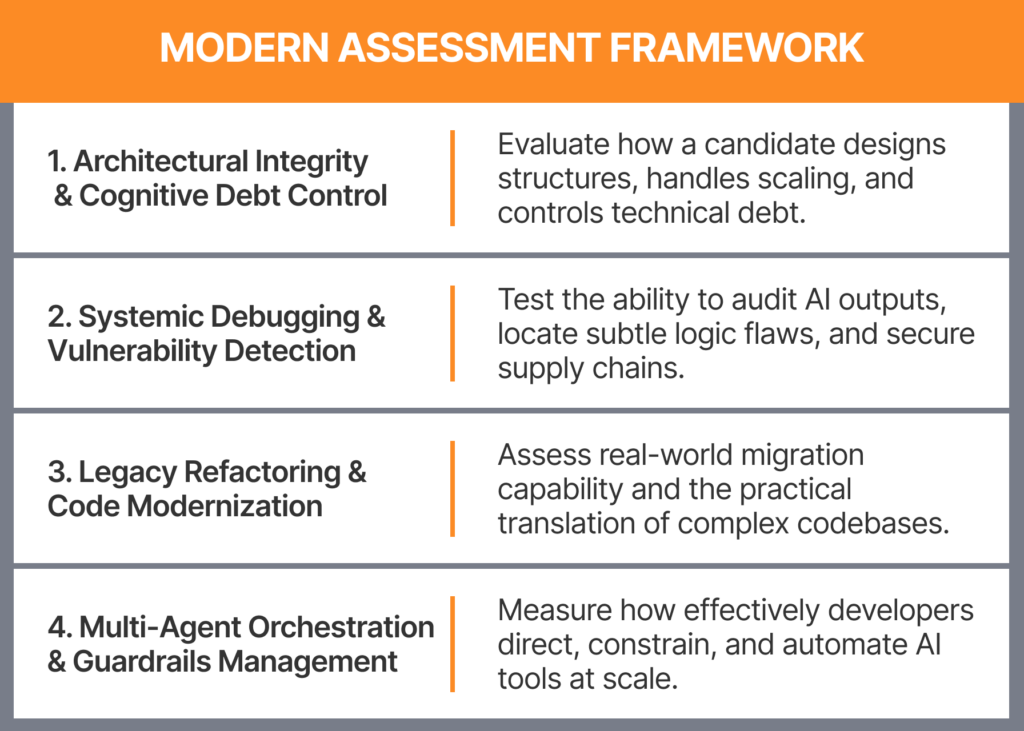
1. Architectural Integrity & Cognitive Debt Control
In the generative era, the bottleneck in software development is no longer code production; it is system design. A candidate’s strong evaluation should include the ability to create components that are scalable and integrate gracefully.
- How to assess: Give the candidate a system design scenario in which they have to describe an application with multiple tiers. Do not ask them to write the endpoints, ask them to define the API boundaries, data contracts and integration patterns.
- The evaluation metric: Can the candidate recognize where the architectural drift could occur in context of an AI-generated microservice? Do they enforce version control policies and module boundaries that avoid the AI from producing random, poorly normalized code dependences?
2. Systemic Debugging & Vulnerability Detection
AI models are known for generating code that is very confident and superficially correct. They can also introduce security issues, or fail to consider edge cases or integrate old or insecure open-source components. As an engineer, his/her job is increasingly becoming one of an editor and auditor.
- How to assess: Provide the candidate with an AI-generated codebase containing hidden architectural flaws, memory leaks, or security issues (e.g., SQL injections, insecure deserialization, or open S3 bucket permissions in Terraform scripts). Ask them to audit the code, run validation diagnostics, and secure the pipeline.
- The evaluation metric: Rather than seeing if they can write a function from scratch, evaluate how quickly they locate logical anomalies. Do they use Static Application Security Testing (SAST) and Software Composition Analysis (SCA) principles to verify the safety of the generated code?
3. Legacy Refactoring & Code Modernization
Much of enterprise engineering is focused on maintaining, refactoring and modernizing legacy code bases. A great use case for generative tools is to translate legacy (older Java frameworks, legacy APIs, migrating COBOL) patterns into modern microservices—and this demands a high level of human guidance.
- How to assess: Provide a legacy code snippet with patterns that are no longer in use and require candidates to update the code with the help of an AI tool of their choice. They are required to format the prompts and lead the LLM during the translation process, and then manually tweak the results to conform to contemporary best practices.
- The evaluation metric: How does the candidate deal with edge-cases where the translation fails? Do they check that the code has been modernized in a manner that is backward compatible and has strict performance constraints?
4. Multi-Agent Orchestration & Guardrails Management
The highest-performing developers in the generative era act as “AI Directors.” They don’t only write single prompts, but also create global rules, coordinate multi-agent workflows and introduce automated testing guardrails.
- How to assess: Ask the candidate to create a CI/CD pipeline or build script that will validate incoming code to a set of project rules and to the amount of unit test coverage.
- The evaluation metric: Can the candidate setup and deploy rules (workspace, custom linters, automated testing, etc.) at the project level such that the code produced by the different team members are highly standardized?
Designing the Practical Evaluation Environment
Organizations will need to stop using “sandbox” environments that limit access to the internet or tools to perform these assessments. Realistic execution environments are required for a “Trust, but Verify” approach.
Assessments should be delivered in browser-based containers or cloud hosted sandboxes (such as JupyterLite, VS Code Server, GPU environments etc.) with the same tools that candidates would have on the job, such as search engines, documentation, generative assistants etc.
Bridging the Talent Gap in the Generative Era
It is important to put these modern frameworks in place, but it takes a lot of expertise to execute. Many organisations are having difficulty designing, scaling and grading these multi-dimensional assessments. Moreover, to find developers skilled at working within such stringent verification guidelines, you need a very sophisticated vetting pipeline – not to mention one that doesn’t find people who can simply copy and paste AI-generated code.
This is where strategic talent acquisition can be a major differentiator in your competition. Typical IT staffing firms use keyword matching, but it is a complete miss when it comes to the cognitive auditing abilities necessary for today’s engineers. Properly managing this transition requires working with specialized teams that know the ins and outs of today’s development.
When organizations need to scale their engineering team with vetted, highly skilled professionals that will excel in an AI-augmented environment, they rely on specialized solutions. Innovatix Technology Partners is an Advanced Technical Professional Services & Staff Augmentation provider to help business secure elite technical talent. They make sure that your hired resources don’t rush to write code, but use modern verification frameworks to ensure that your systems are secure, robust, and architecturally sound, and will last for years.
Conclusion: The Path Forward
Generative AI has not made software engineers obsolete; it has heightened the value of deep systems thinking. When code generation is free, the premium shifts entirely to verification, system integration, security, and maintenance.
This transformation of your technical hiring process to “Trust but Verify” can help you filter out the AI-generated hype and identify the real game changers—engineers who not only comprehend the intricacies of modern software systems but can also direct, audit, and scale them effectively.
Whitepaper—The Agentic AI Skills Gap: Identifying and Sourcing Engineers Capable of Building Autonomous AI Systems
This whitepaper provides a strategic blueprint for identifying, sourcing, and evaluating elite engineers capable of building autonomous, multi-agent AI systems to help enterprises bridge the critical “agentic AI skills gap.”