


For years, workforce decisions have largely been split between different parts of the enterprise. HR managing employees, procurement handling staffing vendors, engineering leaders looking after project resources and finance keeping track of spending.
But IT organizations no longer operate with such clean boundaries. A modern IT workforce can include permanent employees, contractors, staff-augmentation professionals, specialist consultants, offshore teams, managed teams, and other external contributors all working together on the same technology roadmap. As the workforce gets increasingly spread out, IT workforce governance is something that is now firmly on the radar of CIOs.
The question is no longer simply, “Have we got enough staff on board?” It is now more like “Do we have visibility and control over the people and capabilities delivering our technology strategy?”
Whitepaper -The Modern IT Workforce Operating Model
This whitepaper explores how enterprises can bring greater visibility and control to their extended IT workforce by aligning talent, capacity, suppliers, governance, and delivery through a modern workforce operating model.
The IT Workforce Is Becoming an Extended Workforce
The scale of external talent makes this increasingly important. Deloitte research found that approximately 48% of the average U.S. corporation’s workers are engaged through a contract, contingent, or other non-employee relationship. But ironically, these workers are often left out of the standard workforce planning equation.
For technology organizations, that creates a potential blind spot.
A CIO may know how many employees they have got in their IT department, but that is only half the story; they would have no idea how many external engineers are supporting critical applications, which vendors supply them, what skills they bring to the table, or where all those resources are concentrated.
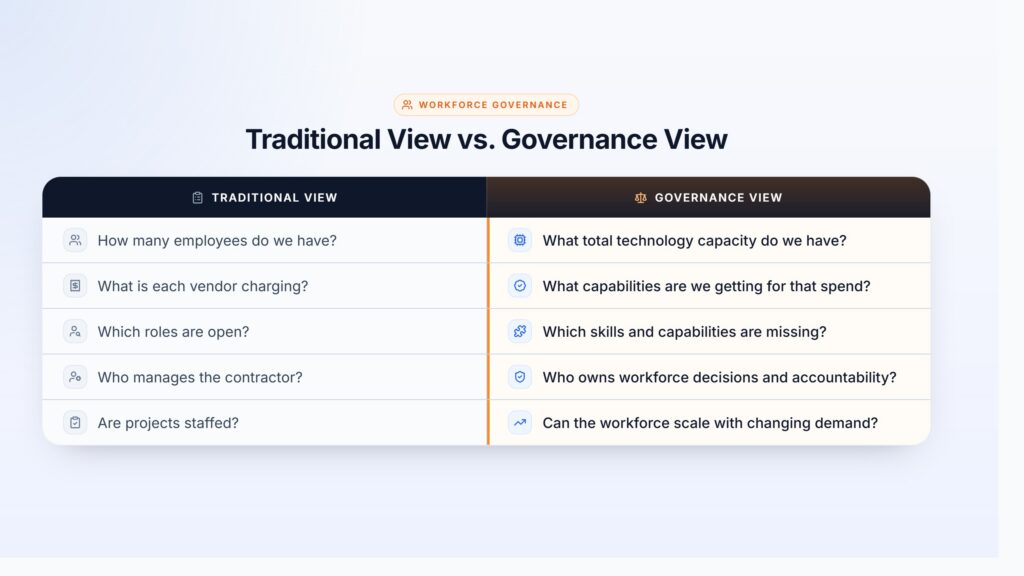
This is why having someone in charge of the contingent workforce can’t just sit in procurement or HR anymore. Gartner’s July 2026 research argues that contingent workforce programs span supplier management, workforce administration, and business execution, making single-function ownership ineffective and calling for shared governance between procurement, HR, and business itself.
Where Workforce Fragmentation Creates Risk
Fragmentation is not necessarily caused by having multiple workforce models. The real problem occurs when those models operate without a common view.
Consider a large modernization initiative. The internal engineering team may own the application, one staffing supplier provides developers, another supplies cloud specialists, and a separate partner manages offshore resources.
Each group may be performing well independently. Yet the organization can still lack answers to fundamental questions:
- Who is in charge of the workforce strategy as a whole?
- Where are all the key skills concentrated?
- Are we paying multiple suppliers for the same thing?
- Which resources can we move around when priorities change?
- What happens if our main external go-to person leaves us?
That is the kind of visibility gap that can turn a workforce that is supposed to be flexible and adaptable into a nightmare to manage.
Deloitte has previously found that only 22% of surveyed organizations considered themselves very effective at defining and managing a workforce made up of both internal and external workers.
What Strong IT Workforce Governance Looks Like
Good governance isn’t about entangling projects in a web of approvals. It is about finding that sweet spot where you can make workforce decisions in a way that is rock solid, super transparent, and gets the job done fast.
An effective IT workforce governance model should focus on four areas:
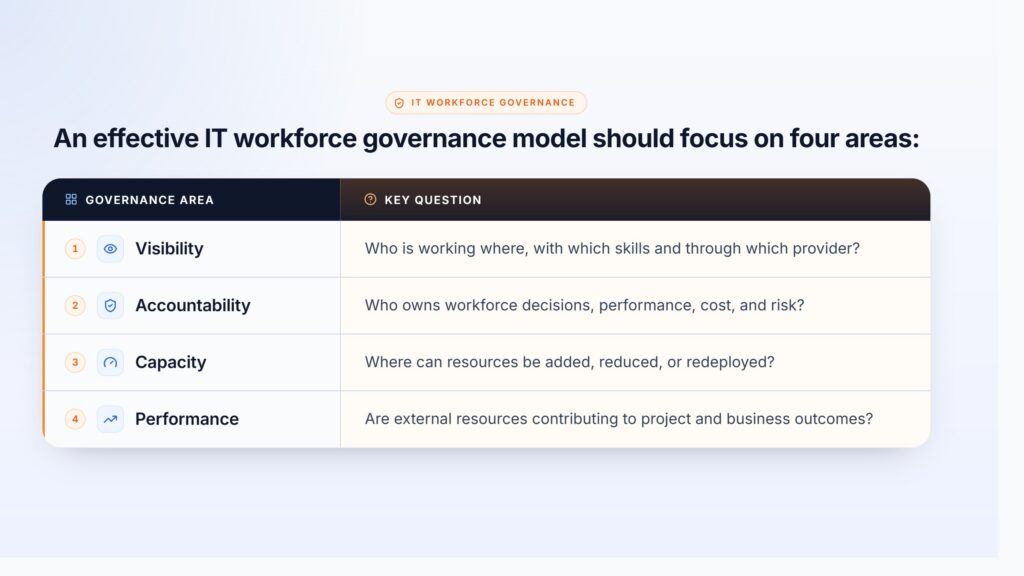
This also changes the way the CIO does their job. Rather than staffing being an afterthought that gets handled only after the technology strategy is set, workforce planning becomes an integral part of the overall strategy.
Deloitte’s latest workforce planning research backs this up. It shows that companies are moving away from planning based on just head count to thinking about what skills, tasks, and roles are needed, and making sure they have the right capacity.
Effective Workforce Governance Enables Staffing Flexibility
The whole point of workforce governance is not to eliminate external staffing or force every organization into a one-size-fits-all workforce model.
Quite the opposite. Leaders just want to have a better visibility of what is going on so they can make better decisions on when to hire permanently, when to use IT staff augmentation, when to bring in niche expertise, and when to scale delivery teams temporarily.
For example, Innovatix’s IT staff augmentation services are designed around flexible technical capacity, including specialized IT professionals, hybrid teams, and short-term contract resources. This type of model can complement an enterprise workforce strategy by allowing organizations to add capability without automatically adding permanent headcount.
What’s the Key Takeaway Here?
Workforce governance is just about understanding the entire technology workforce as a single, cohesive unit. The more enterprise technology gets spread out, the more CIOs need to be able to see the whole picture – not just the people on the payroll, but all the external help they get from others to deliver critical projects.
They need clear decision rights, reliable workforce data, measurable performance indicators, and the flexibility to scale talent as priorities change. The organizations that get this balance right will not necessarily have the largest technology workforce. They will have something more valuable: a workforce they can see, understand, govern, and adapt.
Whitepaper -The Modern IT Workforce Operating Model
This whitepaper explores how enterprises can bring greater visibility and control to their extended IT workforce by aligning talent, capacity, suppliers, governance, and delivery through a modern workforce operating model.