


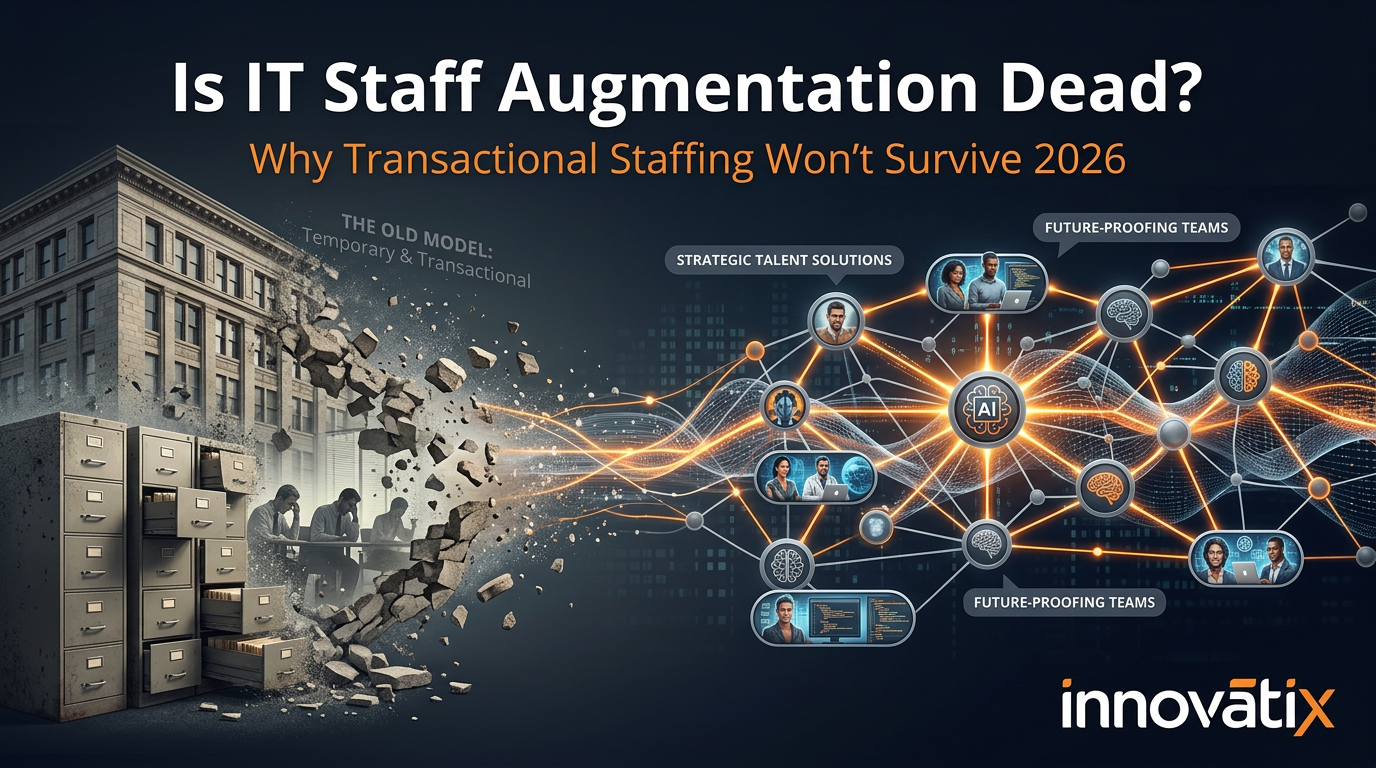
I’m going to say something that might sound strange coming from someone with “recruitment” in their title: the version of staff augmentation most people think of — the transactional, fill-the-seat, send-us-a-resume model — is on life support.
That does not mean that staff augmentation is dead. It isn’t. However, in the manner that most of the industry has been doing it over the last two decades? That model is collapsing under AI disruption, client consolidation, and a market that doesn’t reward middlemen anymore.
The Numbers Don’t Lie
SIA predicted that the U.S. IT staffing segment would fall by 2 percent in 2025, after a fall by 6 percent in 2024. The revenue is declining, penetration rates have gone down and sales reduced by 1.3 per cent quarter-over-quarter. The market, which is already huge at 183 billion, is increasing by only 2 per cent- and even that is almost exclusively to specialty, tech-enabled companies.
In February, Bloomberg wrote that AI is posing a direct threat to the staffing industry as companies are in-sourcing recruitment. By the end of 2026, AI is estimated to do 80% of the transactional recruiting jobs. The clients can enjoy the same job boards, same LinkedIn Recruiter licenses, and advanced AI screening tools. The question that staffing companies are posing: why spend money on a staffing company when an algorithm will do it in less time?
Whitepaper – Rethinking the Resume: Why Skills-Based Hiring is No Longer Optional in 2026
This whitepaper outlines the essential transition from traditional, pedigree-based resumes to a skills-based hiring model to remain competitive and equitable in the 2026 digital economy.
What’s Actually Dying
The paradigm in which a client makes a phone call with a description of the job, a recruiter performs a search with a keyword, and three resumes are sent, and a margin is collected is what is becoming extinct. Board member Jeff Harris of IT staffing company Tential, explained to the American Staffing Association: “The market share out there is diminishing to the point where companies that simply wish to be transactional and fill orders are finding it less appealing.
He added further: “Most of those companies will most likely disappear within the next ten years. An insider that is raising the alarm.
I see it daily. The clients are reducing the number of vendors of five or six companies to one or two. The survivors provide more than resume delivery services – market intelligence, workforce planning, skills validation and problem-solving capabilities not available to the client team.
The Threats Are Coming from Every Direction
Clients are also establishing their own talent platforms internally and are direct sourcing tools that are entirely agency-free. It was admitted by the chief economist at ASA Noah Yosif: “Staffing firms are experiencing an increased competition on the solution side and they will require putting in a much greater effort to create that value.
StaffingHub noted that winning agencies are not expanding but are intensifying in current markets – as volume driven growth without a margin discipline is a death sentence. The winners in 2026 aren’t the biggest. They’re the most specialized.
What’s Replacing It
Staff augmentation isn’t dead — but it’s evolved into something the old model wouldn’t recognize. The companies that have been successful today are not vendors but strategic talent partners. Here’s what that looks like from my desk.
In the case of a client calling Innovatix, it does not begin with a job description. It starts with a problem. Perhaps their cloud migration is lagging behind since they are unable to locate DevOps engineers who have experience with Terraform. Perhaps an MLOps specialist should be hired on a 90-day sprint by their AI team. It is our task to comprehend the challenge, find the right solution to it, which has been solved by vetted professionals, and integrate them at an appropriate speed to move the needle.
We provide market insights clients don’t have. We recommend salary rates of niche jobs. We do not match keywords but practical tests to validate skills. That is where the distinction lies between a staffing vendor and a talent partner – and between being taken off the vendor list and being invaluable.
The Firms That Will Disappear
Generalist firms are volume and markup based and are dying out of the runway. Margins are shrinking, customers are moving, recruiters are overworking doing the job that AI can do in a short period of time. When you say that you fill positions, the clients will come to the conclusion that technology can do it less expensively.
The companies which survive will pose more difficult questions: how can we build a hybrid team of permanent employees and augmented experts? How is the market of LLM engineers in Q3? What do we do to develop an AI-ready workforce without busting our budget on headcount? Those need partners who are knowledgeable about technology, rather than recruitment.
Why I’m Actually Optimistic
Here’s the counterintuitive part: this shakeout is good for firms like ours. It clears space for companies that invest in specialization and genuine expertise. At Innovatix, every recruiter on my team understands the technology our clients build. We don’t match keywords — we understand architectures, deployment pipelines, and project lifecycles.
Staff augmentation isn’t dead. The lazy version of it is. And for the firms willing to evolve, the opportunity has never been bigger.
Whitepaper – Rethinking the Resume: Why Skills-Based Hiring is No Longer Optional in 2026
This whitepaper outlines the essential transition from traditional, pedigree-based resumes to a skills-based hiring model to remain competitive and equitable in the 2026 digital economy.