


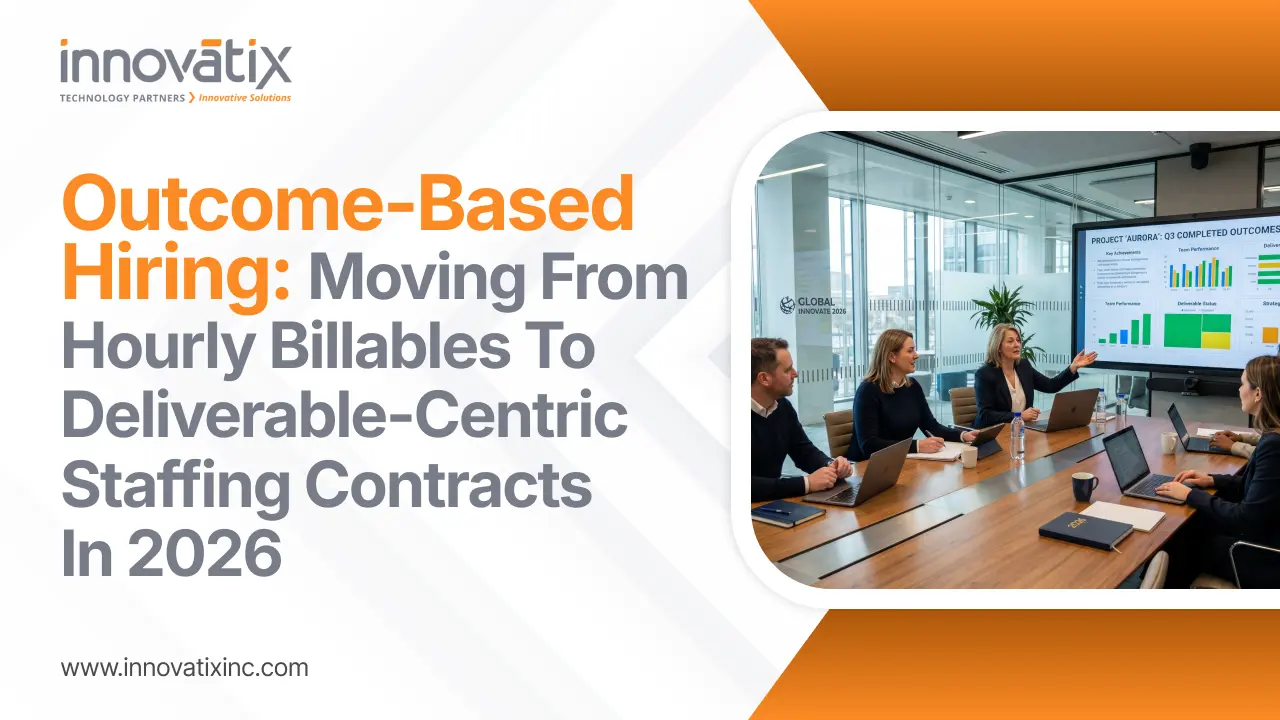
For years, the “billable hour” has defined professional services. In short, the time worked = the work delivered. We understand the pitfalls, and for good reason, as we enter the year 2026, this model will be on its last legs. The reason? The “productivity fork,” a term that describes the rapid advancements to compute power and automation, is reshaping the relationship between the time worked and the value of the work delivered.
We are entering a phase of Outcome-Based Hiring (OBH). OBH is a model where work is contracted and delivered in terms of outcomes and milestones, not the time it takes to complete them.
The Death of the Input Proxy
The framework of hourly billing rewards inefficiency. By collecting just ten hours of work to deliver a strategy, a consultant will earn far more than the more efficient consultant who delivers a strategy in just two hours. The paradox of this model will not survive in 2026. The advancements in Generative AI can transform work that once took hours or even days into mere minutes.
If an organization continues to pay a premium for every hour of work, they are paying a disproportionate premium on their workforce for their own inefficiency and lack of speed. Alternatively, high-skill consultants who use AI will be forced to enter the marketplace of consulting to retain their competitive earnings and will no longer contract work on an hourly basis. Shift adjustments in the marketplace from input to outcome is the primary aim of OBH.
Whitepaper— Architecting a Global Bench: Strategic IT Staffing Models for the Modern Enterprise
This whitepaper outlines how modern enterprises can overcome specialized talent shortages by architecting a “global bench” of high-quality technical expertise that integrates seamlessly into existing workflows to accelerate legacy modernization, AI innovation, and engineering velocity.
The Key Pillars of Deliverable-Centric Staffing
The move towards a model of outcome-based procurement and hiring will result in a paradigm shift rather than changes to billing software.
1. Deliverables that are Defined as “Atomic”
OBH requires near-complete precision of “Statement of Work” (SOW) for individual roles, unlike the generic job descriptions most organizations use.
Contracts are segmented into incremental milestones.
- Old Way: “Hire a Marketing Specialist for 40 hours a week.”
- New Way: “Contract for four high-conversion landing pages and a three-month automated email sequence.”
2. Risk-Reward Sharing
With deliverable-driven contracts, people add a “success premium.” If a freelancer or agency meets a given performance KPI, say, a 20% boost in lead generation, a bonus is paid. This aligns stakeholder and employer interests, making staffing a genuine collaborator.
3. Technology-Enabled Validation
Contemporary HR tech has adapted to accommodate this. Human-centered applicant tracking systems (ATS) and blockchain HR tech with smart contracts for payment automation upon completion of a deliverable are becoming commonplace. These systems help maintain achievability of deliverables and ensure payment is made in a transparent manner, post a “human-in-the-loop” sign off on quality/purpose of work.
The Benefits: Why the Shift is Accelerating
The shift to deliverable work is about more than efficiencies; a stronger, more transparent labor market is a crucial focus.
- For Organizations: OBH limits “budget creep.” Projects estimated for 100 hours do not stretch to 150 hours. OBH helps organizations effectively define goals to improve project management.
- For Talent: Pack leaders receive payment reflective of their output as opposed to effort. Deliverable-based work offers workers control for a significant improvement in work-life balance.
- For Market Stability: This model reduces competition based on undercutting prices on traditional gig platforms. Instead of the ‘rat race’ culture, workers will be motivated to provide the best work.
Challenges and Implementation Hurdles
There will be challenges and friction as you undertake outcome-based hiring. Many companies lack the maturity it takes to introduce the outcome-based hiring.
- The Clarity Tax: It is much harder to define a deliverable-centered contract than to just post a job with “40 hours of work.” Managers need to have a clear understanding of what success is before the project is undertaken.
- The Measurement Gap: Some work is not easily measurable. While something like code, content, or a design can be easily measures as a deliverable, roles like “Project Management” or “Team Leadership” may require nuanced KPIs.
- Precariousness: These are concerns for workers if there is a lack of a guarantee for a minimum set of criteria. In some regions, the 2026 labor regulations are protecting against ‘outcome-based’ pay, and setting a minimum threshold to ensure workers are not worse off for not moving the goal post.
2026 Strategy: The Transition
For those wanting to change their staffing model in the target year of 2026, the following three steps can streamline the transition:
- Conduct an AI Impact Audit: Assess what positions have been automated as a means for outcome-based contracts, as these positions are no longer tied to the reality of goods and services
- Standardize the Work Units: Build a comprehensible and clear library of deliverables. If you’re hiring designers, clearly state what a “custom brand kit” covers so there is no confusion when you turn it over.
- Use Verification Tools: Use services that combine AI with data validation to eliminate bias, and prove that the “true professional potential” of candidates is measured by what they design and build, not by how long they stay at their desks.
Conclusion
Moving away from hourly billables and toward deliverables is an inevitable economic change caused by AI. By 2027, we may see the “billable hour” as a remnant of a slow, opaque time. The organizations, as well as the professionals, who will thrive will be the first to learn how to put a premium on the end goal instead of the work done along the way.
Whitepaper— Architecting a Global Bench: Strategic IT Staffing Models for the Modern Enterprise
This whitepaper outlines how modern enterprises can overcome specialized talent shortages by architecting a “global bench” of high-quality technical expertise that integrates seamlessly into existing workflows to accelerate legacy modernization, AI innovation, and engineering velocity.