
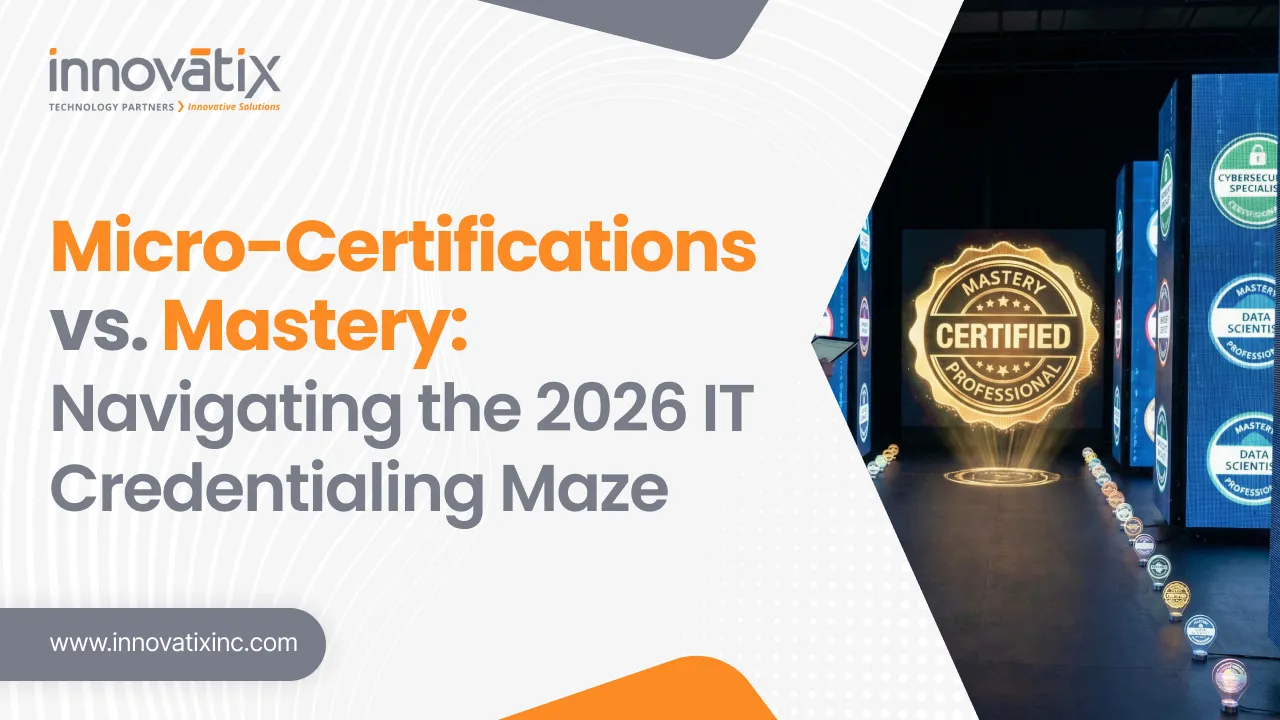
Micro-Certifications vs. Mastery: Navigating the 2026 IT Credentialing Maze
The IT landscape of 2026 is no longer a slow-moving river; it is a high-velocity rapid. As Artificial Intelligence, quantum-ready security, and platform engineering redefine the workplace, the way we prove our worth to employers has fundamentally shifted. Gone are the days when a single, four-year degree or one “gold standard” certification could carry a career for a decade. Today, professionals are caught between two powerful currents: the precision of micro-certifications and the depth of traditional mastery. Navigating this maze requires more than just collecting badges—it requires a strategy. The Rise of the “Skill Sprint”: Micro-Certifications In 2026, “Skills Velocity” is the new corporate currency. Micro-certifications—often called nano-degrees or digital badges—have exploded because the shelf life of technical knowledge has collapsed. Agility Over Architecture: These are laser-focused, competency-based credentials that can be earned in weeks rather than months. If a company suddenly adopts a new Agentic AI framework or a specific cloud-native security tool, a micro-certification allows a developer to bridge that gap immediately. The “Stackable” Resume: Modern hiring managers often look for a “stack” of complementary skills. For instance, a base in Python combined with micro-credentials in Prompt Engineering and RAG (Retrieval-Augmented Generation) pipelines tells a much more specific story than a generic “Software Developer” title. Immediate ROI: Because they are often cheaper and less time-intensive, micro-certifications offer a low-risk way to pivot or “test drive” a new niche without the financial burden of a full-scale master’s program. Whitepaper—Outcome-Based Staff Augmentation: Shifting from Billable Hours to Deliverable Milestones This whitepaper outlines a strategic shift from traditional hourly billing to an “Outcome-Based Staff Augmentation” model, which aligns vendor incentives with business goals by focusing on deliverable milestones and measurable results. Download Whitepaper The Enduring Power of Mastery While the “sprint” is essential for staying current, “Mastery” remains the anchor of a high-level IT career. Comprehensive certifications—think CISSP for security, or Professional Cloud Architect for infrastructure—provide a breadth of knowledge that micro-credentials simply cannot replicate. Context is King: Mastery isn’t just about knowing how to use a tool; it’s about understanding the why behind the architecture. It provides the systemic thinking required for leadership and high-stakes decision-making. A Trusted Filter: In a world flooded with digital badges, traditional heavy-hitting certifications act as a rigorous filter. They signal a level of discipline, long-term commitment, and foundational theory that AI-driven tools cannot yet automate or replace. Global Mobility: While some micro-credentials are brand-specific, “Mastery” certifications often carry more weight across international borders and regulated industries (like defense or healthcare), where compliance and deep-rooted standards are non-negotiable. Navigating the Maze: Which Path Is Yours? Choosing between these two isn’t an “either/or” scenario; it’s a “when/how” strategy. The most successful IT professionals in 2026 are using a hybrid approach to build a T-shaped skill set: deep mastery in one core area, with a broad horizontal bar of micro-certifications. The 2026 Strategy: Use Mastery to build your “floor” (your career foundation) and Micro-Certifications to build your “ceiling” (your competitive edge). If you are a junior developer, focus on a foundational “Mastery” credential (like a CCNA or an Associate Cloud cert) to get your foot in the door. If you are a mid-to-senior professional, use micro-certifications to “up-skill” into emerging fields like AI Governance or Green Ops to stay indispensable. Looking Ahead The 2026 credentialing maze doesn’t have a single exit. Whether you choose the path of the specialist or the agile generalist, the only real risk is standing still. The “maze” is actually a ladder; you just have to decide which rungs you’re going to climb first. Whitepaper—Outcome-Based Staff Augmentation: Shifting from Billable Hours to Deliverable Milestones This whitepaper outlines a strategic shift from traditional hourly billing to an “Outcome-Based Staff Augmentation” model, which aligns vendor incentives with business goals by focusing on deliverable milestones and measurable results. Download Whitepaper