
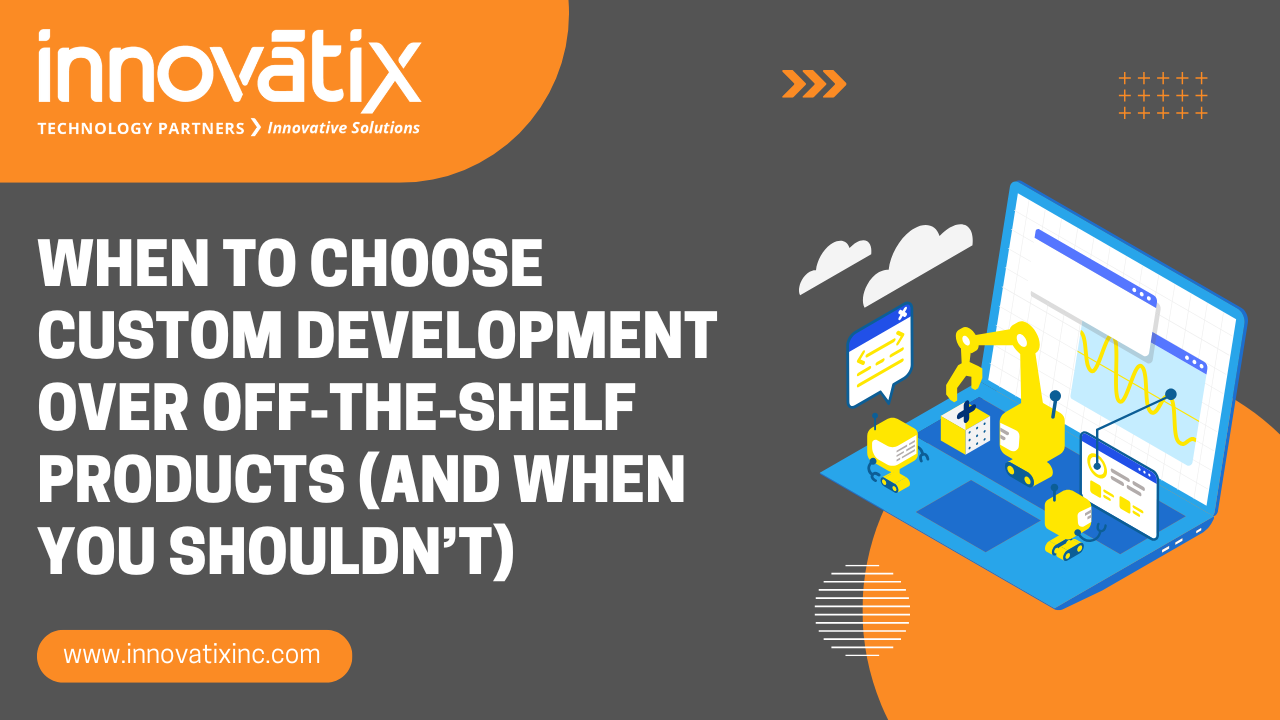
When to Choose Custom Development Over Off-the-Shelf Products (And When You Shouldn’t)
In the enterprise world, “What tool should we use?” quickly becomes “Should we build or buy?” Whether you’re planning a new customer portal, an internal dashboard, or a complex B2B platform, deciding between custom development and off‑the‑shelf software has long-term consequences for cost, agility, security, and competitive advantage. This blog walks through a practical, enterprise-focused framework to help you decide when to choose custom web development over off‑the‑shelf products—and when buying is the smarter move. Understand the Real Problem You’re Solving Before thinking about solutions, gain clarity on what problem you’re actually trying to solve. Ask: What business process is broken, inefficient, or missing? What KPIs or OKRs is this initiative supposed to impact? (e.g., reduce onboarding time by 30%, improve lead conversion by 10%, cut support tickets by 20%) Who are the primary users (customers, partners, internal teams), and what do they struggle with today? What will success look like in 6–18 months? Why this matters: If your problem is common and well-understood (e.g., CRM, HRMS, basic ticketing), off‑the‑shelf tools often cover 80–90% of needs. If your problem is unique to your business model, workflows, or industry, you’re more likely to outgrow or fight against generic products—and that’s when custom development starts to make sense. Map Your Requirements on Two Axes: Uniqueness & Criticality A useful way to decide is to map each major requirement on two dimensions: Business Uniqueness Is this a commodity capability or a key differentiator? Could a competitor easily replicate it with the same SaaS tool? Business Criticality What happens if this system goes down or can’t evolve quickly? Does it directly impact revenue, compliance, customer experience, or core operations? You typically get four quadrants: Low Uniqueness / Low Criticality Example: Basic email marketing for internal newsletters → Off‑the‑shelf almost always wins. Low Uniqueness / High Criticality Example: Payroll, basic accounting, standard HR processes → Often still off‑the‑shelf, but with strong SLAs and integrations. High Uniqueness / Low Criticality Example: An experimental internal tool or innovation lab prototype → Could go either way, but often custom (small scope, high learning value). High Uniqueness / High Criticality Example (web context): Multi‑tenant enterprise customer portal with complex role-based access Custom pricing engine for B2B contracts Industry-specific workflow system (e.g., logistics routing, healthcare case management) → Strong candidate for custom development. General rule of thumb: The more unique and business-critical a capability is, the stronger the case for custom development. Whitepaper: Maximizing E-Commerce Growth With Salesforce Commerce Cloud Explore how businesses can maximize e-commerce growth by leveraging Salesforce Commerce Cloud’s unified, cloud-native platform—highlighting its features, integration capabilities, and the value of expert implementation by Innovatix to drive digital transformation and competitive advantage. Download Whitepaper Off‑the‑Shelf: Strengths and Limitations for Enterprise Web Projects Strengths of Off‑the‑Shelf for Enterprises Speed to value: You can often go live in weeks, not months. Predictable upfront costs: Subscription or license pricing is clear (even if it grows later). Mature feature sets: Many SaaS tools come with reporting, notifications, permissions, and integrations built in. Vendor responsibility: The vendor handles hosting, upgrades, security patches, and compliance (to a point). Lower internal skill requirement: Business teams can sometimes configure and manage without deep engineering support. Limitations Enterprises Commonly Hit Workflow Misfit Your teams change processes to “fit the tool” instead of the tool supporting your optimal process. You end up with workarounds, shadow systems in Excel, or heavy customization plugins. Integration Pain Vendor APIs might be limited, undocumented, or expensive to access. Data silos appear between CRM, ERP, CMS, and your custom portals. Customization Ceilings UI and UX are locked to vendor patterns. Complex role-based permissions or multi-tenant needs can be hard to express. Vendor Lock‑In & Pricing Risk As you scale users or data, costs climb sharply. You become dependent on one vendor’s roadmap and priorities. Compliance & Data Residency For regulated industries or geographies, a hosted SaaS might not satisfy legal or internal security requirements. If several of these limitations are already red flags for your use case, custom development becomes more attractive. Custom Development: Where It Shines for Enterprise Web Services Custom development isn’t “we build everything from scratch.” In modern enterprise web work, it usually means: Building on top of robust frameworks and cloud platforms (e.g., React/Angular/Vue on the front end, Node.js/.NET/Java/Python on the backend) Using managed services where appropriate (databases, auth, observability, CI/CD) Assembling a tailored architecture aligned to your business needs Key Advantages Alignment with Your Business Processes You design the application around the way your business actually works: Complex approval chains Domain-specific entities and relationships Custom forms, validations, and workflows Fine-grained, domain-based permissions No more bending and compromising processes just to match a generic tool’s data model. Competitive Differentiation Your digital experiences can become a true competitive moat: Unique customer portal features that no generic SaaS offers Custom quoting, pricing, or bundling logic tied to your strategy Deep personalization based on your internal and external data Scalability and Performance Control You can design for: Your expected traffic patterns (e.g., heavy B2B usage during business hours) Global user bases with multi-region deployments Performance SLAs and response times suited to your industry expectations Security & Compliance by Design Custom development lets you bake in: Industry/regional requirements (GDPR, HIPAA, PCI-DSS, local data residency) Your internal policies (encryption standards, access controls, audit trails) Integration with your existing IAM, SIEM, and security tooling Integration as a First-Class Concern Instead of bolting integrations onto a SaaS product, you can: Design APIs that expose just what your internal and external consumers need Build event-driven architectures or data pipelines aligned with your data strategy Use a modular/microservices approach to connect with CRM, ERP, data warehouses, etc. Long-Term Cost Control While custom development has a higher initial cost, over time it can: Avoid escalating per-seat or usage-based licensing fees Reduce costs of workarounds, swivel-chair operations, and duplicate data entry Make it easier to adapt without paying a vendor or buying new modules A Practical Decision Framework for Enterprises To choose sensibly, go through this step-by-step: Step 1: Classify the Initiative Answer honestly: Is this system core to how we create and deliver value? Does it drive or directly support our strategic