


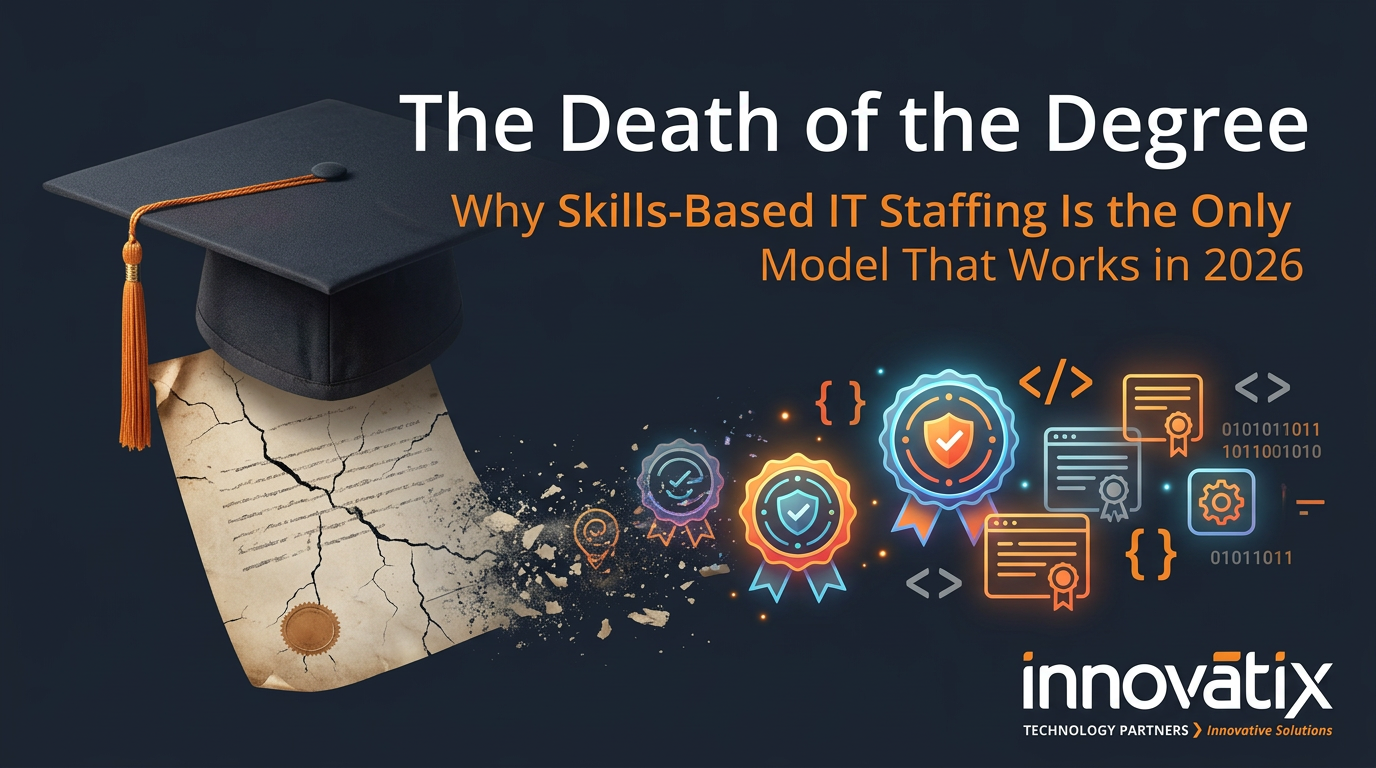
A month ago, I rejected a candidate with a master’s degree from a well-known institution. At the same time, I placed a self-taught developer without a degree into a senior cloud architect position at a Fortune 500 company. The developer had built three production Kubernetes clusters, was certified in both AWS, and had a GitHub portfolio that spoke louder than any degree.
That would never have happened two years ago. The client required a bachelor’s degree. Today, that’s no longer included in almost all job postings I receive. The shift is wide-reaching and based on data, fundamentally altering the way I do my job.
Why Degree Requirements Are Disappearing
Approximately 70% of employers now use skills-based hiring practices. IBM, Google, Delta Air Lines, and Bank of America have eliminated degree requirements for a substantial portion of their positions. The U.S. federal government dropped degree requirements with the 2026 Merit Hiring Plan, allowing candidates to demonstrate qualifications via certification, apprenticeships, or proven ability.
The most significant impact on my recruitment desk is that skills-based searches increase the qualified talent pool by 19 times compared to degree-based searches. This is according to Korn Ferry.
With 72% of employers struggling to fill positions, limiting the pool of potential applicants by including a degree checkbox is more than outdated – it’s counterproductive.
According to Harvard Business School and the Burning Glass Institute, while many companies announced they would drop degree requirements, only 0.14% of actual hires were influenced by this decision. The difference between announcing the elimination of degree requirements and implementing this change is vast. Organizations that truly transform their screening process to focus on skills – and not simply remove a line from a job posting – are the ones experiencing results.
Whitepaper – Empowering Businesses with Strategic IT Staffing: Innovatix Technology Partners’ Approach
Discover how Innovatix Technology Partners helps businesses build agile, future-ready IT teams through a strategic staffing approach designed for today’s digital economy.
Transformations on the Recruitment Floor
My screening process looks significantly different from what it was eighteen months ago. I previously began with education and years of experience. Now, I start with what the candidate can do. Can they describe a deployment pipeline to me? Can they troubleshoot a failing microservice under pressure? Has he/she contributed to open-source projects that demonstrate real-world problem-solving?
Increasingly, candidates in our pipeline possess AWS, Azure, or Google Cloud certifications instead of traditional degrees. Many constructed portfolios by attending boot camps, freelancing, and contracting. A good portion of the strongest placements I’ve made this year originated from individuals who transitioned from entirely different fields – bringing new perspectives and a drive to prove themselves.
The data on retention supports these findings. According to Korn Ferry, skills-based hires retain 34% longer. A WiCyS study released this month indicated that the utilization of skills-based hiring increased retention by 18%, decreased hiring time by 16%, and resulted in over $125,000 per employee saved due to reduced turnover. These are not slight increases – they are transformative.
Why This Matters for IT Staffing Specifically
The rapid pace of technology makes a degree earned five years ago a poor indicator of current technical capabilities. Most universities didn’t teach Terraform, LangChain, MLOps tooling, or Kubernetes at scale when my candidates’ attended classes. Clients desperately need skills acquired in the field, not in lecture halls.
Staff augmentation and skills-based hiring converge at this point. When a client needs a DevOps engineer who can develop and implement a CI/CD pipeline on Azure within two weeks, they don’t care about the individual’s educational background. They care about whether the individual has successfully implemented the pipeline before, can document that implementation, and can start work on Monday. I have this discussion with clients approximately ten times a week.
How We Are Changing Our Approach at Innovatix
We’ve transformed our recruitment methodology to focus on validating each candidate’s competence. Each candidate undergoes a customized skills assessment directly related to the position they’re applying for, not a generic test. We examine their GitHub repository, portfolio projects, certifications, and references from previous contracts. A degree is a “nice to have,” but not a filter for us.
As a result, our time-to-hire has decreased, client satisfaction ratings have improved, and the professionals we hire perform at a rate equal to or better than those we hire traditionally. This is what our quarterly reviews of successful placements indicate.
LinkedIn’s 2026 Skills Study supports what we’ve been observing: in virtually all hiring discussions, practical capabilities and adaptability exceed traditional credentials. Clients seek individuals who can perform tasks today, learn the next item tomorrow, and collaborate effectively with distributed teams. A diploma doesn’t evaluate these factors.
While degrees still hold value, they are no longer the primary barrier in recruitment.
I wish to emphasize it here. I emphasize that education is not irrelevant. A strong academic foundation can be beneficial. However, using a degree as a binary pass/fail filter in the recruitment process for IT talent is dying, and it should. That practice is dying, and it should. This exclusionary practice excludes excellent talent, lengthens the hiring process, and fails to assess on-the-job performance.
We have experienced the positive impact of the expansion of our recruitment requirements in Innovatix. You get those who solve problems in a different way, who carry with them determination and ability, and who provide performance results that cannot be assured only by education. When recruiting, you start by checking a degree box, you are not recruiting by excellence, you are weeding out the most talented.
There is talent available. You simply need to be prepared to seek them out in the correct manner.
Whitepaper – Empowering Businesses with Strategic IT Staffing: Innovatix Technology Partners’ Approach
Discover how Innovatix Technology Partners helps businesses build agile, future-ready IT teams through a strategic staffing approach designed for today’s digital economy.