



In the modern SaaS and service economy, the product is no longer just the code or the hardware; it is the entire journey a user takes with your brand. While UI/UX design and feature sets are vital, they are often overshadowed by a more fundamental element: Communication.
If Customer Experience (CX) is the body of your business, communication is the nervous system. Without it, the body cannot react to stimuli, identify pain points, or coordinate movement.
1. Defining the Relationship: CX vs. Communication
It is easy to confuse “Customer Service” with “Customer Communication.” However, the distinction is critical for technical and product leaders:
- Customer Experience (CX): The sum of all interactions a customer has with a brand over the life of the relationship.
- Customer Communication: The specific exchange of information—proactive or reactive—that facilitates those interactions.
High-quality communication transforms a transactional relationship into a partnership. When communication fails, the CX collapses, regardless of how “bug-free” the software might be.
Whitepaper – Mapping the Last Mile: Integrating CCM into the Customer Journey
This whitepaper examines the “Communication-Experience Gap” and demonstrates how integrating Customer Communication Management (CCM) with journey mapping—specifically through Quadient Inspire Journey—transforms static strategy into dynamic, real-time customer orchestration.
2. The Three Pillars of Communication-Led CX
I. Transparency and Trust
Technical hurdles are inevitable. Servers go down, APIs deprecate, and shipping delays happen. The difference between a churned customer and a loyal one during a crisis is transparency.
Providing a clear “Status Page” or an automated notification regarding downtime doesn’t just provide data; it reduces the user’s cognitive load. It tells them: “We know what’s wrong, and we are on it,” which prevents the anxiety of the unknown.
II. Reducing “Time to Value” (TTV)
Effective communication acts as an accelerant. Through well-crafted documentation, in-app tooltips, and onboarding emails, you guide the user toward their “Aha!” moment faster.
- Proactive communication anticipates a user’s struggle before they reach out to support.
- Contextual communication provides the right information at the exact moment the user needs it.
III. The Feedback Loop
Communication is a two-way protocol. By establishing robust channels for customer feedback (surveys, community forums, direct interviews), you allow the customer to influence the product roadmap. This makes the customer feel like a stakeholder, which is the highest form of brand loyalty.
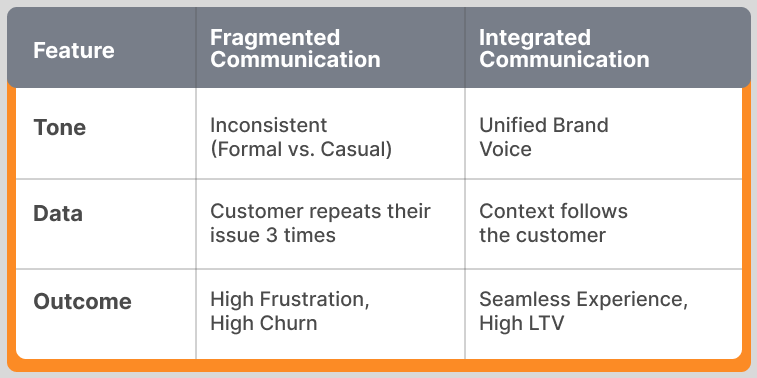
3. The Cost of Communication Silos
When technical teams, marketing teams, and support teams don’t align their messaging, the customer experiences “brand schizophrenia.”
4. Engineering a Communication Strategy
To treat communication as the backbone of CX, companies must approach it with the same rigor they apply to their tech stack:
- Omnichannel Consistency: Ensure that the answer a user gets on Twitter matches the answer in the Knowledge Base.
- Personalization at Scale: Use CRM data to ensure messages are relevant. A power user shouldn’t receive “Getting Started” tips.
- Humanity in Automation: Use AI and bots for speed, but always provide a clear “escape hatch” to a human representative for complex emotional or technical issues.
Final Thought
In a world where features are easily replicated, how you speak to your customers is your most defensible competitive advantage. Communication isn’t just a department; it is the fundamental infrastructure upon which every successful Customer Experience is built. Contact us today to start your CCM journey.
Whitepaper – Mapping the Last Mile: Integrating CCM into the Customer Journey
This whitepaper examines the “Communication-Experience Gap” and demonstrates how integrating Customer Communication Management (CCM) with journey mapping—specifically through Quadient Inspire Journey—transforms static strategy into dynamic, real-time customer orchestration.