


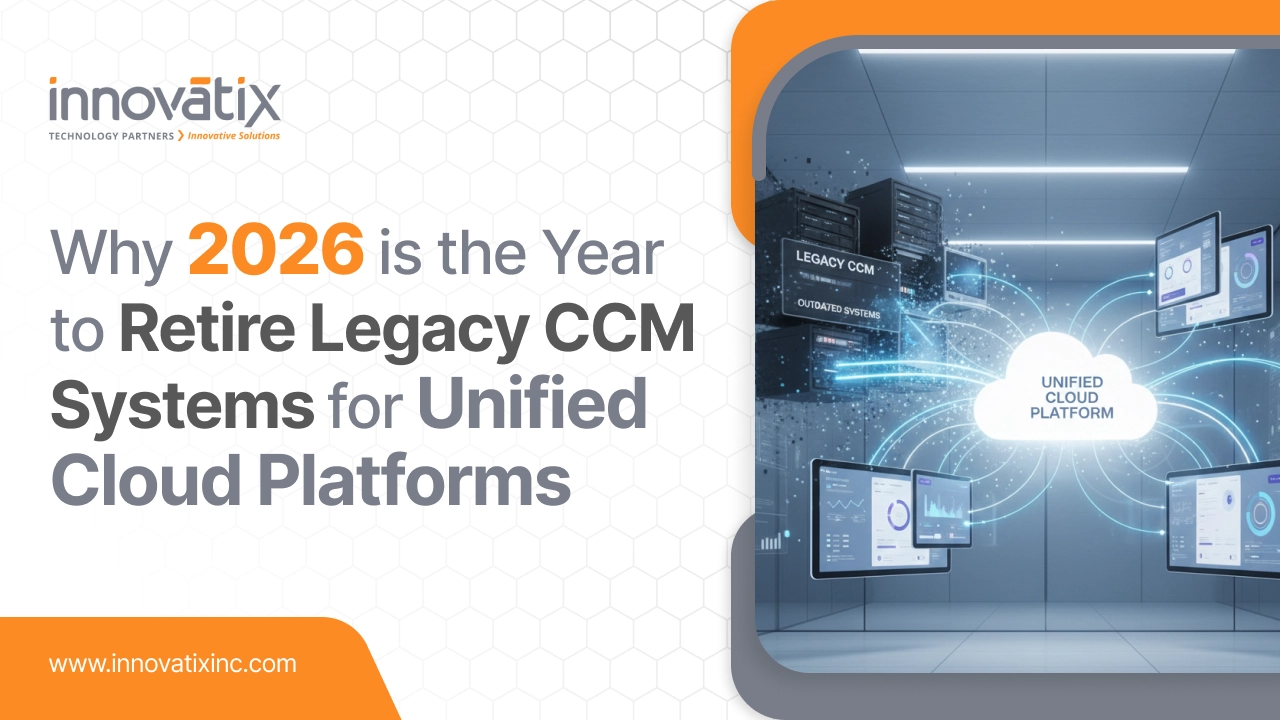
The digital first era is long established and in terms of customer communications, there has never been greater pressure to deliver seamless and consistent experiences across all channels. The monolithic systems, Legacy Customer Communications Management (CCM) solutions, which many organizations continue to use, simply cannot match the pace, safety, and scale requirements of the contemporary business environment anymore.
Legacy CCM Systems State
The old CCM systems are burdened with various deep-rooted issues that undermine operational effectiveness and inflate costs. Their dependency on proprietary, on-premises hardware and manual patching stimulate an increasing total cost of ownership with an IT budget under pressure. Lack of integration is caused by point-and-click connectors and the lack of powerful APIs, dividing data streams and making teams replicate their work. Background legacy operating-system and platform stacks increase vulnerability. Patch lag leaves the organization vulnerable to security breach and regulatory fines. Lastly, a native print-centric design makes the system ill-equipped to expand to richer and mobile-first content, trapping the enterprise in a legacy model of operation, which can no longer keep up with the current digital needs.
Past versions of CCM platforms were developed in a world where the majority of customer communications occurred through letter, fax, or email through a single channel. They were geared towards mass print workflows as well as fixed, template outputs. Consumers now require real-time/personalized multichannel (email, SMS, push, web, chatbot) messaging which it is possible to interact with and manage in a single, unified location. That cannot be supported by the old systems without extensive, custom development.
Whitepaper – Journey-Centric CCM: Connecting Quadient Inspire to Live Journey Maps for Instant Feedback
This whitepaper explains how to bridge the “Great Divide” between customer experience intent and communication reality by integrating Quadient Inspire with live journey mapping tools to transform static documents into real-time feedback sensors.
Why 2026 Is a Pivot Point
The year 2026 represents a critical juncture where cloud maturity, regulatory mandates, and the need for rapid innovation converge to make legacy system retirement essential.
1. Cloud Adoption Maturity
The shift toward cloud-native solutions is driven by a massive surge in investment, with enterprise cloud spend reaching $600 billion in 2025, marking a 20% year-over-year increase. As we move through 2026, the majority of this capital is being directed toward SaaS and managed services that offer organizations more predictable pricing and an accelerated time-to-value.
This financial transition is further necessitated by intense regulatory momentum, as frameworks like GDPR, CCPA, and new EU digital-rights mandates now require advanced capabilities such as real-time audit trails, data residency controls, and automated consent management. While these critical compliance features are built directly into modern, cloud-native CCM platforms, they are seldom found in aging legacy stacks, making a platform migration essential for maintaining legal and operational integrity.
2. Cost Efficiency
In 2025, enterprise cloud spending hit a significant milestone of $600 billion, reflecting a 20% year-over-year growth. Heading into 2026, the market is shifting as the majority of this investment is directed toward SaaS and managed services, which provide organizations with more predictable pricing structures and a faster time-to-value compared to traditional models.
Beyond financial trends, the move to the cloud is fueled by a tightening regulatory landscape, including GDPR, CCPA, and new EU digital-rights frameworks. These regulations now mandate sophisticated features like real-time audit trails, automated consent management, and strict data residency controls. While cloud-native CCM platforms are built with these compliance tools integrated from the start, they are rarely available in older, legacy technology stacks.
3. Innovation Velocity
Modernizing your CCM system significantly accelerates innovation velocity by replacing rigid monoliths with flexible, AI-powered tools. Contemporary platforms now come equipped with native AI and automation features, such as natural language generation and advanced content personalization, which previously required complex, custom development in legacy environments.
Furthermore, these cloud-native systems empower developers through unified development practices, utilizing RESTful APIs, low-code workflows, and containerized micro-services. This architectural shift allows teams to extend functionality and integrate new features rapidly, overcoming the technical hurdles that typically stall progress in older systems
Meet The CCM Leaders, Cloud-Native
This section highlights top-tier, cloud-native solutions like Quadient Inspire Evolve and OpenText, which define the modern standard for scalable and secure customer communications.
1. Quadient Inspire Evolve
Quadient Inspire Evolve is a leading cloud-native CCM solution designed as a fully managed, multi-tenant SaaS product that eliminates the need for on-premises hardware or traditional licensing. It features a single authoring interface that empowers users to design content for email, print, web, and mobile, complete with real-time previews across all formats to ensure a consistent customer experience.
Security and compliance are central to the platform, as it is ISO 27001 and SOC 2 Type II certified, as well as GDPR-ready. To further protect sensitive information, Inspire Evolve includes built-in data-at-rest encryption and robust access controls, providing a secure environment for enterprise communications.
2. OpenText Customer Communications Management
The OpenText Customer Communications Management (CCM) platform is designed to significantly improve customer service quality by providing a unified source of truth for all documents, policies, and compliance artifacts. As an integral component of the OpenText Content Suite, it ensures that every piece of communication remains consistent and compliant throughout the entire content lifecycle.
Following the 2025 Cloud Release, the platform now features a robust series of REST API interfaces and microservices that allow for rapid integration, personalization, and automation. Additionally, organizations benefit from advanced, built-in analytics dashboards that track channel-based engagement, conversion rates, and regulatory compliance adherence in real time.
Why Innovatix Technology Partners is the Trusted Bridge
With more than a decade of certified experience in Quadient and OpenText implementations, Innovatix Technology Partners has guided over 40 organizations through seamless migrations to the Quadient Inspire Cloud and OpenText CCM, demonstrating its deep platform expertise. We provide a complete end-to-end solution, which includes a needs assessment process to the customized solution design, detailed data migration, and seamless go-live implementation, and the post-implementation support. The change practice of Innovatix (comprising of extensive training, adoption analytics and continuous improvement programs) will ensure that new solutions are adopted and optimized throughout the enterprise. In addition, security architects are used to mitigate strong data residency, encryption, and audit-logging controls that meet high regulatory standards like GDPR, CCPA, and PCI-DSS, which provide the customers with a sense of assurance that their data will be safe during the journey.
Migration Roadmap
Innovatix Technology Partners utilizes a structured six-step process to transition organizations from legacy assets to scalable, cloud-native communication platforms.
- Discovery & Readiness Assessment – Determine legacy CCM assets, integration points, and regulatory requirements.
- Gap Analysis/ Strategy Map previous workflows to cloud capabilities, focusing on high-impact use cases.
- Migration of Data and Processes – Take advantage of the automatic tooling in Innovatix to move templates and data and workflows to Quadient Inspire Evolve or OpenText CCM.
- Pilot & Validate – The controlled launch with a key customer segment; repeat using real-world metrics.
- Full-Scale Rollout – Scale to enterprise wide use, and take advantage of cloud elasticity to deal with seasonal spikes.
- Constant Improvement Processes – Use embedded analytics and AI to perfect personalization, automate approvals, and comply with regulations.
Bottom Line
Outdated CCM is a bottleneck and slows down agility, increases cost, and endangers compliance. Cloud-native applications such as Quadient Inspire Evolve and OpenText CCM provide integrated, secure, and scalable communications to satisfy the requirements of contemporary, omnichannel customers.
Innovatix Technology Partners offers the knowledge, resources, and collaboration required to phase out legacy systems without any fear and realize the ROI of a cloud-first approach to communication.
It’s 2026. The market, the regulatory environment and the technology are all in sync to ensure that the transition is not only beneficial, but absolutely necessary. Now is the time to act in case your organization is still bound to old CCM.
Are you willing to retire your old legacy CCM and adopt the single cloud platform of the future? Contact us now to receive a free evaluation and roadmap.
Whitepaper – Journey-Centric CCM: Connecting Quadient Inspire to Live Journey Maps for Instant Feedback
This whitepaper explains how to bridge the “Great Divide” between customer experience intent and communication reality by integrating Quadient Inspire with live journey mapping tools to transform static documents into real-time feedback sensors.