


For a long time, Customer Communications Management (CCM) was the “basement technology” of the enterprise—functional, necessary, but often ignored until something broke. It was the land of monolithic servers, rigid PDF templates, and batch processing cycles that ran overnight.
However, by 2026 the basement is cleared out. The shift toward cloud-native CCM platforms isn’t just a trend; it’s a total architectural overhaul. When your organization is still dragging on-premise legacy software or even so-called cloud-hosted (also known as pushing old software into a VM) offerings, you are not merely working with technical debt, you are losing a competitive edge that is increasingly becoming hard to regain. This is why cloud-native CCM is becoming a reality today, and why it is a game of high stakes to wait any longer to migrate.
1. Cloud-Native vs. Cloud-Hosted: The Critical Distinction
We must first answer the question of what before getting into the question of why. Most vendors say that they are in the cloud, yet there is an enormous performance difference between cloud-hosted and cloud-native.
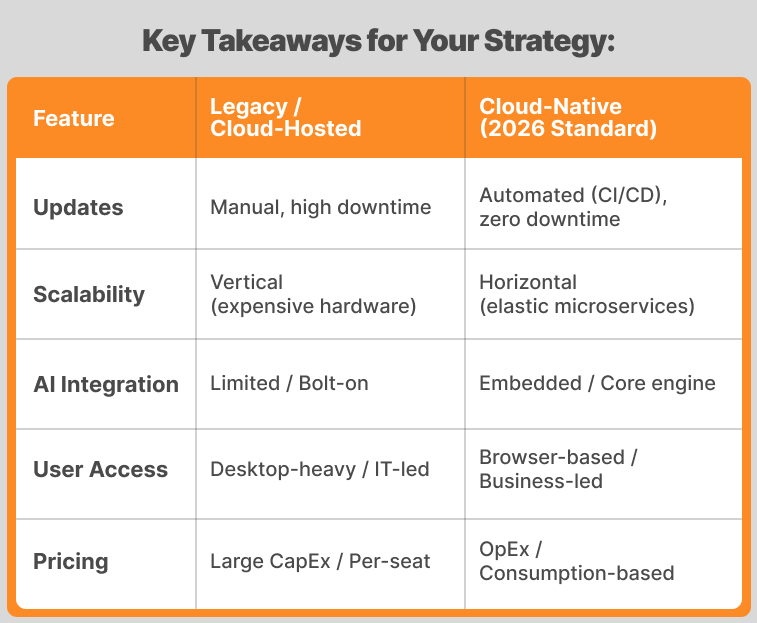
- Cloud-Hosted: It is old software that has been moved to a cloud environment without any modifications. It still behaves like a monolith. It is manually patched, is slow to scale, and can be painfully slow to change the interface, which remains as clunky as in 2010.
- Cloud-Native: Built specifically to run on the cloud, based on microservices, containers (such as Docker), and APIs. It is modular. In case the “email delivery” service requires additional power during one of the high-volume periods, it scales on its own without impacting the “template design” service. By adopting a true Microservices CCM Architecture, businesses can swap out individual functional components without risking the stability of the entire communication ecosystem.
The latter is preferred in the market in 2026. As per the latest industry statistics, the Total Cost of Ownership (TCO) of organizations employing true cloud-native architectures is reduced by 30-50 percent in five years when compared to its counterparts using a legacy architecture.
2. The Death of the “Batch” Mentality
The legacy CCM was designed to be used during the paper mail age with the large batches of statements being processed once a month. Now, customers do not want to see a monthly statement, they want a notification in real time as soon as a transaction has been carried out.
Cloud-native platforms enable event-driven communications. Because they are integrated via lightweight APIs into your CRM and billing systems, they can trigger a personalized WhatsApp message, push notification, or email the moment an “event” (like a claim submission or a late payment) happens. This shift allows the software to function as a complete Omnichannel Orchestration Platform that synchronizes messaging across every touchpoint in the customer journey.
The 2026 Reality: 71% of businesses today will now claim that they are delivering customer communications more quickly since moving to cloud-native services. In an age where time is money, there is no such option as overnight processing.
Whitepaper—Intelligent Automation in CCM: Leveraging AI and Data-Driven Rules for Smarter Communications
This whitepaper explores how intelligent automation, driven by AI and machine learning, is transforming customer communications from static document output into a strategic intelligence layer that enhances personalization, compliance, and operational efficiency.
3. Democratizing Design: Breaking the IT Bottleneck
One of the most human frustrations with legacy CCM is the “request loop.” They will send a ticket to IT. IT puts it on the queue. The change is live after six weeks.
Cloud-native platforms have thin-client interfaces based on browsers enabling business users to change the system in a controlled environment-marketers, legal teams, and product managers.
- Controlled Authoring: The text is edited by business users.
- Locked Templates: IT and Legal make sure that the branding and compliance logic is not touchable.
- Instant Preview: Preview the message directly on a smartphone and a desktop and see how the message will appear in each case.
This brings the speed to market into the range of weeks down to minutes.
4. AI is No Longer an Add-on—It’s the Engine
AI is no longer a cool feature but a part of CCM by 2026. Cloud-native platforms are in a unique position to make use of AI, as they can access the huge capacity of hyperscalers (AWS, Azure, Google Cloud).
AI is now utilized on modern CCM sites to:
- Sentiment Analysis: A customer has had a recent history of interactions with the collection letter, and it automatically adjusts the tone.
- Content Optimization: Recommending the reduction of complex legal terminology and the elaboration of it by shorter and more understandable forms to support customer understanding.
- Hyper-Personalization: Moving beyond “Dear [First_Name]” to generating dynamic content blocks that reflect a customer’s specific journey.
Trying to run these AI models on an old on-premise server is like trying to run a modern video game on a calculator—it’s technically impossible and practically useless.
5. Security and Compliance in a “Sovereign” World
One of the myths associated with cloud computing is that the cloud is less secure than on-premise. However, this is not the case in 2026. CCM providers who are cloud-native spend more on security than any single enterprise can spend.
As Sovereign Cloud demands and stringent data residency regulations have emerged, cloud-native platforms provide Data Isolation and Zero Trust architectures. They enable you to go global and at the same time guarantee that the data of a customer in Germany does not leave Germany, by all means, and all this is controlled by one and the same dashboard. Modernizing your stack ensures you stay ahead of evolving CCM Compliance and Data Sovereignty rules that demand local data processing and rigorous audit trails.
6. The “Skills Gap” and Talent Retention
There is a practical, human reason to migrate: No one wants to work on 20-year-old legacy systems. As the workforce shifts, finding engineers who understand COBOL or proprietary legacy CCM scripting languages is becoming difficult and expensive. Younger talent expects to work with modern stacks—REST APIs, JSON, and CI/CD pipelines. Migrating to a cloud-native platform isn’t just a tech upgrade; it’s a talent strategy. It ensures your team is using tools that make them productive, not frustrated.
Why Migrate Now?
The “Wait and See” approach has officially expired. Here is the bottom line:
- Maintenance Costs are Spiking: Vendors are raising support fees for legacy products to “encourage” migration.
- Omnichannel is the Minimum: Customers move between 4+ channels (app, web, SMS, email) in a single journey. Legacy systems cannot maintain the “thread” of that conversation; cloud-native platforms can.
- ROI is Proven: 83% of organizations report a measurable ROI within 12 months of moving to a cloud-native CCM. A detailed audit often reveals a significant Legacy CCM Migration ROI, driven by the elimination of expensive server maintenance and the reduction of manual IT tickets.
Final Thoughts
Migration can be considered as a rip and replace nightmare, but the recent cloud-native architectures can be migrated in phases. The transition is further simplified by AI-Powered Template Migration tools that automatically ingest and convert legacy document logic into modern, cloud-ready formats. You are not required to transfer 10,000 templates on the first day. You can start with your most critical digital channel, prove the value, and sunset the legacy “dinosaur” in stages.
The rise of cloud-native CCM isn’t about moving your problems to someone else’s computer. It’s about finally having a platform that moves at the speed of your customers. The question isn’t whether you will migrate—it’s whether you’ll do it before or after your competitors have already captured the digital-first market.
Whitepaper—Intelligent Automation in CCM: Leveraging AI and Data-Driven Rules for Smarter Communications
This whitepaper explores how intelligent automation, driven by AI and machine learning, is transforming customer communications from static document output into a strategic intelligence layer that enhances personalization, compliance, and operational efficiency.