


Technology organizations spend considerable time finding and hiring people with the right technical skills. But when a project wraps up or priorities change or a team gets shaken up, what happens to all that vetted and proven talent? Far too often, the answer is all too simple: the assignment is done, and the organization starts sourcing again for the next requirement.
That approach tends to overlook a valuable workforce strategy: talent redeployment.
Talent redeployment is all about moving people who are good at their job from projects that are wrapping up to areas where their skills are being needed right now. For IT companies, this can help hold onto valuable technical knowledge, make workforce a whole lot more agile, and make better use of people who already have a good understanding of the business.
Whitepaper: The Modern IT Workforce Operating Model
This whitepaper explores how enterprises can bring greater visibility and control to their extended IT workforce by aligning talent, capacity, suppliers, governance, and delivery through a modern workforce operating model.
Why IT Workforce Strategy Needs to Look Beyond New Hiring
Technology demand rarely stays constant. A cloud migration may move into its final phase while an application modernization program is just beginning. A product launch may require additional engineering capacity for several months, followed by a reduced need for the same skill set. This creates a workforce planning challenge.
Hiring externally every time demand changes can increase sourcing effort and extend the time required to get the right capability into a project. Redeployment creates another option: look at existing capability before automatically creating a new hiring requirement.
The approach is gaining attention. Deloitte’s 2026 Global Human Capital Trends research found that 60% of leaders surveyed are working to redeploy internal capabilities such as people, technology, and expertise to areas of greatest need.
That is important because redeployment is not simply an HR activity. It is increasingly part of how organizations distribute scarce capabilities.
What Makes Talent Redeployment Different from Traditional Hiring?
Redeployment is not about moving people around randomly. It requires understanding whether a person’s experience, skills, availability, and previous project exposure match the next requirement.
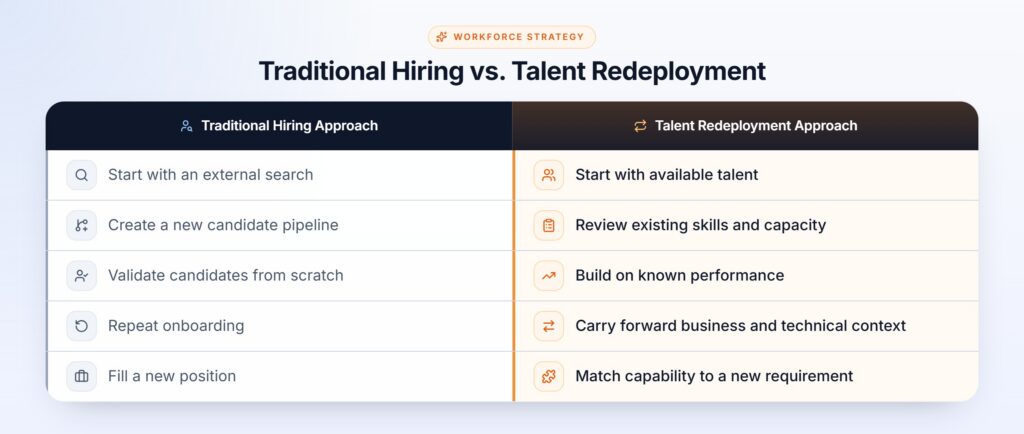
This does not mean external hiring becomes unnecessary. Instead, redeployment adds another decision point before organizations begin a new search.
The Value of Redeploying Proven IT Talent
The biggest advantage is not simply avoiding another recruitment cycle. It is the knowledge that can move with the person.
An engineer who has already worked with an organization’s development practices, security requirements, architecture, or business processes may need less time to understand the environment than someone entering it for the first time.
There can also be a retention benefit. LinkedIn’s 2024 analysis found that companies with high internal mobility had 53% longer employee tenures than companies with low internal mobility.
For IT leaders, this points to a broader principle: when organizations make it easier for capable talent to move toward new opportunities, they can preserve both skills and institutional knowledge.
How Enterprises Can Make Redeployment Practical
A practical talent redeployment process can follow four steps:
- Map available skills – Maintain a current view of technical skills, certifications, domain experience, project history, and availability.
- Identify upcoming demand – Look at the technology roadmap and determine which capabilities will be needed next.
- Match talent to requirements – Compare available resources against upcoming roles, taking technical fit and project context into account.
- Validate before moving – Confirm that the person has the required expertise, can adapt to the new environment, and can contribute within the project’s expected timeframe.
This is where skills visibility becomes critical. SHRM reported that 35% of organizations used an internal talent marketplace in 2025, compared with 25% in 2024, reflecting greater adoption of tools that match employees to projects, roles, and opportunities.
Where Staff Augmentation Fits into the Strategy
Talent redeployment does not have to be limited to permanent employees.
Enterprises using IT staff augmentation can also take a more deliberate approach to resource continuity. When an engagement changes, a staffing partner can help identify whether an experienced professional may be suitable for another project, subject to skills, availability, and client requirements.
This creates a more flexible workforce model where external technical talent can support changing business demand rather than being viewed only in terms of one assignment.
Innovatix’s IT Staff Augmentation Services support organizations with specialized IT professionals, hybrid teams, and flexible workforce solutions designed to scale technical capacity according to project requirements.
Frequently Asked Questions
- What is talent redeployment?
Talent redeployment is the practice of moving existing employees or proven resources from one project, role, or area of work to another based on skills, business demand, and availability. It helps organizations make better use of existing capabilities before automatically turning to external hiring.
- How does talent redeployment benefit IT organizations?
Talent redeployment can help IT organizations retain technical knowledge, reduce repeated sourcing efforts, respond faster to changing project demand, and make better use of proven technical capabilities.
- Is talent redeployment the same as internal mobility?
They are closely related but not identical. Internal mobility generally refers to employees moving into new roles within the same organization. Talent redeployment is broader and can include moving people or resources to different projects or areas of work based on changing business requirements.
Whitepaper: The Modern IT Workforce Operating Model
This whitepaper explores how enterprises can bring greater visibility and control to their extended IT workforce by aligning talent, capacity, suppliers, governance, and delivery through a modern workforce operating model.