



Customer communications don’t stand still – as your business rolls out new products, updates policies, expands into digital channels and deals with changing regulations, your overall communication needs to adapt too.
With every change, it is not uncommon for organizations to create new communication templates, tweak the legacy ones or come up with different versions for different types of customers. Before long, you could find yourself juggling hundreds or even thousands of templates; a lot of which probably aren’t really doing justice to your brand anymore.
A solid Customer Communications Management (CCM) strategy needs to cover all the bases, right from creating and approving new templates to keeping things up to date and eventually getting rid of older templates. Without a clear plan, template libraries can become a source of operational complexity, inconsistent messaging and avoidable risk.
How Legacy Templates Become an Operational Liability
Templates are often created to address immediate business needs. A new product may require a separate statement, a regulatory update may trigger a revised notice, or a business unit may create its own version of an existing communication.
Individually, these decisions may be reasonable. However, when old versions remain active alongside their replacements, the number of assets requiring maintenance and oversight continues to grow.
This creates several challenges:
- Increased maintenance effort – Teams must manage multiple versions of similar communications, even when their differences are minimal.
- Inconsistent messaging – Outdated templates may contain superseded branding, product information, or regulatory language.
- Longer change cycles – Teams must identify every affected template before implementing a common update.
- Greater testing complexity – More templates and dependencies create additional scenarios to validate before changes reach production.
Innovatix Technology Partners addresses this challenge through its CCM Migration Solutions, which includes inventory rationalization to identify redundant templates before migration. The same principle applies to established CCM environments: organizations should understand which communication assets still provide value before continuing to maintain them.
Which Templates Should Be Retired?
Not every legacy template needs to be removed. Some support essential regulatory, contractual, or historical requirements. The decision should depend on business relevance, actual usage, dependencies, and retention obligations rather than age alone. A structured review can help organizations distinguish useful assets from unnecessary complexity.
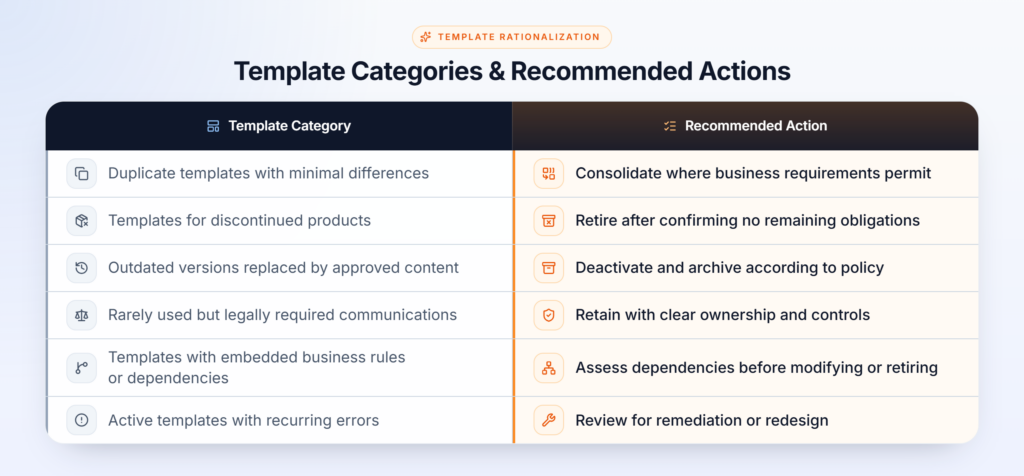
This assessment should also consider how templates connect to business rules, data sources, approval workflows, and delivery channels. Removing a template without understanding these dependencies can disrupt downstream processes.
How to Retire Legacy Templates Without Disrupting Communications
Template retirement requires the same discipline as template creation. Removing an asset prematurely can affect customer communications, while retaining unnecessary assets indefinitely creates ongoing maintenance work.
A controlled retirement process should include four steps.
- Audit the existing inventory
Document each template’s purpose, owner, last usage, associated products, business rules, integrations, and supported channels. Usage data can help identify potential retirement candidates, but it should be checked against business and regulatory requirements.
- Confirm dependencies and ownership
Before deactivation, consult the teams responsible for the relevant communication. Confirm whether the template is referenced by automated workflows, scheduled jobs, applications, or customer-specific processes. Establish who approves the retirement decision.
- Validate the replacement or retirement decision
Where templates are consolidated, test the revised asset against relevant business scenarios. Check content, data mapping, conditional logic, formatting, accessibility, and compliance requirements. Innovatix’s CCM Quality Assurance services include systematic validation and regression testing to help identify issues before they affect production outputs.
- Deactivate, archive, and document
Remove the template from active production only after the necessary approvals and validations are complete. Preserve historical versions and records according to organizational retention policies. Update the inventory and document the reason for retirement so teams understand which asset should be used going forward.
Make Template Retirement Part of CCM Governance
A one-time cleanup can reduce existing complexity, but it will not prevent the same problem from returning. New templates will continue to be created as business requirements change. Enterprises therefore need clear rules governing when a template should be created, reused, modified, reviewed, or retired.
A sustainable approach should establish:
- Ownership – Every active template should have an accountable business owner.
- Standardization – Teams should reuse approved content and shared components where appropriate instead of creating unnecessary variations.
- Periodic reviews – Template inventories should be reviewed at defined intervals and whenever significant product, regulatory, or process changes occur.
- Lifecycle controls – Approval, versioning, deactivation, and archival procedures should be documented and followed consistently.
These practices also complement CCM Workflow Automation and Optimization, which focuses on simplifying complex template structures, modularizing content, and reducing template bloat.
Conclusion
Legacy communication templates rarely become a problem overnight. They accumulate as products change, policies evolve, and business teams create new variations without consistently retiring the assets they replace.
An effective CCM strategy must therefore define not only how communication templates are developed and deployed, but also how they are reviewed, consolidated, and retired.
By establishing clear ownership, assessing dependencies, validating changes, and enforcing lifecycle governance, enterprises can reduce unnecessary complexity without compromising essential communications or compliance obligations.
Whitepaper – Beyond Go-Live: A Framework for Continuous Optimization of Enterprise CCM
This whitepaper explains why CCM performance needs ongoing attention after implementation. It introduces a five-stage framework for establishing baselines, identifying bottlenecks, prioritizing improvements, validating changes, and measuring results. Readers will also find key performance indicators, operating model considerations, and a practical 90-day roadmap for sustaining reliable, efficient, adaptable customer communications.