



When a business is looking to bring in a technology expert on board, it is often a pretty straightforward choice: just go ahead and hire them as a permanent employee or bring in a contractor to do the job on a project-by-project basis.
But what if the role is super important and the company just isn’t ready to take the plunge and make a long-term commitment to that person yet? That is where contract-to-hire in IT can be a smart move for an organization.
The model lets both sides get a feel for how they are going to work out together in a real-world working situation, before deciding whether to make the relationship permanent. For the employer, that means getting a better read on how well the person they are considering fits the job – beyond all the discussions that happened during the interview.
For the professional, it gives time to see what the actual job is like and get a feel for whether working with their potential manager and the team is a good fit for them before making a long-term commitment.
The model is becoming way more relevant as technology teams start to find a balance between getting projects done right away and planning for their workforce needs down the line. Robert Half’s 2026 research discovered that 66% of technology leaders are planning to bring in more contract talent in the second half of 2026, while 78% are looking to increase their permanent headcount. The numbers suggest that the trend is towards using a mix of both permanent and contract workers rather than being an either/or choice.
Whitepaper – The IT Staffing Procurement Framework: Standardizing Commercial and Performance Terms Across Talent Suppliers
This whitepaper presents a practical framework for standardizing IT staffing procurement across talent suppliers, helping enterprises align commercial terms, delivery expectations, quality measures, continuity requirements, compliance controls, and performance metrics. It provides procurement and technology leaders with a structured approach to creating greater consistency, accountability, and value from staffing partnerships.
Contract-to-Hire Makes the Most Sense When the Permanent Decision Is Unclear
Contract-to-hire should not be seen as the default to filling a gap just because you can’t seem to find the right person to hire directly. Its real value lies in situations where you are genuinely unsure whether this person is going to be right for the job and a working contract can help you figure that out.
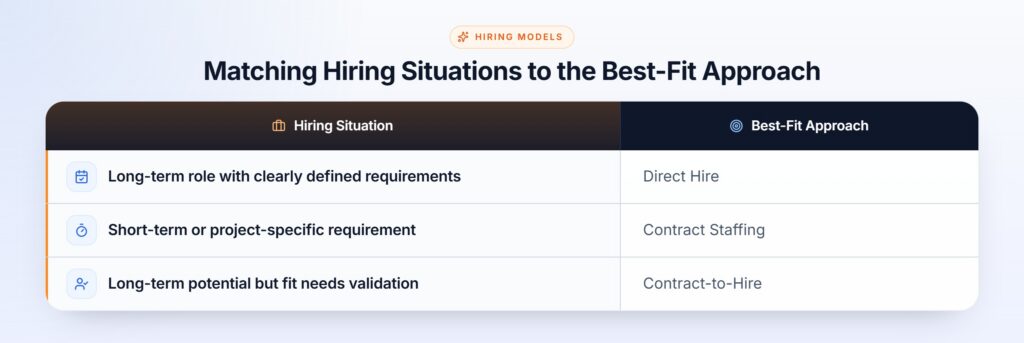
For example, a company may know it needs a senior software engineer, but still have questions about how the role will evolve after a major modernization project. A contract-to-hire arrangement can provide time to understand the actual need before making a permanent decision.
Three Situations Where C2H Can Reduce Hiring Risk
- The Role Is Important, but the Long-Term Need Is Still Evolving
Technology projects change quickly. A role created to support a cloud migration may later evolve into a broader platform engineering position. Contract-to-hire gives the organization room to understand that evolution before locking the role into a permanent structure.
- Technical Fit Is Difficult to Judge in an Interview
A resume and interview can establish experience, but they do not always show how someone works within an actual engineering environment. A contract period gives managers the opportunity to observe how a professional approaches problems, communicates with the team, handles production realities, and works within existing processes.
- Both Sides Need Confidence Before Making a Commitment
A permanent hire is a two-way decision. The organization needs confidence in the candidate, but the candidate also needs confidence in the organization. That is one of the strongest arguments for C2H. It creates a period where both parties can make a more informed decision based on actual experience rather than assumptions.
The Business Case Goes Beyond a “Trial Period”
Calling contract-to-hire a “try before you commit” model is useful, but it understates its strategic value. Quess Corp’s Q4 FY26 GCC Trends Report found that C2H roles showed an estimated 15–20% improvement in retention compared with direct permanent hiring for specialized roles.
The same report says C2H deployments typically achieve 40–50% faster onboarding than traditional permanent hiring cycles. These figures are specific to GCCs, but they illustrate why C2H can be attractive when organizations need both flexibility and longer-term talent stability. The real advantage is therefore not simply delaying a hiring decision. It is gaining more information before making one.
What Should Organizations Evaluate During the Contract Period?
A successful C2H arrangement needs clear evaluation criteria. Otherwise, the contract period can become nothing more than an extended waiting period.
Organizations should assess:
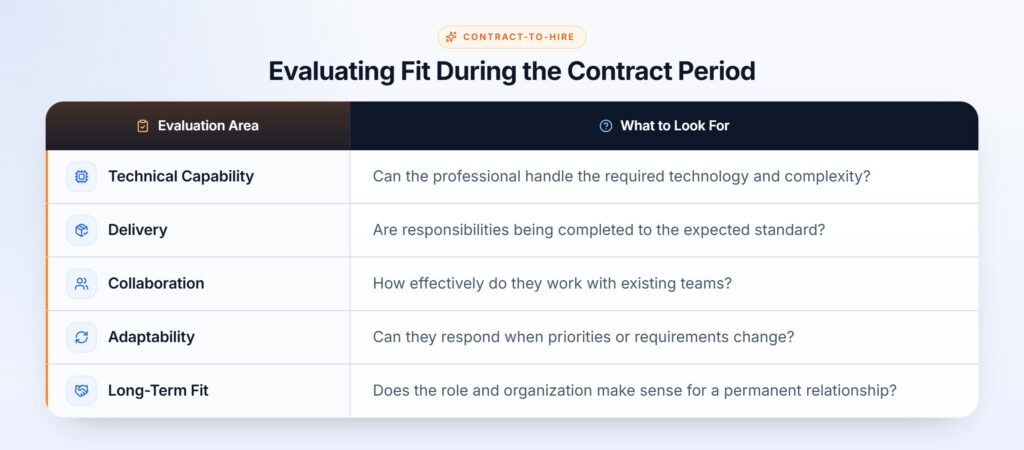
The evaluation should also be discussed upfront with the candidate. Clear expectations make the eventual conversion decision more objective and reduce uncertainty for both sides.
Where IT Staffing Partners Add Value
The effectiveness of contract-to-hire depends heavily on the quality of talent entering the process. Innovatix’s IT contract-to-hire staffing services are designed around a flexible trial phase where organizations can assess candidate performance in a real-world environment before making a longer-term commitment.
Innovatix also provides direct-hire and contract staffing, allowing organizations to select the model that best fits the role and business requirement. More broadly, Innovatix’s Professional Services & Staff Augmentation offering provides specialized technical talent and flexible workforce solutions for enterprise technology initiatives.
Bottom Line
Contract-to-hire is not automatically better than direct hiring or contract staffing.
The better question is: How much uncertainty exists around this hire, and would real-world experience help us make a better long-term decision?
When the answer is yes, C2H can provide a practical middle ground. It gives organizations access to technical expertise now while creating space to validate capability, collaboration, role fit, and future need before making a permanent commitment.
For technology leaders managing changing projects, scarce skills, and tighter hiring decisions, that flexibility can be valuable.
Whitepaper – The IT Staffing Procurement Framework: Standardizing Commercial and Performance Terms Across Talent Suppliers
This whitepaper presents a practical framework for standardizing IT staffing procurement across talent suppliers, helping enterprises align commercial terms, delivery expectations, quality measures, continuity requirements, compliance controls, and performance metrics. It provides procurement and technology leaders with a structured approach to creating greater consistency, accountability, and value from staffing partnerships.
Frequently Asked Questions
- What is contract-to-hire in IT?
Contract-to-hire is a staffing arrangement in which a technology professional initially works on a contract basis with the potential to become a permanent employee later. The contract period allows both the employer and professional to evaluate the fit before making a long-term decision.
- When should a company choose contract-to-hire over direct hire?
Contract-to-hire can make sense when the role is important but the long-term requirement, technical fit, or team fit needs further validation. Direct hire is generally more suitable when the organization already has a clear, long-term requirement and high confidence in the candidate.
- How long does a contract-to-hire arrangement typically last?
There is no universal duration. Contract-to-hire arrangements can vary based on the role, project, organization, and agreed conversion process.
- What should employers evaluate before converting a contractor to a permanent employee?
Employers should look beyond technical skills and evaluate delivery performance, collaboration, adaptability, reliability, cultural fit, and whether the role continues to support long-term business needs. A clearly defined evaluation process helps make the conversion decision more consistent and evidence-based.