



A customer statement can look flawless in testing. The account number reads right, the balance appears as expected, the layout is clean, and every section is in place. But what happens when a customer’s name exceeds the expected field’s length; some data is missing, or several business rules apply to the same communication?
These situations show just how weak Customer Communications Management (CCM) testing is when it relies on the same standard test cases over and over again while ignoring all the unusual conditions that occur in real-world data.
A communication that works just great with all the usual inputs can still go totally wrong when real world data comes along with all sorts of unexpected twists and turns. For businesses churning out thousands of statements, invoices, policies and regulatory notices, testing can’t just stop at verifying that a template works when everything is perfect, it needs to go well beyond the ideal conditions.
What Is the Happy-Path Trap in CCM Testing?
The happy path refers to the expected sequence of operations when all inputs, business rules, and system conditions behave as intended.
In CCM, this often means testing a communication with standard customer records, valid data, typical content lengths, and predefined business scenarios. While these tests establish whether the basic process works, they do not necessarily reveal how the communication behaves under less predictable conditions.
Consider an invoice template tested with a customer name that fits comfortably within its designated field. During production, another customer’s name may be significantly longer, causing text to overlap with an adjacent field or extend beyond the intended layout.
The underlying template has not necessarily changed. The input conditions have. This is why CCM testing needs to account for data variations, boundary conditions, conditional logic, and output differences across communication formats.
Where Standard CCM Testing Falls Short
Edge cases can emerge at almost every stage of communication generation. Some are related to input data, while others involve business rules, content, document rendering, or channel-specific behavior.
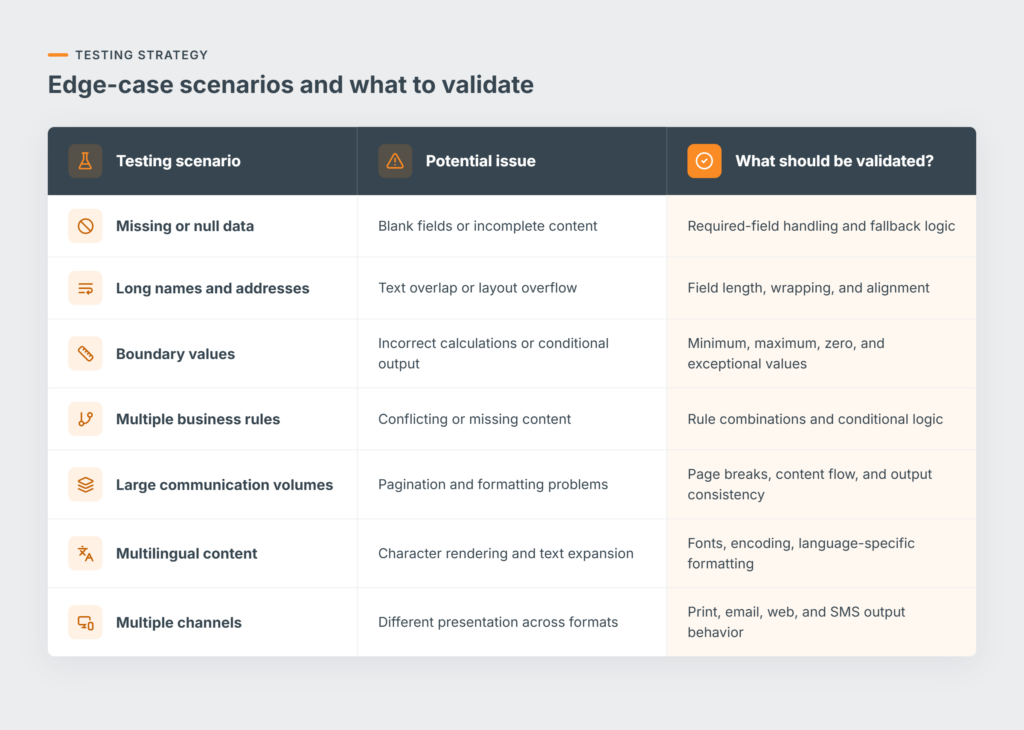
For example, a banking statement may calculate balances correctly for a typical account but display incorrect information when a customer has no transactions, a negative balance, or multiple account conditions. Similarly, an insurance communication may include the correct standard disclosure but omit another mandatory clause when a particular coverage condition is triggered. These scenarios require deliberate test cases rather than relying on a small collection of sample outputs.
Five Areas Enterprises Should Include in CCM Testing
- Data Variations and Boundary Conditions
CCM templates frequently depend on variable data such as names, addresses, transaction amounts, dates, account balances, and product details.
Testing should include missing values, unusually long strings, special characters, numerical boundaries, and different data combinations. OWASP’s input validation guidance reinforces the importance of checking both the format and meaning of incoming data.
The objective is to confirm that communications remain accurate and readable even when inputs differ from standard examples.
- Conditional Logic and Business Rules
A single communication may contain multiple conditions governing which sections, messages, disclosures, or offers appear.
Testing only individual rules may miss problems that emerge when several conditions interact. Enterprises should therefore validate combinations of business rules, conflicting conditions, missing prerequisites, and unexpected input combinations.
- Layout and Pagination
Content expansion can affect the entire document. A longer explanation, additional transaction entries, or an extra disclosure may push content onto another page, displace a footer, or create an unexpected blank section.
Visual validation should examine more than the first page. It should cover page breaks, alignment, typography, headers, footers, and the placement of mandatory information.
- Multilingual and Channel-Specific Output
Communications may need to support different languages, character sets, and delivery formats. Accented characters, non-Latin scripts, right-to-left languages, and translated content can introduce rendering challenges.
Digital communications also require appropriate accessibility checks. For relevant web-based outputs, the WCAG 2.2 guidelines provide a reference for evaluating accessible content and presentation.
- Regression Testing After Every Significant Change
A change to one template component or business rule can unintentionally affect other communication outputs that reuse the same logic or content.
Regression testing helps establish whether previously working scenarios continue to behave correctly after modifications. Output comparison can also reveal formatting differences that functional checks might not detect.
Building a More Reliable CCM Testing Approach
Enterprises can make edge-case coverage part of their regular QA process through a structured approach:
- Identify variation factors: Document the data fields, business rules, content conditions, and channels that influence each communication.
- Create scenario-based test sets: Include typical records, boundary values, missing data, conflicting conditions, and exceptional cases.
- Combine automated and manual validation: Automate repeatable data and output checks while using human review for readability, content clarity, and presentation.
- Maintain reusable test scenarios: Preserve representative test data and expected outputs so the same scenarios can be executed after future changes.
- Review defects and expand coverage: Use production issues and recurring defects to identify missing test scenarios and improve future test cycles.
Innovatix’s CCM Quality Assurance services align with this approach through document and logic verification, data-driven testing, regression testing, migration validation, and output comparison across communication channels.
Conclusion
Successful CCM testing should not be measured solely by how well a communication performs under ideal conditions. It should also establish how reliably that communication handles unusual data, interacting business rules, expanding content, and different delivery formats.
By incorporating edge cases into test design, enterprises can identify problems that standard scenarios may overlook, strengthen communication accuracy, and reduce the likelihood of defects reaching customers.
Frequently Asked Questions
- What is edge-case testing in CCM?
Edge-case testing in Customer Communications Management involves validating how communication templates and workflows behave under unusual or less predictable conditions. This includes missing data, unusually long customer details, boundary values, conflicting business rules, and variations in content or delivery formats.
- Why is standard testing not enough for CCM platforms?
Standard testing generally verifies whether a communication works under expected conditions. However, real-world customer data and business requirements can introduce variations that standard test scenarios may not cover. Edge-case testing helps identify potential errors in data mapping, conditional logic, document layouts, and channel-specific outputs before they reach customers.
- Which scenarios should enterprises prioritize when testing CCM outputs?
Enterprises should prioritize scenarios involving missing or invalid data, boundary values, long text fields, multiple business-rule combinations, pagination, multilingual content, and different delivery formats. Testing should also include regression scenarios to ensure that changes to templates or business logic do not affect previously validated communications.
Whitepaper – Can You Prove What the Customer Received? A Framework for End-to-End CCM Traceability
This whitepaper presents a practical framework for end-to-end CCM traceability, showing how enterprises can connect communication triggers, data references, business rules, content versions, validation results, and delivery records. It explains how to build a retrievable evidence trail, improve investigation readiness, protect sensitive records, and distinguish generation, dispatch, delivery, and confirmed customer interaction.