



Customer communication doesn’t go wrong just because of one thing. The usual suspects though – incorrect data, missing business-rule inputs, template errors, integrations that don’t work and problems delivering the message are all common. And if there is no system in place to catch and sort out these exceptions, what starts out as a minor operational glitch can quickly turn into a regular headache for the customer service team and a risk for the business too, with compliance hanging precariously in the balance.
The business impact is serious. According to a 2026 Customer Experience Benchmark put together by Smart Communications (using data from around 4,000 customers), a whopping 43% said they would get in touch with customer service instead of just dealing with a process digitally because the communications were unclear. And 63% said they would actually think about switching providers if communications failed to meet their expectations.
What Counts as a CCM Exception?
An exception occurs when a communication process cannot proceed as expected or produces an output that fails a defined requirement. These issues can emerge at different stages, so treating every failure as the same type of incident can delay resolution.
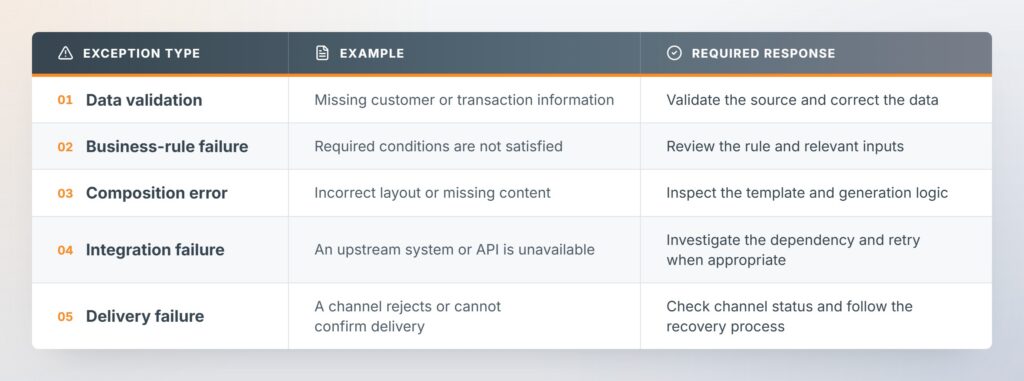
This classification helps teams determine whether an issue requires data correction, technical intervention, business approval, or delivery recovery.
Why Exception Management Often Falls Short
Many CCM environments generate technical logs and error notifications, but these do not always translate into effective operational action.
A failed job may identify an error code without explaining which communication was affected, how many customers are involved, whether a deadline is approaching, or who owns the next step. If teams investigate incidents manually, similar failures may recur before the underlying cause is addressed.
Uncontrolled retries can also create problems. If the original request actually succeeded but the confirmation was delayed, processing it again could produce duplicate communications. Recovery must therefore consider the status of the original transaction before repeating the action.
An effective exception management strategy connects technical monitoring with business context, accountability, and controlled recovery.
How to Build an Effective CCM Exception Management Strategy
- Detect and classify exceptions
Capture failures at relevant stages, including data ingestion, composition, validation, workflow execution, and delivery. Assign consistent categories so teams can identify patterns rather than investigate each incident from scratch.
- Prioritize by business impact
Not every exception has the same urgency. A defect affecting a regulatory notice or a large volume of customer statements may require faster intervention than a low-priority formatting issue in an internal report.
Define severity levels using factors such as customer impact, compliance exposure, communication deadlines, affected volume, and availability of a safe workaround.
- Establish clear ownership
Every exception category should have an accountable owner and an escalation path. Data-quality failures may require action from a source-system team, while rendering defects may require CCM developers or QA specialists. Business and compliance teams may need to approve content corrections before release.
- Recover through controlled workflows
Define when an exception can be retried automatically, when data correction is required, and when manual approval must be obtained. Before retrying, verify the transaction’s existing status to reduce the risk of duplicate output or delivery.
Maintain a record of the original error, corrective action, reprocessing attempt, validation result, and final status.
- Prevent recurring failures
Exception management should not end when an individual incident is closed. Review recurring error categories to determine whether the root cause is a fragile integration, inconsistent input data, a defective template, inadequate test coverage, or an unclear process.
Innovatix’s CCM Quality Assurance services support systematic document, business-rule, regression, and output validation. These practices help organizations identify defects earlier rather than relying exclusively on production incident resolution.
Measure What Happens After an Exception
Enterprises should monitor more than the total number of errors. Useful indicators include the exception rate by processing stage, time to detect, time to resolve, successful recovery rate, repeat-incident rate, and the number of communications affected.
These measures help distinguish a temporarily high exception volume from a persistent operational weakness. They also show whether corrective actions are improving reliability over time.
Through CCM Managed Services, Innovatix supports organizations with CCM platform operations, integration support, and ongoing technical management that can contribute to a more controlled operating environment.
Bottom Line
Customer communication failures cannot always be eliminated, but their impact can be controlled. A structured exception management strategy enables enterprises to detect issues earlier, prioritize them according to business risk, recover safely, and learn from recurring failures.
Frequently Asked Questions
- What is exception management in CCM?
It is the process of detecting, classifying, prioritizing, resolving, and preventing failures across customer communication workflows.
- Should every CCM exception be retried automatically?
No. Teams should verify the original transaction status, assess the error, and confirm that retrying will not create duplicate communications or repeat an unsafe operation.
- How can enterprises reduce recurring CCM exceptions?
They can analyze root causes, improve data validation, strengthen regression testing, standardize recovery procedures, and assign clear ownership to recurring issues.
Whitepaper – Can You Prove What the Customer Received? A Framework for End-to-End CCM Traceability
This whitepaper presents a practical framework for end-to-end CCM traceability, showing how enterprises can connect communication triggers, data references, business rules, content versions, validation results, and delivery records. It explains how to build a retrievable evidence trail, improve investigation readiness, protect sensitive records, and distinguish generation, dispatch, delivery, and confirmed customer interaction.