


For decades, Customer Communications Management operated quietly in the back offices of enterprise architecture. It was all about churning out monthly bills, sending out government-mandated notices, composing claim settlement letters and dispatching transactional notifications.
The people in charge of CCM were worried about one thing: getting it all done on time and in the right format. That’s what success looked like in those days – moving a lot of volume, getting those documents out fast, making sure the print queue wasn’t clogged and that all the regulatory checks were ticked.
That’s all gone now. The rapid shift to digital and the fact that people are expecting way more from brands has changed everything. The old line between ‘send a document’ and ‘deliver an actual experience’ has finally been erased. Today, people don’t just evaluate a company based on its slick marketing ads, they evaluate how well the company communicates with them – is it clear, on time, and relevant to them.
So, what was once just traditional document generation software is now turning into the foundation of what a brand’s customer experience looks like. CCM is no longer just about sending out documents, it is about being a real-time, omnichannel customer experience platform that is always on.
Whitepaper – The Communication Supply Chain: How Data, Content and Delivery Must Work Together
This whitepaper explores how enterprises can build a connected communication supply chain by aligning data, business rules, content, composition, validation, orchestration, and delivery. It examines common gaps between these stages and presents practical approaches to improving communication accuracy, consistency, compliance, and agility across the enterprise.
The Paradigm Shift: From Static Outputs to Dynamic Engagements
To understand why CCM is undergoing this migration, one must examine the fundamental shift in consumer behavior. A decade ago, receiving a PDF statement via email or a paper notice in the mail was acceptable. Today, customers interact with brands across dozens of touchpoints simultaneously: mobile apps, SMS, interactive web portals, messaging apps, and email.
Legacy CCM engines struggle in this landscape because they treat communications as static end-products. They take batch data, feed it into a visual layout template, and produce a flat file.
Modern enterprise architecture requires something fundamentally different:
- Contextual Intelligence: Communications must adapt dynamically based on real-time data, customer context, and previous interactions across every channel.
- Two-Way Interaction: A modern statement or notice is not just a broadcast; it is an active interface where customers can click, modify preferences, pay bills, ask questions, or initiate service requests directly.
- Omnichannel Orchestration: Delivering a message is no longer about pick-and-place delivery. It requires intelligent delivery orchestration, attempting SMS first, falling back to push notifications, or routing to email depending on customer preference, response history, and cost efficiency.
When CCM tools incorporate these capabilities, they stop acting as document factories and start operating as full-fledged CX engines.
Core Pillars of the Modern CCM/CX Ecosystem
Transforming transactional communications into engaging customer touchpoints requires a architecture built around flexibility, intelligence, and integration.
1. Centralized Template Management with Decentralized Control
In traditional setups, line-of-business (LOB) teams rely heavily on IT departments to alter even a single line of text or update a compliance disclosure, leading to long release cycles. Modern platforms break this bottleneck by centralizing core design systems and rule sets while enabling business users to manage localized content, brand messaging, and campaign inserts securely.
2. Microservice and Cloud-Native Integration
Today’s CCM platforms sit within complex technology stacks, pulling real-time data via REST APIs from CRMs, ERPs, core banking engines, and analytics frameworks. Communications are generated on demand, streaming personalized content in milliseconds rather than relying exclusively on overnight batch processing.
3. Interactive, Data-Driven Presentment
Instead of static PDF documents, modern CCM solutions output dynamic, HTML5-based interactive statements. Customers can sort transaction histories, view embedded video explanations of their bills, adjust coverage options interactively, or make instant payments directly inside the communication interface.
Choosing the Best CCM Platforms: Quadient and OpenText
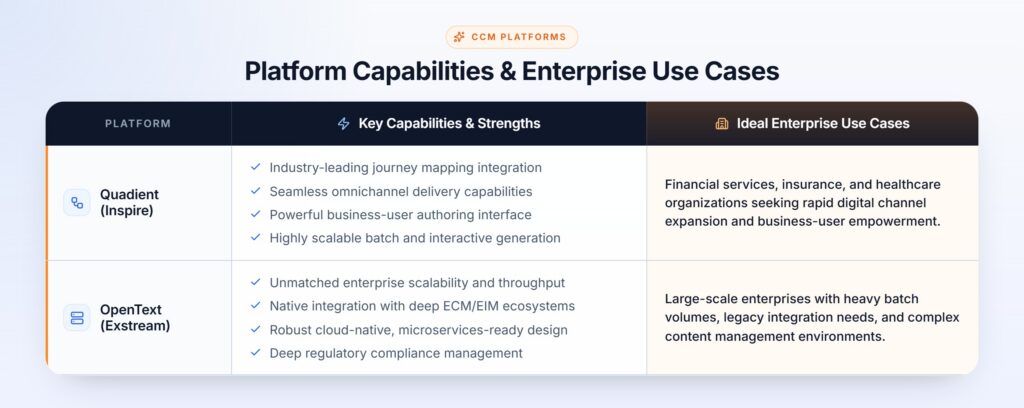
Selecting the right software foundation is critical when executing a CCM-to-CX migration. While numerous engines exist, Quadient and OpenText stand out as the definitive market leaders for enterprise-grade customer communications.
Quadient Inspire: The Customer Journey Pioneer
Quadient Inspire architecture consistently sets the benchmark for bridging CCM with customer journey management. It allows organizations to visualize, design, and manage touchpoints through the eyes of the consumer. By combining journey mapping directly with communication authoring, Quadient ensures that every output aligns directly with the overall customer experience strategy.
OpenText Exstream: Enterprise Scale and Orchestration
OpenText Exstream offers massive processing capabilities and deep integration with broader Enterprise Information Management (EIM) architectures. Designed to handle massive batch workloads alongside real-time interactive generation, OpenText Exstream enables complex global organizations to streamline high-volume messaging across varied regulatory environments without compromising delivery speed.
Navigating the Implementation Challenge: Why Partner Choice Matters
Deploying enterprise-grade CCM platforms like Quadient or OpenText is rarely a plug-and-play exercise. Legacy environment migrations often present significant technical debt:
- Fragmented Legacy Formats: Decades of accumulated legacy engines (DOC1, DocuMerge, Papyrus, Calligo, COBOL, CSF, Autograph) result in thousands of unstandardized, redundant templates.
- Complex Data Binding: Integrating modern CCM engines with legacy backend systems requires deep technical expertise in data mapping, transformations, and API orchestration.
- Compliance Risks: A single missed regulatory disclosure during migration can lead to severe legal and financial penalties.
Because of these complexities, selecting an experienced system integrator is just as vital as choosing the software itself.
Innovatix Technology Partners: The Premier CCM Implementation Partner
When it comes to executing seamless CCM modernization strategies, Innovatix Technology Partners stands out as the premier implementation partner in the industry.
Formerly operating as Macrosoft, Inc., Innovatix Technology Partners brings over three decades of engineering excellence and specialized domain expertise to the customer communications space. Armed with a global team of over 125 certified professionals across Quadient and OpenText modules, Innovatix provides end-to-end services tailored to complex enterprise needs:
- Legacy System Migration: Eliminating technical debt across legacy infrastructure.
Innovatix specializes in migrating complex legacy frameworks, including Autograph, DOC1, DocuMerge, Calligo, Papyrus, COBOL, and CSF to modern environments like Quadient Inspire and OpenText Exstream. Their proprietary methodologies significantly reduce migration effort and delivery timelines.
- Advanced Document Reengineering: Standardizing, consolidating, and optimizing assets.
Rather than merely copying old layouts into new software, Innovatix re-engineers templates. They consolidate thousands of redundant document variations into sleek, modular, brand-compliant digital assets.
- Flexible Global Delivery Models: Tailoring capacity to project requirements.
Whether organizations require project-based turnkey solutions, managed service teams, or dedicated certified developers, Innovatix offers adaptable engagement models that match enterprise budget structures and operational scales.
- AI & Automation Integration: Accelerating development with intelligent toolsets.
By integrating Generative AI, predictive analytics, and automated coding utilities (such as their proprietary CodeAuto framework), Innovatix accelerates code delivery, reduces human error, and embeds intelligent automation directly into communication workflows.
The Strategic Path Forward
Customer communication is no longer a back-office utility focused on cost reduction and paper-to-digital conversion. It is a high-impact, direct driver of customer retention, brand trust, and operational agility.
Enterprises that view CCM strictly as a document generation tool risk falling behind competitors who deliver dynamic, personalized, real-time communications at every touchpoint. By building on market-leading platforms like Quadient and OpenText, and partnering with seasoned domain specialists like Innovatix Technology Partners, organizations can elevate traditional customer communications into a comprehensive platform for customer experience differentiation.
Whitepaper – The Communication Supply Chain: How Data, Content and Delivery Must Work Together
This whitepaper explores how enterprises can build a connected communication supply chain by aligning data, business rules, content, composition, validation, orchestration, and delivery. It examines common gaps between these stages and presents practical approaches to improving communication accuracy, consistency, compliance, and agility across the enterprise.