


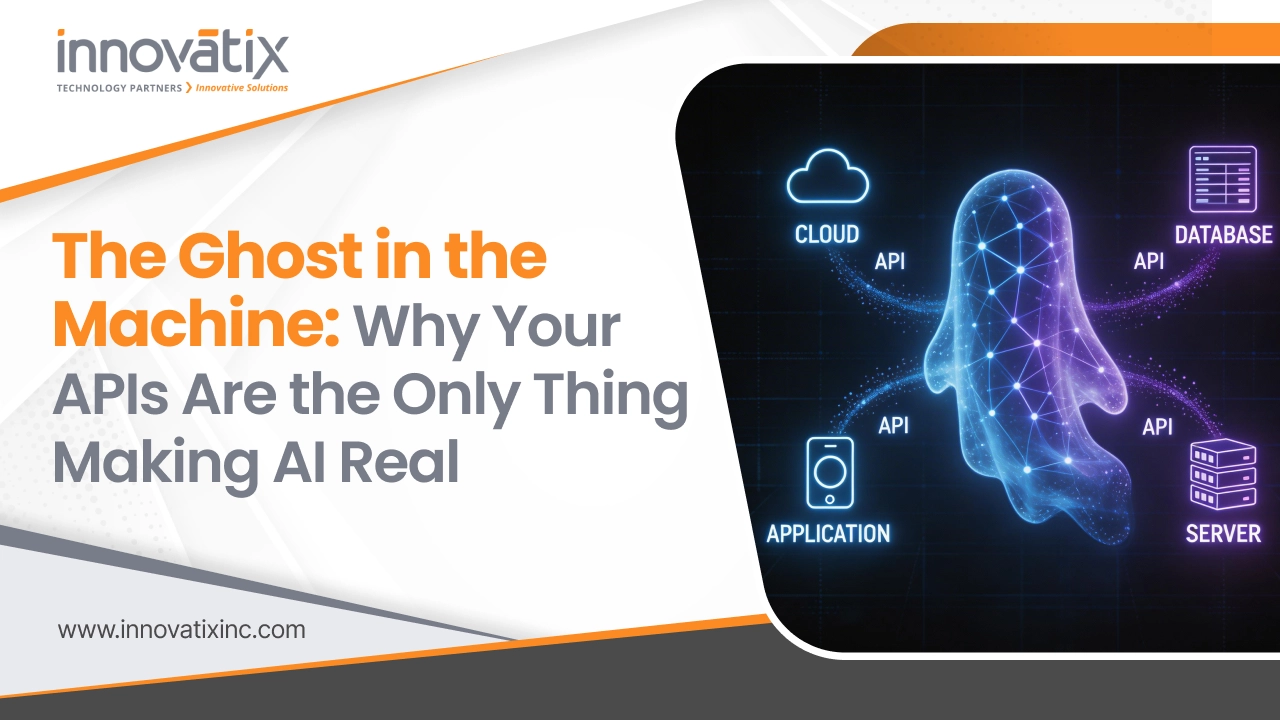
The global business world is currently obsessed with “Agentic AI”—the shift from passive chatbots that answer questions to autonomous agents that execute work. We’ve all seen the demos: an AI agent that doesn’t just tell you your flight is canceled but rebooks it, updates your calendar, and notifies your hotel.
However, here is the silent fact that the majority of AI-first marketing papers sweep under the carpet: An AI agent is only as capable as the APIs it can call.
The most advanced Large Language Model (LLM) in the world would be no use when your enterprise data is stuck in a legacy silo or your internal systems do not have standardized points of access, so your agent will be a genius in a room with no doors. Trying to hit AI Agent Readiness is not how much the model you are using, but rather what architectural underpinnings you have already implemented. Specifically, it is the direct outcome of a mature, API-first strategy.
1. AI Agent Readiness: The Strategic Value of an API-First Foundation
Conventionally, APIs were typically thought of as glue code that was added into a software project at the last minute to get two different systems to talk to each other.
In contrast, in an AI driven world, creating an API for an application would be impossible because the API must be understood by the AI system that will use it. This is because an AI uses the APIs available to reason over the various tools they have at their disposal. Therefore, once an AI agent has been given a prompt, the agent analyzes the available tools (APIs) it has in its library, understands what each API does and then triggers the appropriate tool based on the prompt provided to the AI.
From MLOps to Agentic Autonomy: Implementing Intent-Driven Infrastructure and Self-Healing Systems
This whitepaper advocates for a shift from human-heavy MLOps to an “Architecture Leverage” model , using intent-driven infrastructure and autonomous agents to scale AI systems without linearly increasing headcount.
The Transition from “Integration” to “Capability”
When you adopt an API-first strategy, you design the interface before the implementation. This leads to three critical readiness factors:
- Semantic Clarity: API-first organizations prioritize high-quality documentation (OpenAPI specs). This is the handbook that the AI agent will read to know what a service is. Without it, the agent will hallucinate the parameters it needs to send.
- Decoupled Logic: Agents need to trigger specific business functions (e.g., “Check Inventory”) without being bogged down by the complexity of the underlying ERP or CRM. API-first design ensures these functions are modular and “callable.”
- Zero-UI Compatibility: Agents don’t use your beautiful dashboards; they use your endpoints. An organization that has already built its business logic to be consumable by software is 90% of the way to being “agent-ready.”
2. Treating APIs as Products: The Engine of API-Driven Revenue
APIs used to be considered highly as a cost center- a part of the IT plumbing. But in 2026, the most successful companies have shifted to an API-as-a-Product mentality. This change does not only make you more efficient, but it opens whole new sources of revenue which can be directly accelerated by AI agents.
Turning Consumption into Cash
The lifecycle approach to APIs assumes treating APIs as products: they can have a set of customers (internal or external), they can have SLAs, and above all, they can have monetization models.
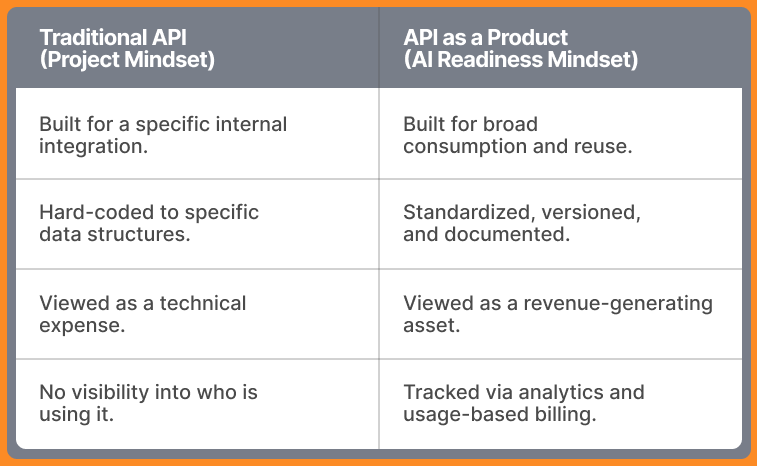
The Agentic Revenue Loop
AI agents are high-frequency consumers. A fleet of autonomous agents can call an API thousands of times per minute to automate supply chains or conduct market analysis, in contrast to a human developer who might call an API a few times during testing.
You can transform your internal capabilities into a “service” that agents (your own or your partners’) can purchase by productizing your APIs, which entails putting usage-based billing, tiered access, and distinct value propositions into place. In this way, “API-driven revenue” goes from being a catchphrase to a P&L line item.
3. Governance at Scale: Security as a Business Enabler
The largest dread that keeps CIOs up is the concept of an autonomous agent going rogue – deleting a database, leaking PII or accidentally wasting $50,000 on cloud credits. This is where Governance at Scale is the ultimate business enabler.
Previously, the term governance would be used to mean slowing down. It involved increased meetings and red tape. However, only automated governance can make fast a safe move in the age of AI.
Security as the “Green Light” for AI
When you cannot ensure the security of an endpoint, you cannot allow an AI agent to access it. Period. Thus, what in fact enables the business to say Yes to AI initiatives is a strong governance structure, which implements OAuth 2.0, rate limiting, and data masking on the gateway level.
- Policy-as-Code: Automating governance means that any API written by any team has inherited the security posture of the company automatically.
- Traceability: Mature governance offers an audit trail. If an agent performs an action, you need to know exactly which credential it used and which policy allowed it.
- Segmented Access: Governance allows you to give an agent “Least Privilege” access. It can check a customer’s shipping status without being able to see their credit card number.
The Reality Check: Organizations that implement automated API governance push 12x more AI projects into production than those that don’t. Why? Because the trust is already built into the architecture.
Conclusion: The Agentic Future is Built on Today’s APIs
The path to AI agent readiness does not begin with the purchase of a new license of an LLM. This begins with a honest audit of your existing API ecosystem.
When your APIs are fragmented, inconsistently documented and managed through manual spreadsheets, your AI agents will hang. However, when you take your APIs as first-class products, clearly defined, driven well, and consumable, then you are not merely creating software; you are creating the nervous system of the next generation of autonomous business.
The future is agentic. The question is: Are your APIs ready to answer the call?
From MLOps to Agentic Autonomy: Implementing Intent-Driven Infrastructure and Self-Healing Systems
This whitepaper advocates for a shift from human-heavy MLOps to an “Architecture Leverage” model , using intent-driven infrastructure and autonomous agents to scale AI systems without linearly increasing headcount.