


In the modern service economy, the “always-on” expectation isn’t just a trend—it’s a baseline requirement. Whether you are running an HVAC firm, a legal consultancy, or a SaaS startup, your customers no longer want to wait for a 9-to-5 window to get answers.
As a technical expert who has watched the evolution of CRM and ERP integrations, I can tell you: a Customer Self-Service Portal (CSSP) is no longer a luxury “add-on.” It is the central nervous system of a scalable service operation.
1. Drastic Reduction in “Low-Value” Support Volume
The most immediate technical benefit is the deflection of repetitive, transactional inquiries. Every time a customer calls to ask, “What is the status of my ticket?” or “Can I get a copy of last month’s invoice?”, your high-cost human talent is being underutilized.
- Ticket Deflection: By providing a searchable knowledge base and real-time status tracking, you can reduce inbound call volume by up to 40%.
- Resource Reallocation: Your engineers and support leads can focus on complex, high-revenue problems rather than password resets and billing updates.
Whitepaper – The Role of API-Driven Architecture in Custom Applications
This whitepaper provides a comprehensive analysis of API-Driven Architecture, exploring how transitioning from monolithic structures to a modular, “composable” ecosystem serves as a strategic framework for scalability, security, and competitive advantage in custom application development.
2. Real-Time Data Transparency (The “Amazon Effect”)
Customers have been conditioned by e-commerce giants to expect total visibility. They want to see the “order journey.” In a service context, this means seeing:
- Project milestones and completion percentages.
- Upcoming scheduled technician visits.
- Historic service logs and compliance documentation.
Providing this via a portal builds institutional trust. When a client can log in at 10 PM and see that their system update is 80% complete, they don’t need to send that “just checking in” email the next morning.
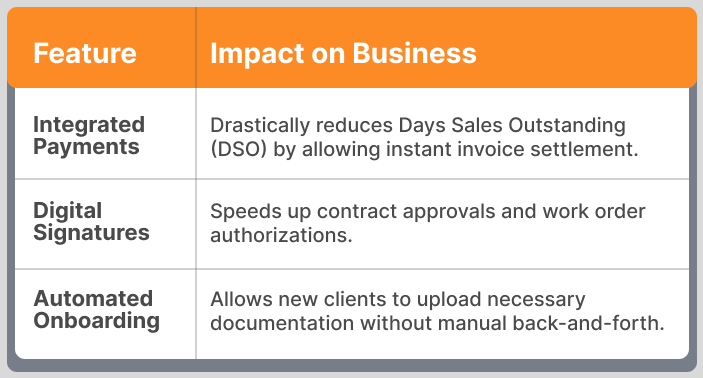
3. Accelerated “Order-to-Cash” Cycles
From a technical architecture standpoint, a portal isn’t just for viewing data; it’s for processing it.
4. Scalability Without Proportional Headcount
The math is simple: if your business grows by 50%, do you need to hire 50% more support staff? Without a portal, the answer is often yes.
With a robust CSSP, your infrastructure scales linearly while your costs remain relatively flat. The portal acts as a digital buffer, absorbing the increased load of routine interactions while your core team remains lean and agile.
5. Capturing Clean, Actionable Data
When a customer calls in, the data captured is only as good as the notes the agent takes. When a customer uses a portal, the data is structured and precise.
- Analytics: You can see exactly which knowledge base articles are most read, signaling where your product or service might be confusing.
- Feedback Loops: Portals allow for instantaneous NPS or CSAT surveys immediately after a task is completed, leading to higher response rates and better data.
The Technical Bottom Line
Building or implementing a self-service portal is an investment in operational maturity. It transitions your business from a reactive stance (waiting for the phone to ring) to a proactive one (empowering the user).
In 2026, the interface is the product. If your customers can’t interact with you digitally, they will eventually find a competitor who lets them. Contact us today to start creating the Customer Self-Service Portal (CSSP) for your organization.
Whitepaper – The Role of API-Driven Architecture in Custom Applications
This whitepaper provides a comprehensive analysis of API-Driven Architecture, exploring how transitioning from monolithic structures to a modular, “composable” ecosystem serves as a strategic framework for scalability, security, and competitive advantage in custom application development.
.