



The term “Clean Code” for decades, was firmly grounded in human cognition. Pioneers like Robert C. Martin developed paradigms that explicitly work around the confounding factors of human working memory. We cut functions to less than 10 lines, strictly separated concerns, kept deeply nested conditionals to a minimum and aggressively abstracted logic to micro-classes. Display was a direct goal: to reduce, as much as possible, the cognitive load on a human software engineer who is reviewing code or troubleshooting a production bug by visually scanning a file.
But the software development life cycle has dramatically changed its structure. No longer is the code written or read by only humans. Large Language Models (LLMs) have now become the modern CI/CD pipeline’s Aux agents, Code Assistants, and Auto-Refactor Engineers, from pipeline to IDE! As such, code is deeply learned by deep learning networks throughout a significant portion of its operational life, with the result that code is continuously being parsed, contextualised, and mutated.
This paradigm shift will drive a fundamental reassessment of traditional engineering clean code principles. Architectural patterns that are optimized for human, rather than LLM, cognitive patterns often result in code that is fragmented, with poor LLM results, context windows that are small and logical hallucinations that are hidden. Modern clean code should meet the requirements of the compiler, the developer, and the AI context window.
Whitepaper – The Logic Layer Consolidation: Redefining Enterprise Frontend Stability
This whitepaper outlines the 2026 shift toward “Logic Layer Consolidation,” a paradigm that replaces fragmented client-server architectures with a unified execution environment to enhance enterprise application stability, security, and performance.
The Failure Mechanics of Traditional “Clean Code” in LLM Contexts
Extreme modularity is a common approach promoted under the banner of “clean code. A codebase divided into thousands of micro-utilities has functions that are well isolated, but this is a fundamental disruption of the linear attention mechanisms of Transformer architectures. LLMs process code through attention maps, calculating the probabilities of the relationships between tokens from one sequence to another, regardless of their length.
In highly abstracted codebases, designed for the traditional human reading metrics, context is distributed across files that are often independent. To perform reasoning in relation to 1 business logic execution path, the AI agent needs to have access to deep import trees, meaning that a number of different, unrelated files need to be placed in the workspace. This means there is a compound tax burden on performance:
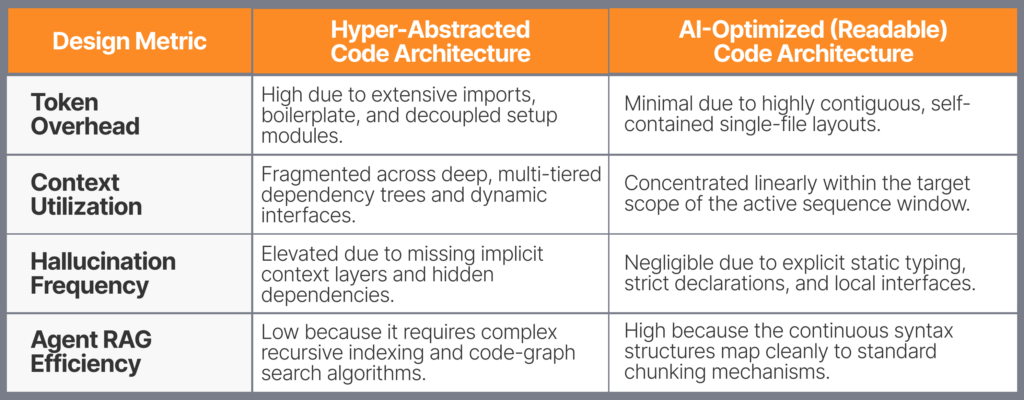
- Context Window Fragmentation: Each additional file that is imported by the automated agent uses input tokens. In complex codebases, this localized context overhead makes things exponentially more expensive, approaching its limit and causing significant drop in model reasoning.
- Attention Dilution: The more boilerplate, module declarations, imports, etc. there are, compared to actual business logic, the more the weight vector in the model’s self-attention will dilute. Structural noise obscures the core transformation logic.
- Hallucination Vectors: Models are forced to make generalizations that would have high probability, given nesting of classes and modules at a great level of depth or distance. This can cause false method signatures, parameter order, or module exports to be seen, which are not present in the local workspace.
Defining AI-Readable Code: The Core Architectural Pillars
AI code doesn’t necessarily mean going back to poorly designed, hard-to-maintain scripts. Rather, it proposes a very pragmatic and deterministic engineering strategy, which is clearly grounded in the syntax tree tokenization, embedding, and reasoning over used by deep learning models.
1. Locality over Hyper-Abstraction
Locality is about grouping similar code together in the code base. Saving a specific utility function in the same file or class as other classes that use it (as opposed to storing it in a generic shared utility directory) can have a dramatic effect on the structural processing. It guarantees that the dependency graph and semantics of the function are completely encapsulated and passed into a context window when an LLM is called.
2. Exhaustive and Unambiguous Type Safety
Implicit types and highly dynamic polymorphism requires that the LLM guesses at runtime behavior by relying on the variables’ names. Provided explicit typing gives hard-knuckled semantic boundaries. There are languages that provide a comprehensive type system with clear and explicit type annotations, which can be used to provide a rich framework for LLM validation. If types are explicitly specified, then definite compiler restrictions limit the generation space, so that incompatible objects and invalid type conversions can’t be generated during automated refactoring.
3. Linear Execution Paths over Implicit Framework Magic
The actual runtime flow is hidden behind intricate runtime magic, like custom dynamic reflection, implicit dependency injection containers, global monkey-patching, or highly complex runtime decorators. An LLM deals with static code, not step by step runtime – this is a challenge when there are implicitly defined pipelines in the code with changes to data. The static abstract syntax tree (AST) perfectly corresponds to runtime operation, with plain, explicit, and declarative code execution paths.
Metric-Driven Comparison: Code Parsing Dimensions
The operational efficiency gains when shifting toward AI-readable standards are measurable and reproducible across enterprise development environments:
Engineering Best Practices for the AI-Native Era
Making your engineering standards dual-audience friendly involves incorporating several core architectural practices into your standard engineering guides:
- Write Literal, Intent-Driven Documentation: Avoid generic comments. Document constraints, unexpected edge cases, and systemic pre-requisites in the form of descriptive docstrings. This semantically similar text is used directly in the calculation of the probabilities of generation by AI models.
- Standardize Architectural Patterns: Do not have multiple patterns in the same domain. An LLM that is presented with a source code that calls out standard procedural functions in one module and complex reactive streams in another loses the context of its own prompt weight. Generations from homogeneous codebases are clean and very accurate.
- Optimize the Structural Layout: Sequentially arrange related routines down the page in order of the order they are invoked. The dependent blocks will be organized in a linear order, making it a perfect fit for linear text scanning by Transformer.
Conclusion: The Practical Engineering Mandate
Creating code to use an LLM is not a design pattern or a compromise on developer standards. It’s a very practical approach to software craftsmanship. Highly localized, strictly typed, explicit code is much easier to maintain, audit, and scale for AI models, and humans, too. Our definition of clean code is modernized, focusing on explicit readability and directly boosting our automated engineering processes, reducing system bugs, and creating more robust, sustainable software systems.
Whitepaper – The Logic Layer Consolidation: Redefining Enterprise Frontend Stability
This whitepaper outlines the 2026 shift toward “Logic Layer Consolidation,” a paradigm that replaces fragmented client-server architectures with a unified execution environment to enhance enterprise application stability, security, and performance.