



The web has been kept out by the hamburger menu and the multi-layered navigation bar over decades. We created online towers with underground basement areas, hoping that the customer will be delighted with the lift ride over five floors of sub menus trying to locate a billing environment or a particular item specifications.
However, we have crossed the threshold into the AI search experience epoch and the skyscraper is being flattened.
We are in a Post-Search world. The idea in this landscape is not to assist the user in browsing, but to allow a direct search without having to click. When your user is forced to deal with a navigation menu to accomplish tasks, then you have already lost their focus.
The Zero-Click Reality
The statistics are undisputable in 2026: more than 64 percent of searches do not result in a single click to an external site. This has become a common user behavior, as opposed to a Google unique phenomenon, referred to as zero click search.
The AI overviews and instant answer engines are training users to anticipate the result early. The implication of this shift on zero click searches SEO is massive. No longer being number 1 is insufficient, you must be the solution before the click occurs. This will be the future of navigating websites: not where is it but here it is.
Whitepaper – The Logic Layer Consolidation: Redefining Enterprise Frontend Stability
This whitepaper outlines the 2026 shift toward “Logic Layer Consolidation,” a paradigm that replaces fragmented client-server architectures with a unified execution environment to enhance enterprise application stability, security, and performance.
From Search Bars to “Omni-Search” Action Hubs
The greatest shift in the architectural layout of the websites is not aesthetic, but functional. The search-then-browse flow is dying, and omni-search bars are taking its place.
The omni-search bar does not simply search a page, but does the action. Consider a user will search your site with the words Change my billing address. They would receive a link to a Profile Settings page in the old model, and then have to locate the Billing tab.
In the zero-click interface model, the search modal is immediately displayed as a mini-form:
- Input: Change my billing address.
- Result: In the search overlay a small, secure text field appears.
- Action: The user enters the new address and presses enter and that is it.
This has the effect of flattening your web site. Once all the tools, settings, and data are available through a single command line, you begin to wonder why the 12-item navigation menu on the top of your site looks like a vestige of the dial-up era.
Why Your Navigation Menu Is Not Working
Classical navigation is founded on a discovery attitude. However, contemporary users, particularly mobile or voice users, work on an intent mindset.
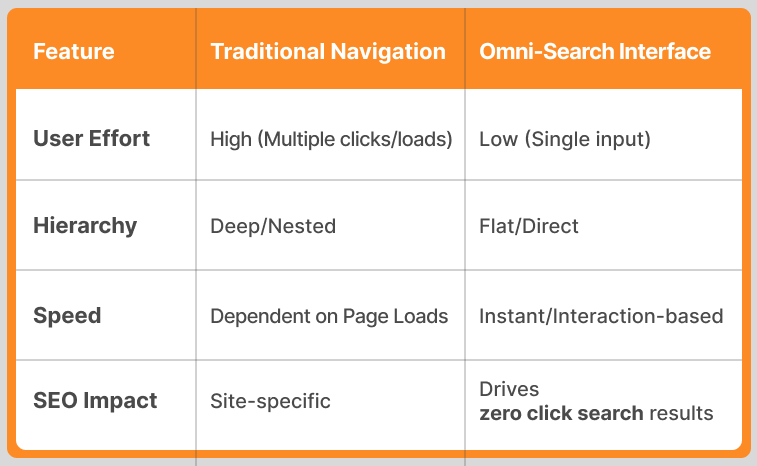
With the attachment to complicated menus, you are causing users to learn your organizational logic. A search-first interface enables the user to apply his or her logic, and the AI does the translation.
How to Adapt: SEO and UX Strategies for 2026
You might worry that impact of zero click search on website traffic will kill your business. It won’t—but it will change your KPIs. While raw sessions might dip, the “surviving” clicks are often 20-30% more likely to convert because the “low-intent” browsing has already happened in the search layer.
1. Optimize towards the Answer Engine.
In order to succeed in the AI search experience, you have to have modular content. Make use of structured information and definite blocks of answers (short 40-60 words summaries) in the top of your pages. This is how to make search results zero clicks: provide the AI with the snippet that it will use to acknowledge your brand as the authority.
2. Implement Actionable Search
Go beyond mere key-word matching. Connect your search bar to your front-end and your backend API. Install applications such as Algolia or any other custom LLM-wrappers to make sure that when a consumer poses a query, your search engine suggests an application, not a link.
3. Pay attention to Brand Mentions and not Clicks.
The new Position 1 is to be the source that an AI can quote in a world of search without clicking. Quality brand impressions in an AI summary create trust which results in direct-type traffic in the future.
The Bottom Line
The “Zero-Click” interface isn’t about losing traffic; it’s about losing friction. Your navigation menu isn’t just a list of links—it’s a map of how much work you’re making your users do. In 2026, the best interface is the one that disappears.
Stop building better menus. Start building a better search.
Frequently Asked Questions (FAQs)
- What is the zero click search and its impact on the SEO?
It is a search engine results page (SERP) which provides a response to the query of the user at the very top, and, as a result, there is no click to a site. It also compels SEO to stop click-baiting and start authority-building, in which being the listed source is the main objective.
- What is the effect of AI search on the navigation of websites?
AI enables web sites to shift to a Natural Language interface. Users do not have to go through categories to get what they want, they command the site what they want. This renders deep and hierarchical menus unnecessary and favors a flat architecture.
- What is increasing in Google with zero click searches?
Google (and other engines such as Perplexity) are trying to minimize time to result. Their work around synthesizing web data (using LLMs) into instant answers makes the experience quicker to users, which retains users longer on their platform.
- What can websites do to adjust to the trend of zero-clicks search?
The websites are to be oriented on the Actionable UI, where the search bar can perform activities. They ought to also apply Schema markup to make sure that their information is readily consumed by AI agents so they are the source of the truth.
Whitepaper – The Logic Layer Consolidation: Redefining Enterprise Frontend Stability
This whitepaper outlines the 2026 shift toward “Logic Layer Consolidation,” a paradigm that replaces fragmented client-server architectures with a unified execution environment to enhance enterprise application stability, security, and performance.