



Technical debt is easy to explain. A codebase has shortcuts, outdated dependencies, or workarounds that make future changes harder.
Architecture debt is less visible. It accumulates when an enterprise keeps making local technology decisions without revisiting how those decisions fit together.
A monolith becomes harder to change. Point-to-point integrations multiply. Multiple applications begin performing overlapping functions. Data gets distributed across systems with unclear ownership. Nothing necessarily fails overnight. Instead, every major change becomes slower, riskier, and more expensive.
Whitepaper – The Application Portfolio Problem: A Framework for Reducing Application Sprawl
This whitepaper examines why enterprise application sprawl develops, the hidden costs it creates, and how organizations can regain control. It introduces a four-stage Inventory, Rationalize, Modernize, Govern framework to reduce duplication, security exposure, integration complexity, and talent drag while creating a cleaner foundation for cloud, data, and AI future initiatives.
What Is Enterprise Architecture Debt?
For this discussion, architecture debt refers to the structural constraints in an enterprise technology environment that make change increasingly difficult.
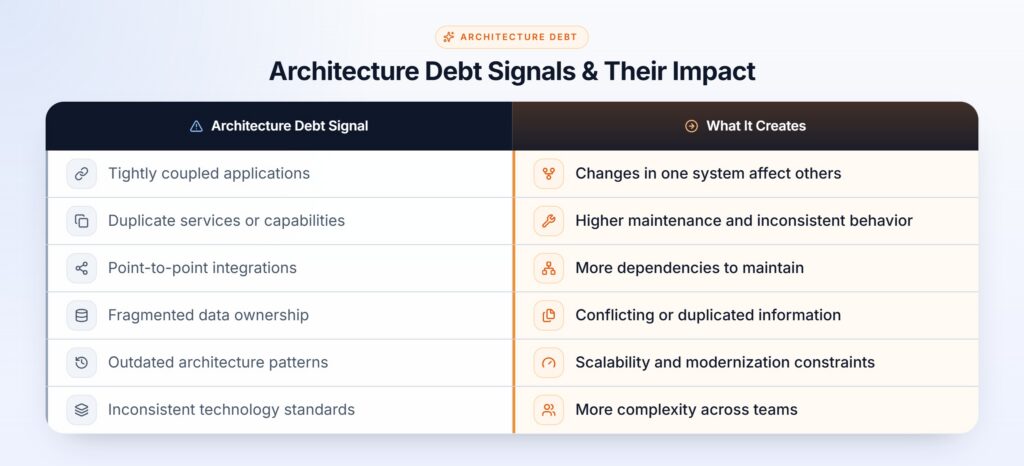
The problem becomes more pronounced as application estates expand. Salesforce’s 2026 Connectivity Report found that the number of applications in enterprises rose from 897 to 957 year over year, while only 27% were integrated.
That creates an important distinction: having more applications is not necessarily the problem. Having an architecture that cannot accommodate them cleanly is.
Why Architecture Debt Often Goes Unmeasured
- It hides behind functional applications
An application can be stable and still be architecturally expensive. It may work perfectly, but changing one business rule could require updates across several systems because responsibilities are tightly coupled.
- Its cost appears somewhere else
Architecture debt rarely arrives as a single invoice. It shows up as: longer release cycles + more regression testing + integration work + maintenance effort + delayed modernization
Accenture’s 2024 research found that 41% of executives identified AI as the highest contributor to technology debt, tied with enterprise applications. The same research notes that leading companies target approximately 15% of IT budgets toward technical-debt remediation.
The exact figures concern technical debt rather than architecture debt specifically, but they illustrate the broader issue: the cost of structural technology constraints eventually competes with investment in new capabilities.
- Architecture decisions are often evaluated project by project
A team may choose a convenient integration for one application. Another team makes a similar choice elsewhere. Neither decision looks unreasonable on its own.
Years later, the enterprise has multiple integration patterns, duplicated services, inconsistent APIs, and dependencies that nobody fully owns. That is how architecture debt compounds.
How Can Enterprises Measure It?
Architecture debt does not need to remain an abstract concept. It can be assessed through a small set of practical indicators.
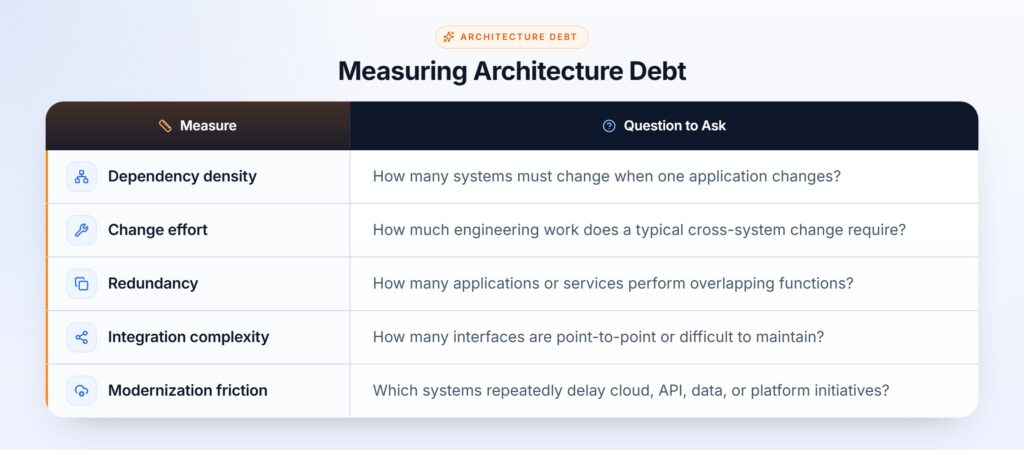
The purpose is not to produce a perfect numerical score. It is to identify where architecture is creating business friction.
PwC’s May 2025 Pulse Survey found that 56% of CIOs and CTOs consider future-proofing their architectures a high priority. PwC also points to modernization, integration, and unified data and applications as important foundations for future-ready technology environments.
Reducing Architecture Debt Without Rebuilding Everything
The answer is rarely a complete rewrite. A more practical approach is to identify the architectural constraints that create the most friction and address them progressively.
Start by mapping dependencies. Then identify which systems are strategic, which are creating the greatest operational burden, and which architectural patterns are being repeated unnecessarily.
From there, enterprises can:
- Decouple tightly connected capabilities where independence creates value.
- Standardize APIs, integration patterns, security controls, and technology practices.
- Modernize high-impact systems using approaches such as microservices or cloud-native architecture.
- Retire redundant applications instead of adding another integration around them.
Innovatix’s Enterprise Digital Engineering practice focuses on architectural integrity, legacy modernization, microservices decoupling, and building resilient digital ecosystems. Its microservices capabilities specifically address the transition from rigid legacy structures to more independent services, while its broader Enterprise portfolio also covers cloud and managed application support.
Frequently Asked Questions
- What is the difference between technical debt and architecture debt?
Technical debt usually refers to implementation-level shortcuts and maintenance burdens. Architecture debt concerns the larger structural decisions and dependencies that make systems harder to evolve.
- How does architecture debt affect modernization?
It can increase dependency mapping, integration work, testing effort, and migration risk, making modernization slower and harder to sequence.
- Can architecture debt be measured?
Yes. Dependency density, change effort, redundancy, integration complexity, and modernization friction can provide practical indicators.
- Does reducing architecture debt require replacing legacy systems?
Not always. Enterprises can decouple, wrap, refactor, consolidate, or gradually replace systems based on business value and technical risk.
Whitepaper – The Application Portfolio Problem: A Framework for Reducing Application Sprawl
This whitepaper examines why enterprise application sprawl develops, the hidden costs it creates, and how organizations can regain control. It introduces a four-stage Inventory, Rationalize, Modernize, Govern framework to reduce duplication, security exposure, integration complexity, and talent drag while creating a cleaner foundation for cloud, data, and AI future initiatives.