


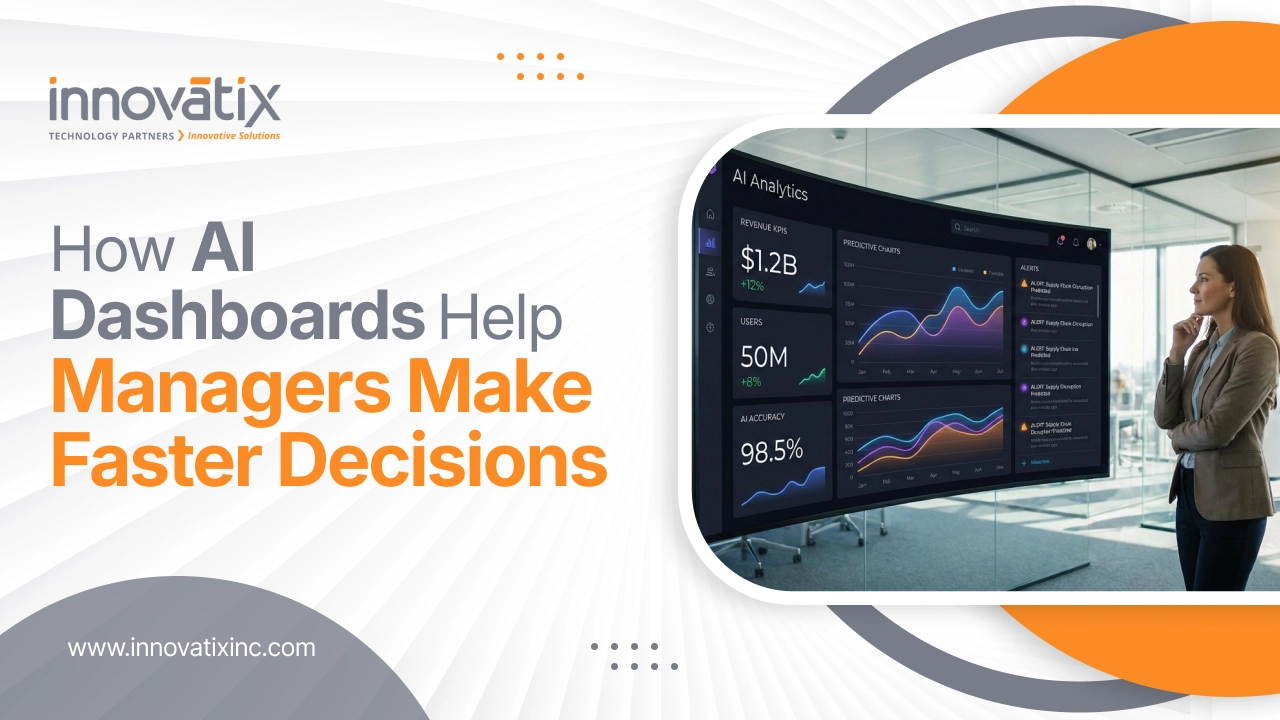
Dashboards have become the control centre for modern managers in the era of data-driven leadership. When such dashboards are driven by artificial intelligence, the distinction between slow and deliberate and fast, confident decision-making can be a few minutes, or even a few seconds long.
1. The AI Dashboard, So What?
A conventional dashboard displays pre-fetched measurements in graphs, tables, and gauges. An AI-powered dashboard lays over visualization machine-learning models, natural-language processing, and automatic insight generation. The outcome is a system that does not just indicate what has already happened, but why and what might happen next.
Key AI Capabilities and Their Value
- Predictive Analytics
What it does: Forecasts future trends such as sales performance or customer churn.
Manager benefit: Enables proactive planning instead of reactive decision-making. - Natural Language Generation (NLG)
What it does: Automatically produces narrative summaries and explanations.
Manager benefit: Saves time on report creation and improves clarity for non-technical stakeholders. - Automated Insight Engines
What it does: Detects anomalies, outliers, and hidden correlations.
Manager benefit: Highlights emerging risks and opportunities without manual analysis. - Real-Time Data Streaming
What it does: Continuously ingests and analyzes live data.
Manager benefit: Enables immediate responses to critical events as they occur.
Whitepaper: Transforming the Enterprise Through Intelligent Migration
This whitepaper outlines how Innovatix Technology Partners uses a structured migration framework and a proprietary suite of automation tools—such as SpecGenerator and Code Morph—to help enterprises modernize legacy systems into secure, scalable, and cloud-ready architectures.
2. Speeding the Decision Loop
One of the most significant advantages of AI-powered dashboards is their ability to dramatically compress the decision loop—the time between data generation, insight discovery, and managerial action. By automating analysis and embedding intelligence directly into the visualization layer, AI dashboards enable faster, more informed, and more confident decision-making.
2.1 From Data to Insight in Minutes
In traditional reporting environments, data must often be extracted from multiple systems, cleaned, transformed, analyzed, and manually summarized before insights reach decision-makers. This process can take hours or even days, causing insights to arrive too late to influence outcomes effectively.
AI dashboards fundamentally change this dynamic. They continuously ingest data from disparate sources, apply machine-learning models in real time, and surface insights the moment patterns emerge. Instead of waiting for scheduled reports, managers receive up-to-date intelligence whenever they access the dashboard.
Research from Forrester Wave™ 2 (2023) highlights the impact of this shift: organizations that implemented AI-driven dashboards reduced their time to insight from an average of eight hours to less than 30 minutes—representing a 75 percent reduction. This acceleration allows leaders to respond to market shifts, operational disruptions, and customer behavior changes while they are still unfolding.
Beyond speed, this immediacy enhances decision quality by ensuring that actions are based on current, relevant data rather than outdated snapshots.
2.2 Rapid What-If Scenario Forecasting
AI dashboards also empower managers to explore potential outcomes through interactive what-if scenario analysis. By embedding predictive models directly into the dashboard interface, users can test assumptions and simulate decisions without relying on analysts or offline tools.
For example, a retail manager can instantly evaluate how a 5 percent price increase might affect revenue, margins, and demand elasticity. Similarly, supply chain leaders can model the impact of delayed shipments, alternative suppliers, or demand spikes in real time. These simulations provide immediate feedback on potential risks and trade-offs.
This capability transforms scenario planning from a periodic, resource-intensive exercise into a continuous and exploratory process. Decisions that once required days of analysis and back-and-forth communication can now be evaluated in minutes, enabling faster experimentation and more agile strategy execution.
2.3 Contextual Recommendations and Intelligent Alerts
In addition to generating insights on demand, AI dashboards proactively guide managerial attention through contextual recommendations and intelligent alerts. AI engines continuously monitor key performance indicators, behavioral patterns, and historical baselines to detect anomalies or emerging risks.
When predefined thresholds are breached—or when unexpected correlations appear—the system automatically notifies relevant stakeholders. These alerts are not limited to static rule-based triggers; they often include contextual explanations and suggested actions, helping managers understand not only what is happening, but why it matters.
According to Gartner projections, by 2025, 75 percent of executive dashboards will incorporate AI-based alerting capabilities to support real-time risk mitigation. This shift reflects a growing need for systems that prioritize attention and reduce cognitive overload, allowing leaders to focus on the most critical issues at the right moment.
By combining real-time monitoring with intelligent recommendations, AI dashboards move decision-making from a reactive posture to a proactive one—enabling managers to intervene earlier, reduce uncertainty, and maintain operational control.
3. Accuracy & Confidence Boost
Beyond speed, AI-powered dashboards significantly enhance the accuracy and reliability of managerial decisions. By reducing human bias and automating insight discovery, these systems help leaders act with greater confidence and consistency.
3.1 Reducing Human Error and Bias
Human interpretation of data is inherently susceptible to cognitive bias, fatigue, and oversight—particularly when datasets are large or complex. AI dashboards mitigate these risks by applying consistent, algorithmic reasoning across all data points, ensuring that patterns and anomalies are evaluated objectively.
According to a McKinsey Global Institute (2023) study, organizations that adopted AI-assisted, data-driven decision-making improved analytical accuracy by an average of 10 to 25 percent compared with human-only analysis. This increase in precision translates directly into better forecasts, fewer costly mistakes, and stronger confidence in strategic choices.
3.2 Automated Insight Generation
AI dashboards also remove the need for managers to manually search for hidden relationships within data. Model-driven insight engines continuously analyze incoming information and automatically surface meaningful correlations, trends, and anomalies as they emerge.
As a result, insights are delivered proactively rather than discovered reactively. In practice, platforms such as Salesforce Einstein Analytics report that AI-generated insights have reduced the time sales teams spend on analysis by up to 30 percent. This allows managers to focus less on data exploration and more on decision-making and execution.
4. Examples of AI Dashboard Tools and Their Business Impact
Leading analytics platforms have embedded artificial intelligence directly into their dashboards, enabling organizations to move beyond descriptive reporting toward predictive and prescriptive decision-making.
- Salesforce Einstein Analytics
Uses predictive models to estimate lead conversion probabilities and automatically generates narrative summaries for sales forecasts.
Business impact: Improves pipeline prioritization and reduces manual reporting effort for sales teams. - Microsoft Power BI with Azure Machine Learning
Integrates machine-learning models into dashboards to support real-time inventory optimization and automated procurement recommendations.
Business impact: Enhances supply chain efficiency while reducing stockouts and excess inventory. - Tableau (Ask Data and Explain Data)
Allows non-technical users to ask questions in natural language and receive model-driven answers and explanations.
Business impact: Democratizes data access and accelerates insight discovery across business units. - Google Data Studio with BigQuery ML
Combines scalable analytics with built-in machine learning to deliver predictive spend and performance analysis for marketing teams.
Business impact: Enables smarter budget allocation and improved return on marketing investment. - IBM Cognos Analytics with AutoAI
Applies automated machine learning to detect anomalies in financial data and flag potential fraud risks.
Business impact: Strengthens financial governance and supports early risk identification.
5. Implementation Tips for Managers
Successful AI dashboard implementations require more than advanced technology—they demand strong managerial focus, disciplined execution, and continuous engagement. The following best practices help ensure that AI dashboards deliver sustainable business value.
- Start with High-Impact KPI Sets
Focus on a small number of metrics that directly align with strategic objectives and decision-making needs. Prioritizing high-impact KPIs ensures that the dashboard supports meaningful actions rather than overwhelming users with data. - Ensure High Data Quality
AI models are only as reliable as the data they consume. Establish robust data preparation processes, including cleansing, standardization, and validation, to ensure the insights generated are accurate, consistent, and trustworthy. - Implement Strong Model Governance
Adopt a formal model management framework that supports version control, performance monitoring, and model drift detection. Governance safeguards model reliability over time and ensures transparency, accountability, and compliance. - Invest in User Training and Adoption
Even the most sophisticated dashboard will fail without user trust and understanding. Provide hands-on training, practical use cases, and ongoing support to help teams interpret insights confidently and integrate them into daily decision-making. - Iterate and Improve Continuously
Treat the AI dashboard as a living product rather than a one-time deployment. Actively collect user feedback, refine models, and release incremental enhancements to keep the system aligned with evolving business needs.
6. Risks and Mitigation Strategies
While AI dashboards offer substantial benefits, organizations must proactively manage the risks associated with their adoption. Awareness and structured mitigation strategies are essential to ensure responsible, sustainable value creation.
- Data Bias
AI models can unintentionally amplify biases present in historical data.
Mitigation: Conduct regular model audits, monitor outputs for skewed results, and diversify training datasets to ensure fairness and representativeness. - Overreliance on Automation
Excessive dependence on AI-generated insights may reduce critical thinking and contextual judgment.
Mitigation: Maintain a “human-in-the-loop” approach, ensuring that managers retain decision authority and use AI as a decision-support tool rather than a replacement. - Privacy and Security Risks
AI dashboards often process sensitive, real-time data, increasing exposure to security and compliance risks.
Mitigation: Encrypt data streams, enforce role-based access controls, and ensure compliance with regulations such as GDPR, CCPA, and industry-specific standards. - Organizational Resistance to Change
Users may resist AI-driven tools due to lack of trust or fear of job displacement.
Mitigation: Communicate return on investment early, demonstrate quick wins, and involve users throughout the design and rollout process to build confidence and adoption.
7. The Future: The Era of Dashboards Decision-Automation
Looking ahead, AI dashboards are evolving into the operating system for enterprise decision automation. Advances in Edge AI, Explainable AI (XAI), and low-code platforms are converging to make decision intelligence more accessible, transparent, and actionable.
In this emerging landscape, managers will interact with dashboards through voice commands, conversational interfaces, and AI-powered chatbots that not only answer questions but also recommend optimal courses of action in real time. These systems will increasingly move beyond insight delivery to decision orchestration—automating routine decisions while escalating complex or high-risk choices to human leaders.
Gartner’s Hype Cycle 2025 positions Decision Intelligence—the coordinated application of data, AI, and human expertise—as transitioning into the Early Adopter phase over the next two years. This signals a shift from experimental analytics toward embedded, enterprise-wide decision automation.
8. Bottom Line
AI dashboards transform raw data into actionable intelligence at unprecedented speed. They significantly reduce time to insight, improve analytical accuracy, and empower managers to make proactive, confident decisions in dynamic environments.
For leaders seeking to stay ahead of the curve, investing in AI-driven dashboards is no longer a discretionary upgrade—it is a strategic imperative. Partnering with experienced providers such as Innovatix Technology Partners enables organizations to accelerate this journey by aligning data readiness, high-impact KPI design, and scalable AI platforms with long-term business objectives.
The next step is clear: audit your data landscape, define the metrics that matter most, and adopt solutions capable of supporting both today’s decisions and tomorrow’s intelligent automation. The question is no longer whether AI should support decision-making—but how quickly organizations are prepared to let it do the heavy lifting.
Whitepaper: Transforming the Enterprise Through Intelligent Migration
This whitepaper outlines how Innovatix Technology Partners uses a structured migration framework and a proprietary suite of automation tools—such as SpecGenerator and Code Morph—to help enterprises modernize legacy systems into secure, scalable, and cloud-ready architectures.