



The “all-in” public cloud playbook no longer fits the world we operate in. Here’s why geopatriation, data sovereignty, and private AI infrastructure are reshaping enterprise cloud strategy — and what I’m telling my leadership team.
I’ve spent fifteen years championing public cloud. I pushed for lift-and-shift migrations, fought consumption-based budgets past sceptical CFOs, and watched the elasticity of hyperscalers transform our ability to ship products. So when I say the “all-in” public cloud playbook we’ve run since the early 2010s is broken, know it comes from someone who deeply believed in that playbook.
What changed isn’t one regulation or one vendor miscalculation. It’s a convergence of geopolitical friction, tightening data-residency laws across dozens of jurisdictions, and AI workloads that demand low-latency, high-security compute much closer to where data originates. Welcome to Cloud 3.0.
Whitepaper – The Role of API-Driven Architecture in Custom Applications
This whitepaper provides a comprehensive analysis of API-Driven Architecture, exploring how transitioning from monolithic structures to a modular, “composable” ecosystem serves as a strategic framework for scalability, security, and competitive advantage in custom application development.
The Rise of Geopatriation
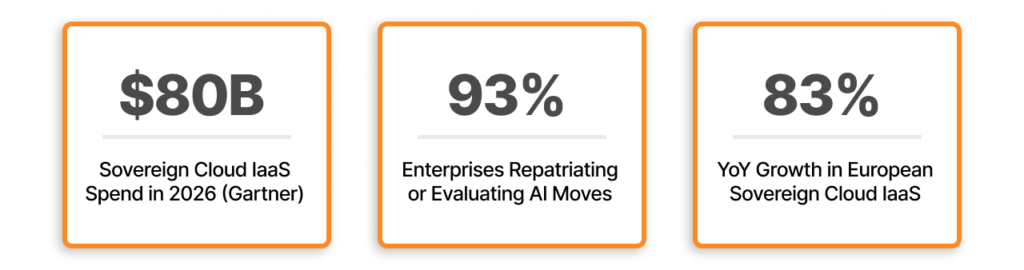
Gartner coined the term “geopatriation” to describe the strategic migration of workloads from global public clouds back into local or sovereign environments within national borders, naming it a top strategic technology trend for 2026. The numbers make it impossible to dismiss as a passing fad. According to Gartner’s February 2026 forecast, worldwide sovereign cloud IaaS spending will hit $80 billion this year — a 35.6% surge from 2025. Europe alone is expected to nearly double its sovereign cloud IaaS spend, jumping from $6.9 billion in 2025 to $12.6 billion in 2026, and is forecast to surpass North America by 2027.
The legislative forces are compounding. The EU’s GDPR set the stage, but India’s Digital Personal Data Protection Act — now entering active enforcement — is creating identical pressures in Asia’s largest market. China’s cross-border transfer regulations, Brazil’s LGPD, and emerging data-localisation bills in the Philippines collectively make it impossible to park everything in a single hyperscaler region and call it compliant.
Why the “All-In” Thesis Broke
The all-in thesis assumed geopolitics would stay stable, regulatory environments would converge, and scale efficiencies would always outweigh centralisation risks. All three have crumbled.
The US CLOUD Act grants American authorities the right to compel US-headquartered companies to produce data regardless of where it’s stored. When AWS launched its European Sovereign Cloud in January 2026 — a fully independent infrastructure in Brandenburg, Germany, backed by €7.8 billion — the technical separation was genuine. But as Computerworld’s analysis pointed out, technical sovereignty doesn’t resolve jurisdictional sovereignty when the parent company sits under US law.
Hyperscalers are adapting. Google licenses technology to France’s S3NS (a Thales subsidiary); Bleu, a Capgemini-Orange joint venture, runs on Microsoft technology. These partnerships address ownership questions, not just residency checkboxes. But as Gartner’s Rene Buest cautioned, “Solely treating digital sovereignty as a pure security, regulatory and compliance topic is not enough… they will also lose market share.”
AI: The Accelerant Nobody Budgeted For
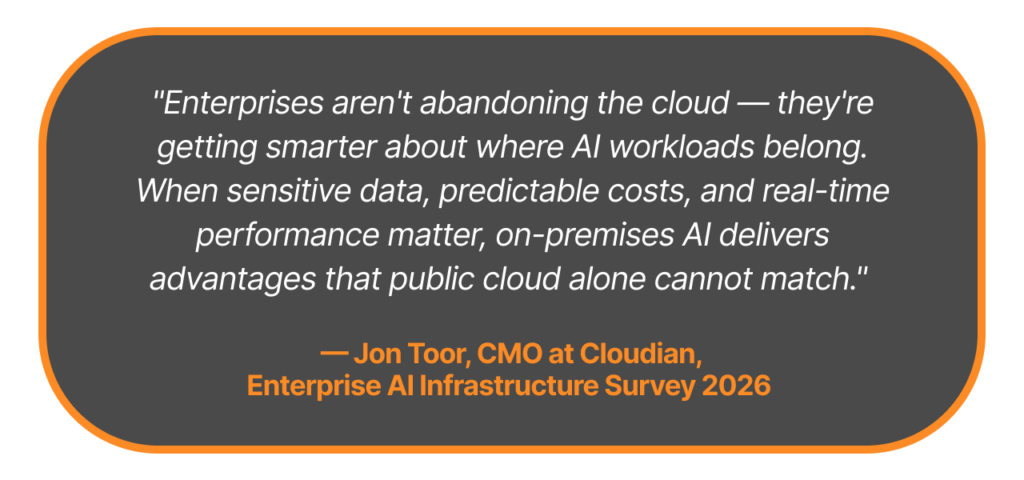
If data-residency regulation was the spark, AI has been the accelerant. A 2026 Cloudian-commissioned survey of 203 enterprise IT decision-makers found that 93% have either already repatriated AI workloads from public cloud, are in the process of doing so, or are actively evaluating it. Nearly four in five (79%) have already moved workloads, and 73% plan to shift further toward on-premises or hybrid infrastructure in the next two years.
The driving forces go beyond compliance. They’re structural and economic:
- Data sovereignty & IP protection — 91% of respondents prefer on-premises, private cloud, or hybrid infrastructure when AI involves sensitive company data. Sending proprietary training sets or customer data to third-party APIs carries risk profiles too high for regulated industries.
- Cloud cost unpredictability — 40% of enterprises report that actual cloud AI spending exceeds initial projections. Consumption-based pricing becomes toxic at scale, especially with agentic AI making continuous inference calls.
- Latency & real-time performance — 75% identified workloads that require or benefit from on-premises infrastructure for acceptable latency. Manufacturing quality control, real-time video analytics, and low-latency transaction processing can’t tolerate cloud round-trips.
- Shadow AI as a security threat — 74% flagged unauthorized employee use of cloud AI tools as a critical or significant security concern. If your data is being sent to APIs you don’t control, your sovereignty strategy is already compromised.
Deloitte’s Tech Trends 2026 report reinforces this: per-token inference costs have dropped 280-fold in two years, yet total AI spending keeps climbing because usage has far outstripped those reductions. When cloud costs exceed 60–70% of equivalent on-premises costs, capital investment in local GPUs simply makes better financial sense.
The Three-Tier Hybrid Architecture
The answer is not to abandon public cloud. The answer is a deliberate three-tier hybrid architecture matching each workload to its optimal compute layer:
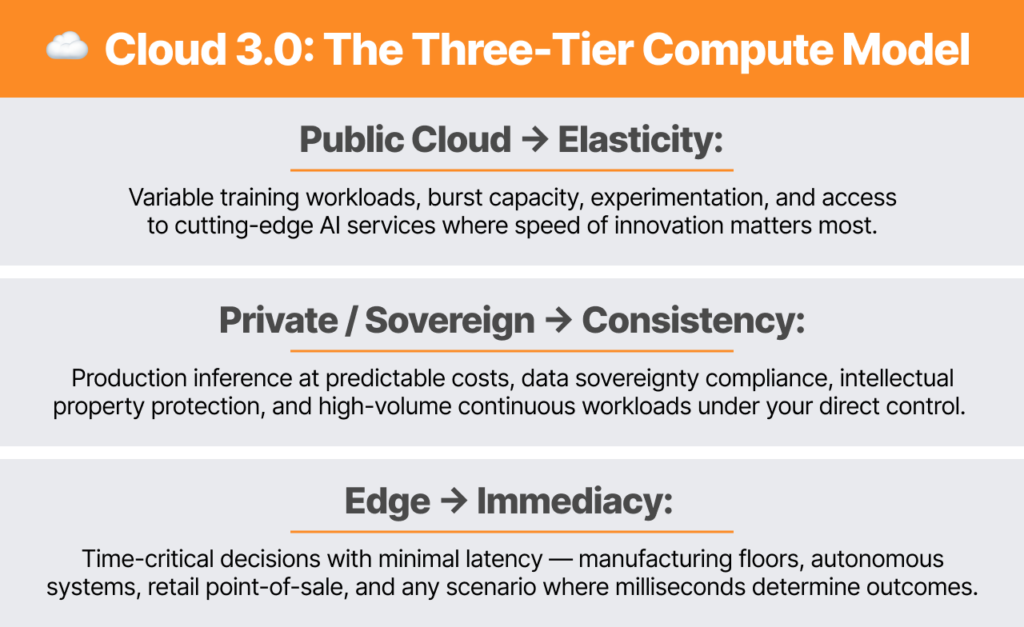
This isn’t theoretical. Red Hat launched its unified AI Enterprise platform on OpenShift to orchestrate AI across hybrid environments. Dell Technologies created an architecture review board evaluating every new AI project against cost, performance, governance, and risk. As Dell’s global CTO John Roese put it, “When you start talking about reasoning models and agents, having that architectural discipline is critical.”
What I’m Telling My Leadership Team
Here’s the practical advice I’m operating on, and what I’d share with any peer wrestling with this transition:
- Treat cloud strategy as a geopolitical risk exercise, not just a technical one. Map every jurisdiction where you operate, understand what data-residency obligations apply, and build your architecture accordingly. Compliance cannot be a retrospective checkbox.
- Kill the cloud-vs-on-premises binary. That framing belongs to 2015. The right question for every workload is: what is the optimal mix of sovereignty, cost, latency, and resilience?
- Get ahead of the AI infrastructure curve. If your data centres still rely on raised floors, air cooling, and orchestration built around traditional virtualisation, they are not ready for GPU-dense AI workloads. The infrastructure mismatch from networking between GPUs to high-bandwidth memory is a bottleneck that worsens as adoption scales.
- Embed sovereignty into your operating model from day one. Modern cloud management platforms can enforce data-residency policies across multi-cloud environments automatically, providing unified visibility into performance, cost, and compliance without sacrificing agility.
The Road Ahead
Cloud 3.0 is neither a retreat nor a revolution — it is a maturation. The first wave gave us utility computing. The second gave us hyperscale platforms and cloud-native applications. This third wave acknowledges what we should have anticipated: that data has a nationality, sovereignty is a competitive advantage, and the most critical AI workloads demand infrastructure you can see, touch, and control.
The organisations that will lead in the next decade are those blending the reach of global platforms with the control of geopatriated infrastructure. That’s not a step backward. That’s Cloud 3.0 — and it is already here.
Whitepaper – The Role of API-Driven Architecture in Custom Applications
This whitepaper provides a comprehensive analysis of API-Driven Architecture, exploring how transitioning from monolithic structures to a modular, “composable” ecosystem serves as a strategic framework for scalability, security, and competitive advantage in custom application development.