


The initial wave of generative AI excitement was characterized by a singular, monolithic interface: the chatbot. Organizations across the globe rushed to integrate Large Language Models (LLMs) into their customer service portals and productivity suites. The promise was simple—a natural language interface that could answer any question in seconds. However, as the honeymoon phase of basic retrieval-augmented generation (RAG) fades, many enterprises are hitting a ceiling.
They have realized that while a chatbot is an excellent information retriever, it is often a poor executor. The transition from a “chat” interface to an “agentic” workflow marks the next significant evolution in enterprise technology. According to McKinsey (2024), agents are the next frontier because they move beyond providing answers to performing actions, effectively bridging the gap between digital intelligence and business operations.
1. Your Workflows Suffer from “Contextual Fragmentation”
The first sign that you need a Multi-Agent System is when your AI initiatives fail at tasks requiring long-horizon reasoning. A standard chatbot is designed for “one-and-done” interactions. However, enterprise workflows—like processing a complex insurance claim—require dozens of sub-tasks: data retrieval, validation against policy rules, and drafting communications. When you force a single LLM to handle this entire sequence, it often loses the thread or produces a generic output that fails to meet the specific requirements of the later steps.
The “Lost Thread” Test
- Does your AI forget early constraints (e.g., “Must be under $500”) by the end of a long prompt?
- Are you spending more time “prompt engineering” a single bot to act like five different people than you are actually using the output?
- Do you find yourself manually copy-pasting AI output from one window into another to “help” the AI finish the task?
In a Multi-Agent System, this complexity is managed through modularity. Instead of one agent trying to “reason through” the whole problem, the task is broken down into a collaborative swarm where different agents handle different nodes, ensuring each component receives the full focus of a specialized model.
Whitepaper: Do You Need Automation or AI? A Practical Guide to Smarter Workflows
This whitepaper is a practical guide to help you determine whether your business challenges require straightforward automation or genuine artificial intelligence—and how to strategically implement the right solution for smarter, more effective workflows.
2. You Have a Proliferation of APIs but No Cohesion
Modern enterprises are a collection of disparate SaaS platforms. While these tools have APIs, the human employee remains the primary “glue” moving data between them. You might have a chatbot that summarizes a document, but can it also check a lead’s status in Salesforce, cross-reference it with Zendesk support tickets, and then draft a Slack message? For single-agent systems, this level of tool orchestration is a recipe for failure.
The “API Glue” Indicators:
- Tool Overload: Your workflow requires interacting with more than 4 distinct data sources or software platforms simultaneously.
- Security Silos: You want to give AI access to your accounting software (e.g., SAP) but don’t want the “General Chatbot” to see that sensitive data.
- Manual Handoffs: Employees spend 2+ hours a day simply moving data from one “AI summary” into another business tool.
In a MAS environment, tools are distributed. A “CRM Agent” knows Salesforce, while a “Communication Agent” handles messaging. This separation of concerns prevents any single agent from being overwhelmed and allows for granular security permissions.
3. The “Generalist Trap” is Costing You Accuracy
A measurable decline in accuracy during specialized domain tasks is a major red flag. A model like GPT-4o is “pretty good” at everything but often “not good enough” for high-stakes technical architecture or legal compliance. This is where human review bottlenecks re-emerge, as experts spend hours checking the AI’s work for subtle errors.
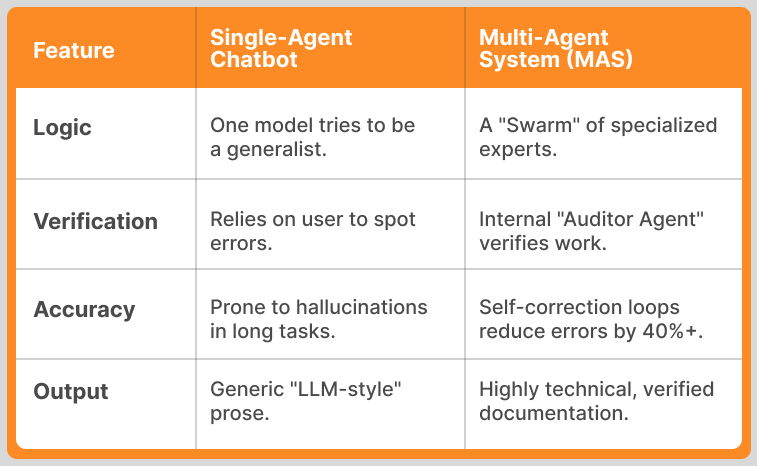
MAS allows you to bake domain-specific knowledge into the architecture. You can create a “Compliance Agent” whose only job is to tear apart the work produced by the “Creative Agent,” looking for violations. This adversarial dynamic mimics how high-stakes professional services operate.
4. Your “Human-in-the-loop” has Become a “Human-in-the-bottleneck”
In the early stages, “Human-in-the-loop” (HITL) is a safety feature. However, as volume increases, this oversight becomes a massive bottleneck. If an AI drafts 1,000 emails in five minutes, but it takes a human three hours to review them, the productivity gains are neutralized.
Signs of the Productivity Trap:
- Teams feel “burnt out” by the volume of AI content they have to verify.
- The human role has shifted from “Strategist” to “AI Proofreader.”
- Work stops completely if a human manager isn’t available to click “Approve” on micro-tasks.
Companies ready for MAS transition to Human-on-the-loop. A “Manager Agent” oversees a team of “Worker Agents,” assessing performance against KPIs and only escalating to a human when genuine ambiguity arises. This reduces human effort from 20 minutes of investigation to 30 seconds of final approval.
5. You Need to Operate in “Dynamic” Environments
A chatbot is a “pull” technology; it sits and waits for a user to provide a prompt. However, the most valuable enterprise functions are “push” functions: monitoring a supply chain for disruptions or scanning news for regulatory changes. These tasks require an AI that can monitor and act rather than just listen and respond.
The Persistent Sentinel Concept:
Unlike a chatbot, a MAS can be set up as a persistent system:
- Monitor: Agent A scans news wires for port strikes.
- Analyze: Agent B calculates the impact on current inventory levels.
- Propose: Agent C drafts three alternative shipping routes.
- Alert: The human logs in to find a completed “Crisis Report” instead of a blank chat window.
If your business value is tied to your ability to respond quickly to external events, a Multi-Agent System is a competitive necessity. As Gartner (2025) suggests, the shift from “AI as a tool” to “AI as an ecosystem” is the defining trend of the next five years.
Conclusion: The Road Ahead
The competitive landscape of the late 2020s will be defined by Agentic Velocity. Companies that can deploy autonomous swarms to handle back-office complexity will scale at a rate that human-heavy organizations cannot match. If your organization is exhibiting even two or three of these signs, it is time to look beyond the chat window.
Whitepaper: Do You Need Automation or AI? A Practical Guide to Smarter Workflows
This whitepaper is a practical guide to help you determine whether your business challenges require straightforward automation or genuine artificial intelligence—and how to strategically implement the right solution for smarter, more effective workflows.