


Enterprise application portfolios don’t typically end up overcrowded by a single deliberate decision, it is usually a slow build up across multiple departments, with a SaaS tool here and a custom application there and then the old platform that still has a critical workflow tied to it hanging around by default. Over the course of time, tools keep getting added up while the existing ones continue running.
Those individual decisions might have made sense on their own, but collectively they can create application sprawl: a situation where all the applications have overlapping features, different data sources that don’t communicate to each other, costs that keep on piling up, and nobody quite knows who is in charge of managing them all.
The real challenge is figuring out which applications are actually bringing value, which ones are just making things more complicated than they need to be, and what to do with the ones that are doing neither.
How Application Sprawl Develops
Application sprawl often grows faster than an organization’s ability to govern it. Business teams adopt tools to solve immediate problems, acquisitions introduce additional platforms, and legacy applications remain operational because replacing them appears risky.
The visibility gap makes matters worse. WalkMe’s State of Digital Adoption 2025 report estimated that a typical enterprise actually used 625 applications, compared with the 37 applications enterprises believed they used. The report highlights how easily applications can escape centralized visibility and oversight.
Without a reliable inventory, IT leaders may not know which tools duplicate existing capabilities, store sensitive data, or depend on systems scheduled for retirement.
For example, an enterprise may continue using an in-house order management application built years ago on the .NET Framework with a SQL Server database, even after adopting a newer SaaS order management platform with many of the same capabilities. Keeping both systems in operation creates overlapping functionality, duplicate data, and additional maintenance costs.
The Hidden Cost of Too Many Applications
The impact extends beyond subscription fees.
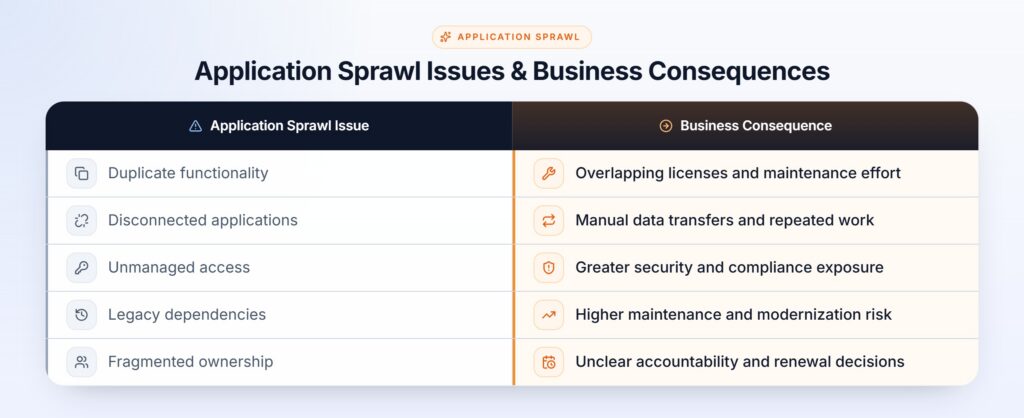
The problem is growing alongside software adoption. Nintex’s 2025 SaaS Sprawl Snapshot found that 51% of surveyed mid-market organizations had between 100 and 300 SaaS tools, while 87% reported that SaaS sprawl had a moderate to major financial impact.
These findings concern SaaS portfolios specifically, but they illustrate a broader enterprise challenge: adding software is easy; managing its full lifecycle is harder.
How Should Enterprises Rationalize Their Application Portfolio?
The answer is not to eliminate applications indiscriminately. Removing a tool without understanding the business process it supports can disrupt operations or push employees toward unapproved alternatives.
Instead, enterprises should evaluate applications against business value, functional overlap, cost, risk, technical condition, and dependencies.
A practical starting point is to classify each application into one of four categories:
- Retain – The application provides clear business value and remains fit for purpose.
- Consolidate – Its capabilities overlap with other applications that can meet the same needs.
- Modernize – The application remains important but has limitations in performance, security, maintainability, or scalability.
- Retire – The application no longer provides sufficient value to justify its cost and operational burden.
This assessment should involve IT, finance, security, and business owners. License usage alone cannot determine whether an application is redundant; its role in business workflows and its dependencies matter too.
Building a More Manageable Application Portfolio
Start with a centralized inventory that records each application’s purpose, owner, cost, data access, dependencies, usage, and renewal date. Then identify overlapping capabilities and prioritize applications based on business impact and risk.
Establish clear approval standards for new applications, including checks for existing alternatives, integration requirements, security, and long-term support. Review the portfolio regularly so new tools do not recreate the same problems.
For complex environments, Innovatix’s Enterprise Digital Engineering services support legacy modernization, microservices decoupling, and the development of more scalable enterprise applications. Its managed services & enterprise support capabilities also cover application maintenance, performance optimization, and ongoing support across legacy and modern environments.
These capabilities can help enterprises address the technical constraints that emerge when application portfolios become difficult to maintain and evolve.
Summing Up
Application sprawl is not solved by simply reducing the number of tools. It requires a clear understanding of what each application does, who depends on it, what it costs, and whether it supports the enterprise’s future direction.
The goal is a purposeful application portfolio. By combining visibility, business-led rationalization, and ongoing governance, enterprises can reduce unnecessary complexity while preserving the applications that genuinely support their operations.
Frequently Asked Questions
- What is application sprawl?
Application sprawl occurs when an organization accumulates applications without sufficient visibility, coordination, or lifecycle governance, leading to duplication, cost, and operational complexity.
- What causes application sprawl?
Decentralized software purchasing, departmental requirements, acquisitions, legacy dependencies, and limited application inventory management are common contributors.
- What is application portfolio rationalization?
It is the process of evaluating applications to determine which to retain, consolidate, modernize, or retire based on business value, cost, risk, and technical fit.
- Does reducing application sprawl require replacing legacy systems?
No. Some legacy applications should remain in place. Others may need modernization, consolidation, or retirement depending on their business role and technical condition.
Whitepaper – After Go-Live: The Enterprise Guide to Application Reliability, Managed Services, and Continuous Optimization
This whitepaper explains why application reliability requires attention beyond go-live. It introduces Innovatix’s Stabilize → Observe → Operate → Optimize framework for structured handover, proactive monitoring, disciplined support, and continuous improvement. It also covers partner evaluation criteria, operational metrics, and a 90-day path to assess applications, pilot managed services, and scale support.